iPhone app iPad app Android phone app Android tablet app More

Puzzles And Bowling Could Slow Progression Of Dementia: Study

Puzzles Dementia

The Huffington Post   First Posted: 12/08/11 08:22 AM ET Updated: 12/21/11 02:13 PM ET

What do puzzles and bowling have to do with dementia?

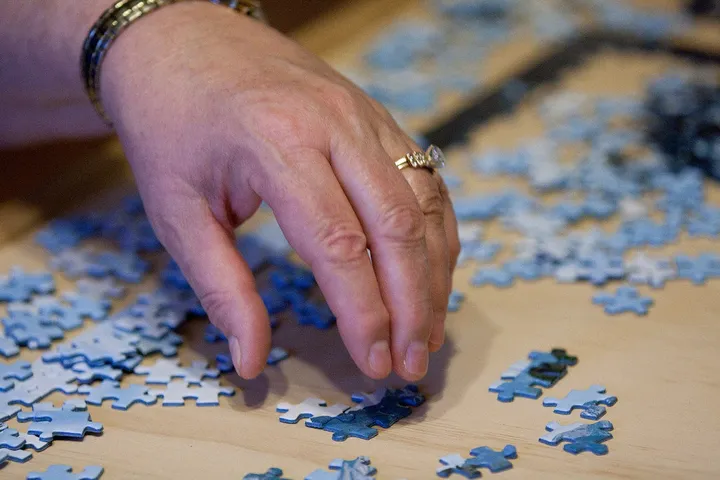
A small new study in the journal BMC Medicine shows that doing puzzles, bowling and singing help to make dementia-slowing drugs more effective, and seem to be effective at slowing down the brain decline of people with dementia.

HealthCanal reports that researchers from the University of Erlangen-Nuremberg in Germany had 61 dementia patients in nursing homes either take their regular treatment for dementia, or take their regular treatment in addition to doing what is called "MAKS" therapy for two hours a day, six days a week. Everyone did their assigned therapies for one year.

"MAKS" includes motor stimulation, "daily living" activities, cognitive stimulation and a "spiritual element." The therapy includes things like singing, playing croquet, gardening, crafts, preparing snacks, talking about happiness and other mentally stimulating exercises.

Researchers found that the MAKS therapy was effective at stopping the dementia from progressing further, and the people on the MAKS therapy were also able to keep doing their everyday tasks. However, people who only took the dementia-slowing drugs had their dementia progress.

The MAKS therapy seemed to work best on people with mild to moderate dementia, compared with people with severe dementia, researchers reported.

"This means that MAKS therapy is able to extend the quality of, and participation in, life for people with dementia within a nursing home environment," study researcher Professor Elmar Graessel, of the University of Erlangen-Nuremberg, said in a statement. "We are currently in the process of extending these preliminary results to see if this prevention of dementia decline can be maintained over a longer time period

Other things that research shows could work to slow down dementia and Alzheimer's disease? Being bilingual, regularly exercising and consuming certain foods and nutrients.

FOLLOW HUFFPOST HEALTHY LIVING

What do puzzles and bowling have to do with dementia? A small new study in the journal BMC Medicine shows that doing puzzles, bowling and singing help to make dementia-slowing drugs more effective,...
 
 
  • Comments
  • 36
  • Pending Comments
  • 0
  • View FAQ
Post Comment Preview Comment
To reply to a Comment: Click "Reply" at the bottom of the comment; after being approved your comment will appear directly underneath the comment you replied to.
View All
Favorites
Recency  | 
Popularity
Page: 1 2  Next ›  Last »  (2 total)
12:28 AM on 10/13/2012
Puzzles with many small pieces like shown in picture are too difficult for dementia patients in early-middle stages. One must select a puzzle their loved one can complete in one sitting and one that will not frustrate them.

If you are looking for simplified puzzles for dementia patients, that have been tested with patients with positive results, check out http://memoryjoggingpuzzles.com. Great story telling themes from The Saturday Evening Post are totally entertaining and beneficial.
This user has chosen to opt out of the Badges program
photo
02:52 PM on 12/11/2011
I'll stick with Chess.
07:12 AM on 12/10/2011
Puzzles, bowling and singing nursery rhymes: almost as bleak as the dimentia.
photo
HUFFPOST SUPER USER
trying this again
01:13 PM on 12/09/2011
I completed my first 1000 piece puzzle when I was 8. It's been a lifelong hobby of mine. One day I am going to do a 10,000 piece puzzle. I just need the space.
12:09 PM on 12/09/2011
If puzzles and bowling are the cure then I'd rather be a vegetable by 50.
08:22 AM on 12/10/2011
With that attitude you are well on your way to vegetable status.
photo
HUFFPOST SUPER USER
sensimilla
Lead with your heart, and your mind will follow...
11:37 AM on 12/09/2011
Use it or lose it. Reading is also an awesome way to fight off dementia.
photo
HUFFPOST SUPER USER
SHIRLEY CARR
optimist with experience sez
10:12 AM on 12/09/2011
So I guess I'm on my way to a dementia-doomed demise. Puzzles try my frustration and heighten my anxiety level. Bowling is non-existent because of a lack of nearby alleys along with having been the victim of a right side bi-lateral stroke, And I am right-handed. Out I go..and dementia doomed.
09:55 AM on 12/09/2011
The key to "staving off" dementia is to begin early with healthy habits as dementia may actually begin decades before symptoms are apparent.

What the brain requires is novelty and situations where new learning occurs with some effort. If a task is too easy or familiar, your brain won't create new synaptic connections. The idea is to develop what is known as "cognitive reserve." This means developing new networks in the brain that may make you more resilient to the onset of Alzheimer's.

Walking is good, but walking on uneven ground is better. The brain has to work harder to keep you stable. Learning a new language is good because you have to struggle to inhibit your tendency to speak your native tongue. Dancing is good for the brain when you have to do the same steps on the right and then the left side of your body (think Dancing with the Stars).

Find activities that provide an optimal level of "struggle." If it's too easy, you may enjoy the activity but it is likely not to be doing anything beneficial for your brain; if it's too difficult, you won't keep doing it.

Find ways to introduce novel situations in your daily life. If you're right handed, brush your teeth with your left. If you drive one way, try a different route. Try new recipes. Plant a garden. Join a new organization, meet new people. Engage with life on as many different levels as you possibly can!
09:19 AM on 12/09/2011
I think everyone would agree that exercise can slow dementia. It would be interesting to know how effective bike riding would be as a treatment. My uneducated guess would be “very effective”. What to do if you “love to bike……but hate the hills”? Consider an electric bike, which is a traditional bike in every way except you have assistance when you want it. Check them out. www.hybrid-cycles.com
08:21 AM on 12/10/2011
SPAM SPAM SPAM
photo
HUFFPOST SUPER USER
Margo Arrowsmith
Elizabeth Warren in 2016!
07:43 AM on 12/09/2011
Brush your teeth with your passive/opposite hand.   Learn a language (Rosetta Stone really is great)  Cross word puzzles, anything that will force your brain to replace what age is destroying.
05:56 AM on 12/09/2011
Just keeping busy doing anything that you like, it keeps the brain active. Hobbies, walking, reading, painting, playing cards, playing golf, becoming a volunteer at your church. Don't just sit there on a rocking chair.
10:08 PM on 12/08/2011
"Puzzles And Bowling Could Slow Progression Of Dementia: Study"

Looks like my Bowling Alleys of America Puzzle Set was a great investment.
06:46 PM on 12/08/2011
Ha! Can someone just recognize Recreation Therapy as an effective approach already? It's crazy how the profession continues to lose credibility despite research such as this. Get educated!
photo
HUFFPOST SUPER USER
Allen Bouchard
I worship His Divine Shadow.
04:10 PM on 12/09/2011
These activities still need to be performed in conjunction with medication. And they only slow the onset of dementia.

Googling "recreation therapy" results in only ads for recreational therapists and for degree programs. No results with discussions on whether it's an effective form of treatment.
photo
HUFFPOST SUPER USER
Susan Schmidt Baker
03:55 PM on 12/08/2011
I love doing crossword puzzles and sudoku puzzles. I also do tons of reading; books, magazines, newspapers, anything I can get ahold of. I also follow a fairly regular exercise program. I think that along with eating sensibly keeps one's mind pretty good.
HUFFPOST SUPER USER
bmitche
04:10 PM on 12/08/2011
Visiting this website should help too :)
03:54 PM on 12/08/2011
Wooow, for real?? Hey, you know what would decrease the risk of people getting this even more and probably all together cure it? If these clowns would stop spraying aluminum, barium, strontium etc . all over the entire global population everyday. : p
photo
proscanusa
res ipsa loquitur
04:24 PM on 12/08/2011
Yeppers....the mystery continues with respect to the question - if the common exposure of aluminm (even the foil in your pantry) may cause Alzheimer's dementia. The link has not been verified [yet] was originally laughed at within the medical research community, but more recently has received a second chance look. The theory postulates that aluminium becomes concentrated in lesions (senile plaques and neurofibrillary tangles) that develop in the brain during the course of the disease. Plastic anit much better folks... Try glass whenever possible to store food items at least. (just my.02)
photo
HUFFPOST SUPER USER
Allen Bouchard
I worship His Divine Shadow.
04:24 PM on 12/09/2011
"The link has not been verified"

So then we can say there is no link. The Alzheimer's Association says as much: http://www.alz.org/alzheimers_disease_myths_about_alzheimers.asp

The only websites that claim such a connection are either really old (a Straight Dope column from 1983), or also have lunatic rants about chemtrails.
photo
HUFFPOST SUPER USER
Margo Arrowsmith
Elizabeth Warren in 2016!
07:47 AM on 12/09/2011
You are correct and that is a good thing to work towards.  However, in the meantime what we can all control immediately is how we use our brains.  They need exercise.  Dementia and Alzheimers all existed long before pollution and were expected.   It also used to be true that at a certain age people just stopped learned and doing, playing and other things.   The pollution is a terrible hazard today, but there are things we can do while we are working to lesson that.
02:00 PM on 12/09/2011
It's true, however the cases were extremely few and far between. Usually it would occur around the time of someones death from being old. It never used to just pop up. Now it seems all elderly people are getting this and many peoples minds are foggy, they just don't always say it.