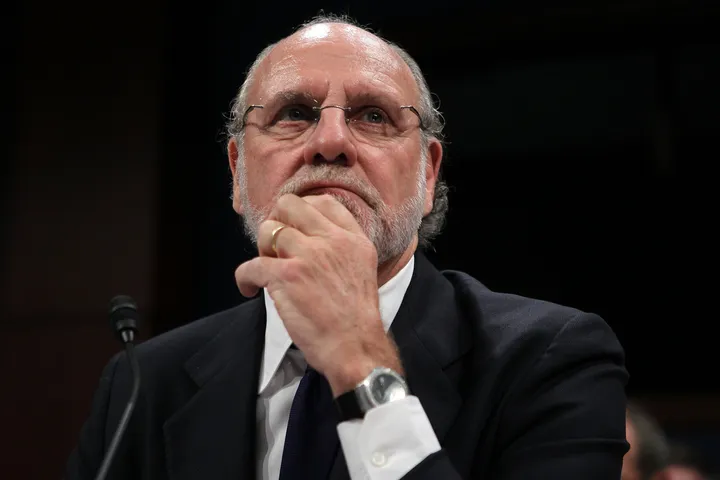
As MF Global inched towards collapse, CEO Jon Corzine pre-occupied himself with a few other things -- namely securing a chateau for him and his wife in the ritzy south of France.
At a party in Paris on October 15 -- just two weeks before MF Global filed for bankruptcy, costing more than 1,000 workers their jobs -- Corzine and his wife, Sharon Elghanayan, were discussing a house they planned to purchase in the south of France, according to an upcoming report in Vanity Fair.
"It's not in Cap Ferrat," one person at the party told Vanity Fair they recall Elghanayan saying in an effort to tone down the extravagance. Cap Ferrat is a coastal town in the south of France known for its lavish lifestyle.
Though Corzine, a former Goldman Sachs CEO, governor of New Jersey and Senator, was able to scrounge up the money for a possible chateau purchase, he's having a little bit more trouble tracking down MF Global clients' money, much of which is still missing. Shortly after the company filed for bankruptcy on October 31 over risky bets on European debt that went disastrously wrong, hundreds of millions worth of customers' money was discovered missing.
Corzine, who resigned in early November after the firm's collapse, told Congress of the lost client funds: "I simply do not know where the money is." The missing funds have attracted the attention of the FBI and federal prosecutors, according to Reuters.
Though shopping for a house presumably worth millions in France while your company is on the verge of bankruptcy may seem uniquely ridiculous, Corzine is not the first executive of a failing firm to spend lavishly. Indeed, it's happened multiple times in the new millenium. Ken Lay, the former CEO of Enron, sold the company's shares back to Enron to pay for luxuries like renting a private yacht, even as the energy giant was on the verge of collapse, according to a 2006 Reuters report.
During the financial crisis, executives at bailed-out American International Group reportedly spent $86,000 on a hunting trip even as they asked for billions more in bailout funds from the Federal Reserve, according to CBS News.
And Morgan Stanley spent tens of thousands of dollars on a send off for the company's departing chairman John Mack, even as the market has hammered the bank's stock price and some officials warned employees that they may not be getting bonuses this year, Fox Business reports.
Related on HuffPost:
A timeline of MF Global's collapse:
Loading Slideshow
Lost Customer Funds Found
James Giddens, the trustee overseeing the liquidation of MF Global, told the Senate Banking Committee in April that $1.6 billion worth of lost customer funds had been found and his analysis <a href="http://www.huffingtonpost.com/2012/04/25/mf-global-missing-customer-money-accounted-for_n_1452128.html?ref=business" target="_hplink">"is substantially concluded,"</a> CNNMoney reports.
Jon Corzine Takes the Reins at MF Global
In a big turning point for the brokerage firm, in 2010 MF Global Holdings hired Jon Corzine, a former chief executive at Goldman Sachs, former U.S. senator and former Governor of New Jersey. Corzine returned to the financial industry after losing his gubernatorial reelection bid to Chris Christie in 2009.
Leveraged Bets on European Debt
Jon Corzine made risky moves in his mission to turn MF Global into a big Wall Street player. After a period of aggressive trading didn't earn the profits Corzine had hoped for, the firm delved into the foreign debt market, making $6.3 billion worth of large and heavily leveraged bets on distressed sovereign debt in troubled European countries like Spain and Italy.
Bankruptcy
Europe's economy continued to melt. MF Global investors panicked when they caught wind of the billions in leveraged bets, and on Oct. 31 MF Global filed for bankruptcy. It was called the first American financial casualty of the European debt crisis.
Federal Investigation
During the firm's collapse, federal regulators discovered that $630 million in customer money couldn't be accounted for. A federal investigation ensued, and forensic accountants found the amount was actually closer to $1.2 billion. Experts suspected the client money was used inappropriately for company purposes.
Lobbying
The investigation shed light on Jon Corzine using his personal influence in Washington to lobby against restrictions on how firms can invest customer money.
Corzine Resigns
On Nov. 4, four days after the firm filed for bankruptcy, Jon Corzine voluntarily stepped down. He had not been accused of any wrongdoing.
'MF Global Rule'
In early December federal regulators adopted the 'MF Global rule' to prevent other firms from using client funds to buy sovereign debt. Regulators restricted the transaction that allowed MF Global to borrow money from its own customers.
Corzine Testifies Before Congress
On Dec. 8 Jon Corzine testified before Congress on the missing money. Speaking to his former colleagues in the Senate, Corzine said he was "stunned" by the missing client funds. He offered an apology but said, "I simply do not know where the money is."
Developing Case
Corzine testified that he didn't know any customer money was missing until the day before the firm filed for bankruptcy. But a financial executive<a href="http://www.huffingtonpost.com/2011/12/13/jon-corzine-testimony-_n_1146192.html?ref=business
" target="_hplink"> claimed</a> Crozine "was aware" of a $175 million transfer from customer accounts to a European affiliate of the firm.
$200 Million Transfer Of Customer Funds
Ex-CEO Jon Corzine allegedly authorized the transfer of around $200 million in customer funds to pay down an overdraft just days before the firm collapsed, <a href="http://www.bloomberg.com/news/2012-03-24/mf-global-s-corzine-ordered-funds-moved-to-jp-morgan-memo-says.html" target="_hplink"><em>Bloomberg</em></a> reported in February.
Pleading The Fifth
MF Global executives <a href="http://www.huffingtonpost.com/2012/03/28/mf-global-hearing-executives-millions-customer-funds_n_1386701.html" target="_hplink">denied having significant knowledge of an authorized transfer of around $200 million</a> in customer funds to avoid an overdraft. Edith O'Brien, an executive who wrote an email about the transfer at the time, <a href="http://www.huffingtonpost.com/2012/03/28/former-mf-global-executive-edith-obrien-5th-amendment_n_1386210.html" target="_hplink">invoked the Fifth Amendment</a>.
Subscribe to the HuffPost Money newsletter!
The Huffington Post Jillian Berman First Posted: 01/05/12 03:23 PM ET Updated: 01/05/12 04:08 PM ET