By Vanessa Quirk(click here for original article)
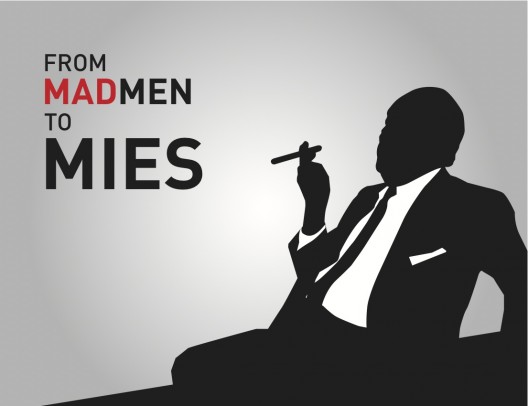 © Megan Jett
It’s June 1966. Mies’ iconic Seagram Building dominates New York City. Bob Dylan has just released Blonde on Blonde. The Vietnam War is escalating. John Lennon has yet to meet Yoko Ono. And Don Draper is readjusting to married life – with his 25 year-old secretary.
The excitement over Mad Men, while always eager, was positively explosive last Sunday. The season 5 premiere resulted in the show’s highest ratings to date (3.5 million viewers, up 21% from last year). While the show has always received critical acclaim, now, for whatever reason, it has reached a fever-pitch of popularity.
On a purely aesthetic level, it’s easy to explain. The show draws in audiences with a meticulous, sumptuous set design that allows a nostalgic journey back in time: when design was innovative & clean, architecture was confident (cocky even), and modernism still held its promise.
But on another level, the show is successful because of its inevitability. The very knowledge of the ephemerality of that confidence, a theme particularly relevant to audiences in the wake of the Recession, is what strikes a chord, what makes the show positively hypnotizing.
Watching Mad Men is like watching a Modernist car crash. A beautiful demise.
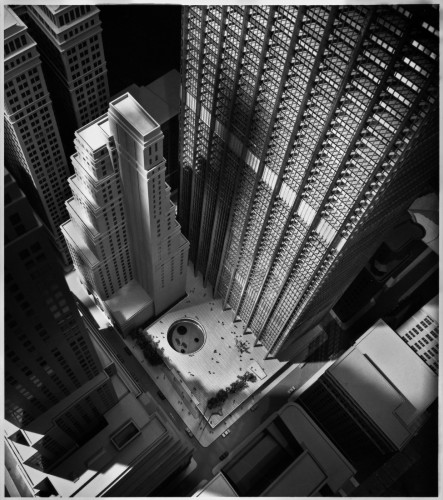 Chase Manhattan Plaza. 1961. By Skidmore, Owings, and Merrill. Ezra Stoller © Esto
Confidence Men
From the Google Doodle to our own popular infographic on Mies‘ life and works (150,000 hits and counting), the hooplah surrounding Mies’ 126th birthday this week showed us that Modernism‘s appeal still very much holds sway.
And Mad Men tells us why. Season 5 sees the characters settled into their new office environment – from Madison Avenue (hence the term “Mad” Men) to the new Time & Life Building on 6th.
While no Seagram building, The Time & Life building was, as The New York Times noted in 2010, ”the perfect location for an upstart firm nurturing an image of being cutting edge.” The building was 92% rented before it even opened its doors; could boast tenants such as The Times, Liberty Steel and Metal, and Sterling-Cooper; and had an opening move-in that made breaking news.
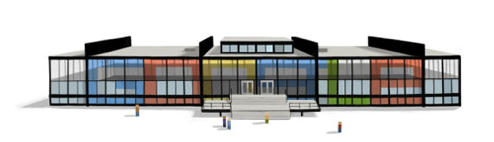 Mies Google Doodle, Crown Hall © Google
The characters’ perspectives and ambitions offer a non-jaded look back to what these buildings signified at their inception: confidence, possibility, power. As Blair Kamin has noted for the Chicago Tribune, Mad Men reflects a ”time when modernism was still fresh and the backlash against corporate sterility had yet to hit.”
In Sunday’s episode, we hear the protagonist, Don Draper, say: “New York City is in decay. But Madison Square Garden — it’s the beginning of a new city on a hill.” As Don’s precipitous decision to re-marry with his young secretary shows us, he is charging ahead in a new direction, believing all the while that new will be better. That Madison Square Garden will become a beacon of progress for the rest of the world.
But the reality is that that just didn’t happen. As blogger for the Los Angeles Times, Christopher Hawthorne, points out: “the Garden actually helped produce not a city on a hill but the seeds of a powerful preservation movement, in Manhattan and elsewhere. Almost immediately, New York realized it had made an enormous blunder by knocking down one of its most remarkable pieces of architecture.”
In fact, you could say the same mentality exists in New York today. When we think of cutting-edge architecture, we look not to our own soils but (as Hawthorne notes) to China and Dubai. Our own architecture has become more subdued, preservationist, quiet: nostalgic for a time when confidence was taken for granted.
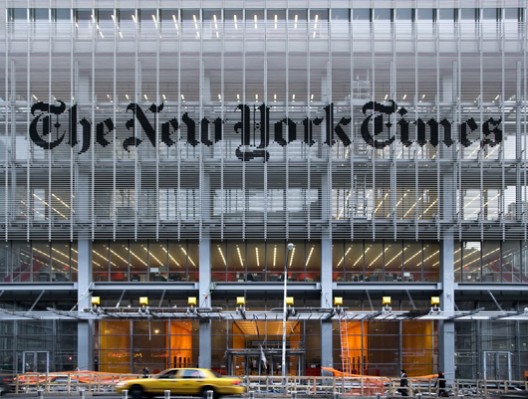
A Sign of the (New York) Times
In The New York Times’ 2007 Review of its new office by Renzo Piano, “Pride and Nostalgia Mix in the Times’s New Home,” critic Nicolai Ouroussoff has this to say:
“The New York Times Building owes its greatest debt to postwar landmarks like Skidmore, Owings & Merrill’s Lever House or Mies van der Rohe’s Seagram Building — designs that came to embody the progressive values and industrial power of a triumphant America. Their streamlined glass-and-steel forms proclaimed a faith in machine-age efficiency and an open, honest, democratic society.”
As you read the article, you can practically feel the author’s discomfort ooze off the page. Because we no longer live in that era. Even as workers were moving into this new “triumphant” building, stock prices in The New York Times were plummeting (forcing the company to lease it out), advertising was shrinking, digital media was threatening to make the publication obsolete.
Where there was once faith, there is doubt. Post-9/11, post-Internet, post-Recession, the New York Times Building is the physical manifestation of our longing for an earlier time, one that is impossible to recreate.
Mad Men speaks to that impossible longing. It presents the past, both its shiny exterior and its darker underbelly, but always suggests the change that we know is coming.
When the opening credits start, we are in a 1960s interior, following our protagonists’ footsteps. The interior falls apart first, advertisements slide down the wall, and we fly with the falling man out the building itself. Mies-ian structures, colorful advertisements, images of beautiful women fly by until – suddenly – our man isn’t falling, but sitting. With a cigarette in hand. The episode begins.
Unlike, say, the exact recreation of a ’60s animation in the opening credits of Catch Me If You Can, the “falling man” sequence is referential, but not a replica. The music, the font, the computer generation all frame the show from a 21st century perspective.
Because despite the smooth, confident exteriors of our Mad Men, we know that they’re falling apart on the inside. The Modernist promise of Mies‘ structures cannot last for ever, progress cannot be sustained, power is not eternal. But the illusion of it is still sexy, the longing still holds sway.
Our man may be falling, but we’re with him all the way.
CORRECTION: An earlier version of this article stated that Season 5 of "Mad Men" debuted the new offices at the Time & Life building. The text has been changed to reflect that the move took place prior to Season 5.