iPhone app iPad app Android phone app Android tablet app More

Featuring fresh takes and real-time analysis from HuffPost's signature lineup of contributors
GET UPDATES FROM Ahmed Younis
 
GET UPDATES FROM Dalia Mogahed
 

Religion Does Not Color Views About Violence

Posted: 01/18/12 07:49 AM ET

ABU DHABI -- A Gallup analysis of more than 130 countries nearly a decade after the 9/11 terrorist attacks suggests that one's religious identity and level of devotion have little to do with one's views about attacking civilians. Almost all residents surveyed in the Middle East and North Africa (MENA), Asia, and sub-Saharan Africa who reject attacks on civilians say religion is an important part of their daily lives -- much like those who say attacks are sometimes justified.
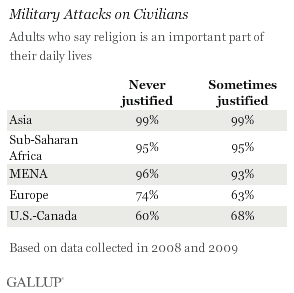
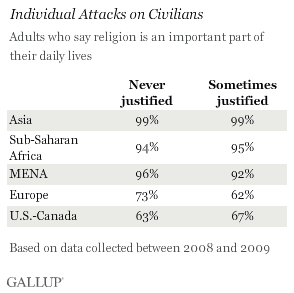
2012-01-02-1.gif

2012-01-02-2.gif

These key findings are among the many featured in a new brief released Friday by the Abu Dhabi Gallup Center, Views of Violence, based on Gallup surveys conducted between 2008 and 2010. Views of Violence examines public acceptance and rejection of attacks on civilians worldwide and what influences these attitudes.

Most Worldwide Agree Military Attacks Never Justified

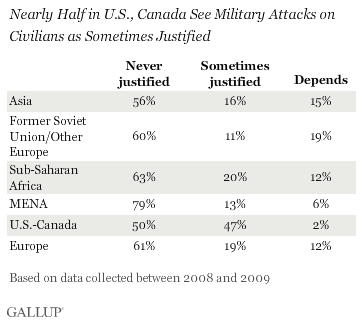
Many of the world's residents agree that military attacks that target civilians are never justified, with a clear majority in Asia and the MENA region finding military attacks against civilians unacceptable. This is not surprising considering the acute conflicts raging in Afghanistan, Pakistan, Iraq, and other parts of the Middle East. Residents of the U.S. and Canada are the most likely population in the world to believe military attacks targeting civilians are sometimes justified, with nearly half (47 percent) sharing this sentiment.
2012-01-02-3.gif

Europeans here break with their counterparts in the U.S. and Canada. The continent that fought two world wars and at one time used military conquest to colonize much of the Middle East, Africa, and Asia, now finds its residents more similarly minded with those in its former colonies than with its modern ally about whether military attacks on civilians are sometimes justified.

Individual Attacks on Civilians Unacceptable

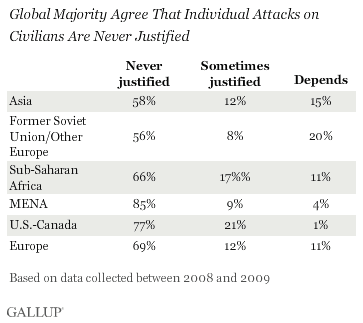
The identity of the attacker makes a difference to some people when weighing the justification of targeting civilians. When attacks are committed by a military, Americans and Canadians find them more acceptable (47 percent sometimes justified) than when they are committed by an individual (21 percent sometimes justified). Europeans, too, make a distinction, and are more likely to reject individual attacks than military attacks by eight percentage points.
2012-01-02-4.gif

On the other hand, populations in Asia, sub-Saharan Africa, former Soviet countries, and MENA are more likely to view violence targeting civilians as uniformly unacceptable.

OIC Member States Less Likely to View Military Attacks as Sometimes Justified

Evidence refutes the argument that Islam encourages violence more than other religions. Residents of the Organisation of the Islamic Cooperation (OIC) member states are slightly less likely than residents of non-member states to view military attacks on civilians as sometimes justified, and about as likely as those of non-member states to say the same about individual attacks.
2012-01-02-5.gif

Public Support Does Not Predict Violence

It is important to note that public perceptions of civilian attacks do not necessarily predict violence against non-combatants, nor are terrorist activities or war crimes necessarily the result of public support. At the same time, higher levels of public rejection of targeting civilians do suggest a higher respect for the value of human life, a prized asset for any society to cultivate.

Rather than look to religion to explain public acceptance of violence, Gallup's analysis suggests that leaders should consider social and economic development and better governance. Gallup analysts tested correlations between the level at which populations say these attacks are "sometimes justified" and a number of independent indicators, and they found human development and societal stability measures are most strongly related. Find out more about relationships between these attitudes and a number of independent indicators in the full report.

For complete data sets or custom research from the more than 150 countries Gallup continually surveys, please contact SocialandEconomicAnalysis@gallup.com or call 202.715.3030.

About the Abu Dhabi Gallup Center

Building on Gallup's seminal work in the field of Muslim studies, the Abu Dhabi Gallup Center offers unmatched research on the attitudes and aspirations of Muslims around the world. Learn more.

Survey Methods

Results are based on face-to-face interviews with approximately 1,000 adults in each country, aged 15 and older, from 2008 through 2010. For results based on the total sample of adults, one can say with 95 percent confidence that the maximum margin of sampling error ranges from ±1.66 to ±5.8 percentage points. The margin of error reflects the influence of data weighting. In addition to sampling error, question wording and practical difficulties in conducting surveys can introduce error or bias into the findings of public opinion polls.

In this analysis, OIC member states included more than 40 predominantly Muslim countries worldwide. Non-OIC member states included more than 80 countries.

For more complete methodology and specific survey dates, please review Gallup's Country Data Set details.

(Originally posted on Gallup.com on September 8, 2011)


Follow Ahmed Younis on Twitter: www.twitter.com/ahmedyounisjd


  • Comments
  • 12
  • Pending Comments
  • 0
  • View FAQ
Comments are closed for this entry
View All
Favorites
Recency  | 
Popularity
photo
HUFFPOST SUPER USER
OtayPanky
You're welcome
04:01 AM on 01/18/2012
Religion may not color views on violence, but it does make them more noble.
photo
HUFFPOST SUPER USER
Niet
11:15 PM on 01/17/2012
What people say is rarely actually what they mean, as religion has demonstrated so amply over the past few thousand years.
photo
ILoveTheUSofA
BREAKING NEWS: There is no God.
10:59 PM on 01/17/2012
For 2,000 years, we have seen countless religious wars, religious massacres, religious murders, and religious atrocities of every kind.

And I have no doubt that the vast majority of the people who actually perpetrated these acts would have told the Gallup pollster, "Why, attacks on civilians are NEVER justified! The very idea!"

If we want to determine what effect people's "level of religious devotion" has on their ACTUAL views regarding "justifiable violence," all we need to do is to study history.
06:31 AM on 01/18/2012
Like the harmless cowpox virus inoculating against virulent smallpox, could the spread of the METAMEME eventually eradicate religious violence... http://rational-buddhism.blogspot.com/2012/01/metameme.html
brokerthanu
all acts of love and pleasure are my rituals
10:37 PM on 01/17/2012
Violence begins at home. And as far as religion is concerned it most certainly does promote violence. Xtians have used their religion for 2 millennia to justify war, slavery, the degradation of women, rape, the abuse of children, torture, all sorts of physical and psychological abuse and the suppression of competing religions, especially the Earth-centered ones. I'm not sure how this pans out under the yoke of Islam but I'm sure it does since they have all of the same ills. Certainly severing hands for petty theft seems violent as do death by stoning and infibulation.
photo
ILoveTheUSofA
BREAKING NEWS: There is no God.
10:24 PM on 01/17/2012
The authors claim, "A Gallup analysis of more than 130 countries nearly a decade after the 9/11 terrorist attacks suggests that one's religious identity and level of devotion have little to do with one's views about attacking civilians."

And then they present the results of a poll - which is actually does NOT support their claim, in the slightest degree!

In order to determine that "religion colors views about violence," or that "one's religious identity and level of devotion have little to do with one's views about attacking civilians," one would need to compare the views of religious people in a given country with the views of non-religious people in the same country. That is NOT what the poll does, at all. Not one of the charts presented compare the views of religious people with the views of non-religious people in the same region.

This is a perfect example of the deceptive practice of making a bold claim, and then waving a lot of data around, as if the data proved it - and hoping that nobody stops to ask whether the data actually proves anything resembling the claim that was made.

The poll data that the authors have presented does not prove their claim in the slightest degree.

It is obvious that poll was designed to compare the views of populations by geographical area. It does nothing whatever to support the authors amazing claim - which, as we all know, is simply false.
09:48 PM on 01/17/2012
I'm not sure what to criticize first: the math or the reading comprehension.
photo
unitron
Reverse Chron Order never stays checked
02:32 PM on 01/17/2012
As best as I can tell from the first two tables, they interviewed 198% of all Asians.

Is this one of those parallel universe deals?

Seriously, you offer a choice of A or B, and say 99% chose A and 99% chose B.

Unpossible!
photo
HUFFPOST SUPER USER
Stephen the Grate
There is grandeur in this view of life ...
03:14 PM on 01/17/2012
Exactly! This article teaches us nothing, and most certainly does not alter my view that religion is a major contributor to violence worldwide!!!
06:40 PM on 01/17/2012
You should read the information explaining the table more thoroughly.
02:28 PM on 01/17/2012
I have listened to evangelical pro-life christians support the massive killing of civilians that we do in every war we have started. We probably killed about 100,000 civilians in Iraq alone and this slaughter was enthusiastically cheered on by right wing christians.
11:13 AM on 01/17/2012
The study seems flawed though this presentation may not have been the original hypothesis. To study this hypothesis one would have to ask about different religions, atheists, and depth of zeal and establish correlation with likelihood of supporting certain types of activities: war under this condition, war under those conditions, suicide bombers under this condition, those conditions etc. Of course you would have to control for socioeconomic status, gender (probably worth reporting as a separate study), sense of oppression by local regimes, fear of survey takers, etc.

But, if we take this at face value, it means religions fail to make people more moral also. Religion, if irrelevant as to informing views on violence, is irrelevant to morality itself. In my heuristic view, either the study is methodologically weak, or simply biased in population sampling (ie buddhists, hindus, voodoo, protestants, catholics, ....atheists, marxists).

If you have the data, would be most interested.

hariaum