
Let the Beijing Summer Olympic Game begin! The once-reclusive China has now commandeered the world stage by celebrating its first-time role as a host of the Olympic Games. To be sure, the Beijing Games were planned and have subsequently arrived in the midst of controversy. Besides its massive investments in needed infrastructure, China was forced to deal with a catastrophic earthquake in the Sichuan province in May, from which it is still reeling, and continues to struggle against the odds to decrease Beijing's stubborn smog. In addition, China's approach to dealing with political activists, including its crackdown on uprisings in Tibet, and its economic ties to Sudan continue to fuel criticism from human rights groups (as well as from President Bush, who is the first U.S. president to attend an Olympics on foreign soil). Although an Olympic boycott is now a moot question, I suspect that the Chinese government is ambivalent about its coming-out party because of the unrivaled mix of problems and promise that it has had ─ and continues ─ to face as host of the 2008 Summer Olympic Games!
It is estimated that some four billion people from around the world will have watched at least part of the Beijing Games before the XXIX Olympiad comes to a close. And in light of the state of the world at this very time, it is both fitting and instructive to view the Olympic Games in historical perspective by reflecting upon the original meaning of the Olympic Games in Ancient Greece, the birthplace of the Olympic Games, as well as by reminding ourselves of the original intent of the first, so-called "Modern" Olympic Games. As a proud Greek-American, it is my honor to share such a perspective in the hopes that it will place what is currently happening in Beijing into a meaningful context.
Ancient Olympic Games:
Although the first recorded Olympic Games were held in the Village of Olympia, Greece, in 776 BCE, it is not certain that these Games were the first ones to be held. Historians and archeologists, while not totally in agreement, believe that the Games were first held between 1370 and 884 BCE. The origin of the Games too is unclear and there are several competing legends; however, we do know that it takes its name from Olympia, a sanctuary site for the Greek gods. The Sanctuary of Zeus in Olympia housed a 12 meter high statue in ivory and gold of Zeus, the father of the Greek gods. This statue was one of the ancient Seven Wonders of the World.
The first Olympic Games, it is important to note, were religious festivals held near the shrine of the god in whose honor they were instituted, as well as were held in honor of deceased heroes (a concept displayed in the funeral games for Patroklos in Book 23 of Homer's epic poem, The Iliad). The Olympic Games were also held in the context of many ancient fertility festivals involving any number of gods and goddesses who were worshipped at the sacred site of Olympia. These festivals, which were held every four years, became so vitally important in Greek life that they were used as the basis for the Greek calendar in which the term, "Olympiad," was used to refer to the period between two Olympic Games.
It is important to underscore that sport and athletics were of prime importance to the ancient Greeks and most cities in ancient Greece had public gymnasiums where people gathered to train and, interestingly, to relax. The Greeks also believed that a healthy body was essential and that it naturally accompanied a fit mind and a healthy life. Sport, of course, was viewed also as good preparation for war, since the Greek armies had to be fit enough to march long distances, carrying all their heavy equipment, and then begin the fight with the enemy.
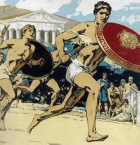
The ancient Greeks, moreover, were highly competitive and believed strongly in the concept of agon, or "competition," "contest." The ultimate Greek goal was to be the best. All aspects of life, especially sport and athletics, were centered around this concept. It was therefore considered one of the greatest honors to win a victory at Olympia. The fact that the only prize given at the Greek Olympic Games was an olive wreath illustrates this point. In other words, Olympic athletes competed for honor, not for material goods.
From the beginning, the games at Olympia served to strengthen the Greek sense of national unity and pride. Huge crowds would gather for the Games and some of the distinguished guests included Plato and Socrates. The tremendous physiques and abilities of the competitors aroused the imaginations and creative talents of artists, poets, sculptors, and writers. When the Games eventually lost their underlying religious significance around 420 BCE, they became a wonderful celebration of athleticism and the arts, which is how we still view them today.
Even though the ancient Olympic Games were fiercely competitive, their peaceful nature was always a distinguishing characteristic that made them unique. In this regard, one of the more extraordinary stories about ancient Greece is that during the Olympic Games, all fighting stopped. In other words, the athletes, who were often soldiers, were permitted to leave the military to participate in the Games and were guaranteed safe passage through enemy territory. No matter how long or how fierce a battle had raged, for seven days before and seven days after the Olympic Games (and, of course, for the period of the Games themselves), no fighting was allowed. Indeed, it was considered disrespectful to the gods to engage in conflict during this period! Against this backdrop, consider what is occurring around the world during the Beijing Games. Wouldn't it be great if all fighting stopped even for such a short period?
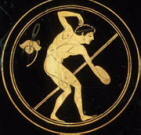
There are several reasons why the ancient Greeks espoused and practiced this fascinating policy in regards to the Olympic Games. First and foremost, the Greeks, as noted above, viewed the Olympic Games as a religious festival. It was therefore their duty to attend and/or participate in the Games, and duty to the gods was more important than duty to their city-states, which were fighting the wars in the first place! Second, many of the best athletes were also soldiers whose commanders did not want them to leave the fighting. With a truce in place and the fighting halted, these soldier-athletes were free to compete in the Games and then return to the fighting when the Games had finished. Third, some of the best athletes were not skilled fighters and were not even part of the military. Since war was so much a part of life in ancient Greece, victorious soldiers came to be heroes for their city-states and role models for the youth. Having the Olympic Games and showcasing the athletic talents of men (women had not yet become participants) who were not soldiers allowed city-states to celebrate heroes and role models who might not be the best fighters.
Modern Olympic Games:
The Olympic Games, as reported, were held every four years from 776 BC to 393 AD, when they were abolished by the Christian Byzantine Emperor Theodosius I. They then lay dormant for roughly 1,500 years. It wasn't until the late 19th century (AD) did the so-called "modern" Olympic movement begin. And it was a French aristocrat by the name of Pierre de Fredy, the Baron de Coubertin, who, fortunately for the world, founded this movement. Influenced by the events of the late 19th century and his education, Coubertin developed a passionate belief that sport and athletic competition possessed the power to benefit humankind and encourage peace among the nations of the world.
When he was just 17 years old, Coubertin began to think about the weaknesses of the French people who were trying to recover hope and self-respect following the Franco-Prussian War. He believed the solution was helping to develop character in each individual. He saw that competing for a place on an athletic team developed qualities of character which was the opposite of what the French schools at that time believed─they thought that games destroyed study. He was convinced that he should devote his entire time and energy to changing these ideas in France. He decided to start at the bottom because, as he expressed it, "the foundation of real human morality lies in mutual respect─and to respect one another it is necessary to know one another."
Coubertin, of course, drew his inspiration from the ancient Olympic Games. Like the Greeks before him, his vision and determination, fueled by his authentic commitment to the ideals of "Olympism," created a movement that, like no other, united athletes and nations of the world in peaceful celebration and competition. It was in 1894 when Coubertin finally was able to rekindle the ancient Olympic spirit and founded the International Olympic Committee (IOC). Two years later, the IOC gave birth to the modern Olympic Games by awarding Greece the opportunity to celebrate the first modern Olympiad with the 1896 Athens Games. And to this day the procession of nations marching in the opening ceremony of each and every Olympic Games gives Greece, the birthplace of the Olympic Games, its traditional place at the start.
We have the Baron Pierre de Coubertin to thank for bringing back the ideals of Olympism and for giving us the chance to experience one of the most universally recognized events and symbols of peace in the world. Let us not forget the following fundamental principles in the Olympic Charter as we watch the 2008 Beijing Summer Olympic Games unfold:
"Olympism is a philosophy of life, exalting and combining in a balanced whole the qualities of body, will, and mind. Blending Sport with culture and education, Olympism seeks to create a way of life based on the joy found in effort, the educational value of good example, and respect for universal fundamental ethical principles."
With these principles in mind, let the Olympic Games continue!