iPhone app iPad app Android phone app Android tablet app More

Featuring fresh takes and real-time analysis from HuffPost's signature lineup of contributors
Anne Woods

GET UPDATES FROM Anne Woods
 

Why Are Military Spouses Being Left Out Of PTSD Treatment?

Posted: 03/18/2012 11:30 am

"As a military spouse for 20 years, we hear that we are the backbone of the military. Now it's time to care for those who proudly serve in the shadow."--Tina Atherall, LMSW, Hope For The Warriors

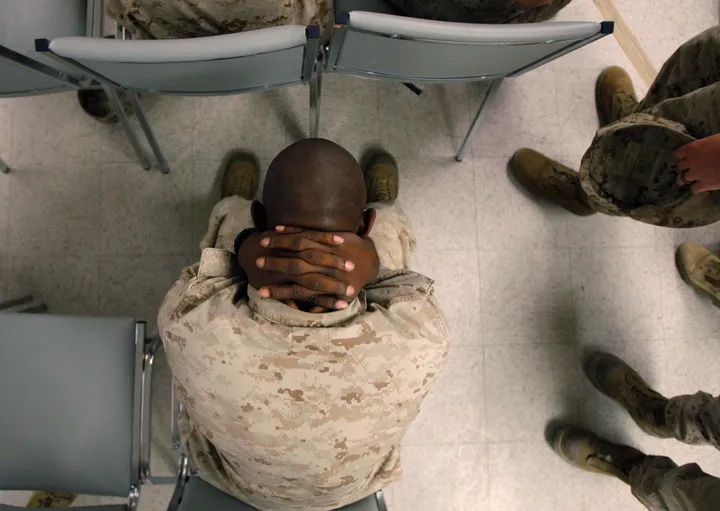
Our military members are returning from combat, some physically wounded and many more with invisible wounds. The impact is difficult to miss in the news. I will let other "experts" discuss the depth of this problem within our military.

I will ask another important question. What about the family?

Let's set the scene.

You are married to someone in the military. They volunteer to serve their country, but you are serving too. You might not wear the uniform, but you are definitely making sacrifices. When your spouse deploys, you are proud of their service and your eyes brim with tears each time you hear the Star-Spangled Banner. They return home, unharmed, you are able to finally release the fears, the anxiety, and the loneliness that you denied. Now, everything will return to normal, right?

Approximately 20 percent of our returning military are diagnosed with PTSD, according to Winoverptsd.com. Studies show that the average lapse between the last deployment and the first diagnosis of PTSD is 291 days. I question both of these statistics.

There is a common saying within military circles, "There are no unwounded in war." In other words, 100 percent of our service members will return with at least some degree of post-traumatic stress. For many, the symptoms are not enough to be diagnosed, but I cannot believe that only 20 percent of those who serve are diagnosed with PTSD. The Pew Research Center sites that among veterans who served after September 11, 44 percent admit that readjusting to civilian life was difficult.

And the time lapse? Working for Hope For The Warriors, we continually meet service members who, for years, refused to acknowledge combat's impact on their mental health. During that time, their spouses and children learn to live with a "stranger" in their home. They recognized the face, but the person who returned does not act or relate to family in the same manner.

According to a Family Guide provided by the VA National Center for PTSD, some of the warning signs for PTSD include: frequent and intense conflicts, poor communication, inability to meet responsibilities, poor performance at work or school, severe depression, and intrusive thoughts or images of war zones experiences.

After months and sometimes years, our service members are being identified and diagnosed with PTSD and entering treatment programs. Treatment programs range from one-on-one psychotherapy to group therapy and applying a wide range of theoretical approaches. Both inpatient and outpatient programs are utilized, depending on the needs of that service member. In most programs, the service member is the only patient -- treatment interventions are aimed directly toward this one person. Family members are an ancillary part of the process at best, and may have no involvement in the treatment process.

Again, I ask the question: What about the family?

Imagine the best outcome, the warrior returns from treatment, equipped with the tools to better manage their life, communicate emotions, and move forward. In many cases, they return to a family that is still living on edge. The family has learned nothing about PTSD, the depth of its impact, and how they can help. The warrior wants to move forward, only to discover that the family is unsure if they can trust the treatment or gains that have been made.

This is precisely why the Family Reintegration Program (FRP) was created. Spearheaded by Dr. Michael DeFalco, PsyD of The Military Wellness Program at Holliswood Hospital and Tina Atherall, LMSW with Hope For The Warriors, DeFalco and Atherall witnessed the deterioration of marriages and families even after the service members were treated for PTSD. It was clear to both--treating the service member alone is not enough.

FRP educates the family, providing training, therapy, and support so the unit can better understand and manage PTSD, mild TBI and substance misuse issues. For warriors in Hollliswood's inpatient treatment, the FRP ensures that direct marital and family therapy is provided. Screening for the spouse and family members for behavioral health issues is also provided. (The service member is not the only one who has been exposed to trauma.) Finally, support and education is ongoing, and continues long after the family leaves the facility.

"Healing the family and promoting family resilience is the key to long-term recovery for so many. It's a community responsibility that we all need to understand and embrace."--Dr. Michael DeFalco, PsyD, Holliswood Hospital

To further benefit the family, the hospital and nonprofit organization work closely together pinpointing other needs. Needs could include financial support for the time the service member is in the inpatient program, respite for the family, and help developing professional job seeking skills for both the warriors and their spouse.

Years from now, veterans will continue to be diagnosed with PTSD. We might be 10 years into this war, but it is not too late tackle the treatment for PTSD. As a nation, we need to recognize that a service member does not serve alone -- they serve with the support of their family.

Therefore, improving the treatment of PTSD must also include the family. As I said before, they might not wear the uniform, but they are clearly serving and sacrificing.

 
"As a military spouse for 20 years, we hear that we are the backbone of the military. Now it's time to care for those who proudly serve in the shadow."--Tina Atherall, LMSW, Hope For The Warriors Ou...
 
 
  • Comments
  • 18
  • Pending Comments
  • 0
  • View FAQ
Comments are closed for this entry
View All
Favorites
Recency  | 
Popularity
photo
Adrienne May
military spouse & social community builder
01:34 PM on 05/06/2012
So many military spouses are left in the dark on how to help and be involved in helping their service member recover and cope with PTSD. They struggle to understand what is going on, they are often confused and hurt and often battle depression and secondary PTSD as a result. Leaving military spouses out of the PTSD equation only decreases the effectiveness of the recovery for the service member and creates more stress and problems for the family as a whole.
HUFFPOST SUPER USER
joeyhas
03:21 PM on 03/25/2012
some aspects of the therapy may include family .. but would the spouse and children want to hear about all the things that have gone on over there? What if the military member suffering ptsd did something they are ashamed of because of the adrenaline rush of being in pack-mode in the field? (Pack = group of soldiers who are always by each other's side for support and everything else). Would you want to know about that? Plus some things being talked about are classified information and they can't tell the family.
10:41 AM on 03/22/2012
In case you are wondering, many VA's have created or implemented groups for veterans' spouses and/or families. In my experience, two things stand in the way of being able to treat family members. First, many spouses work. Many of the nonworking spouses do come to our daytime groups, but the working ones cannot. As such, we created an evening family group two years ago. Spouses then could not come because they do not have childcare at the facility, not to mention that most VA facilities do not allow children younger than 12. We even tried to have child psychologists available for the younger children, but again the red tape can be untenable. Joint projects between medical centers and VA's may be the best way to reach these populations.
03:57 PM on 03/21/2012
Recovering From The War is a book for wives of veterans. I wrote the book I wish I had had when my husband came back from Vietnam with PTSD when it didn't have a name and wasn't supposed to exist. Many current veterans family members find it helpful. I also have posted a lot of free articles at http://www.patiencepress.com and patiencemason.blogspot.com.
Patience Mason
photo
HUFFPOST SUPER USER
ttsgw
Atheist and secular humanist
02:56 AM on 03/21/2012
The money will make much more good in the pockets of the owners and executives of the military industry.
11:51 AM on 03/19/2012
...While PTSD can cause depression, depression does not cause PTSD. And as far as adjusting to civilian life goes--to attribute this to PTSD, again, blows my mind. It's hard. Civilians don't understand us. Since we're referring to Pew Research studies here, I'll jump on board. According to the PRC more than 70 percent of Americans say they feel a disconnect from veterans. They don't get us. And the feelings are mutual. This is the #1 reason why so many returning vets have a hard time readjusting to civilian life. Yes, a great number of us are dealing with the challenges of PTSD. I've been in therapy/treatment for it since my return home from Fallujah in 2004. My second deployment only made it worse. I know how hard it can be and I know what it does to our families who want things to be the way they were before. But don't make the assertion that ALL of returning vets have some degree of PTSD. That is simply incredibly false.

We, as a whole, are not broken. Not everyone who comes home is a crazy war vet. Only some of us are ;) Please show the others some respect by not making such wild assertions and over generalizing the veteran population to plug your nonprofit.

Thanks,
Corporal S, USMC, 03-07, Iraq
HUFFPOST SUPER USER
joeyhas
03:25 PM on 03/25/2012
I am not military, but I have grown up in a military family. I have also had some 'battles' that most people couldn't think of as battles. One becomes disconnected because the information we receive through experience is outside the box of 'normal'. Our perceptions change, we walk out of Plato's Cave, if you will. For those who never walk outside, they will never know what was experienced and they cannot relate to the person who did walk outside.
11:51 AM on 03/19/2012
I agree that PTSD treatment needs to include families. But on behalf of the men and women I served with, I need to clear something up. The author writes:

"There is a common saying within military circles, 'There are no unwounded in war.' In other words, 100 percent of our service members will return with at least some degree of post-traumatic stress. For many, the symptoms are not enough to be diagnosed, but I cannot believe that only 20 percent of those who serve are diagnosed with PTSD. The Pew Research Center sites that among veterans who served after September 11, 44 percent admit that readjusting to civilian life was difficult."

Yes, it could be argued that there are no unwounded in war. But to say 100 percent of our service members will return with some degree of PTSD is absolutely ridiculous, not to mention offensive to the greater number of men and women coming home who DO NOT suffer from PTSD. In order to have PTSD, one must have experienced something traumatic, first of all. The majority of men and women who service in a war zone do not endure traumatic experiences. There is a difference between depression and PTSD and the two require different treatment approaches...
photo
HUFFPOST SUPER USER
pepper1311
POGS are dirt
10:42 AM on 03/19/2012
Wife's and children ( till 21) can recieve treatment at any VA if Vet is service connected. VAMC's have great books about PTSD and what it is and is not. It's simple when you come home you have changed and those at home have not. VN 12/66-7/69 lost arm and kidney, I found this quickly by going to a gathering of friends who were in college, they acted just as they did, but I didn't. A good therapist will never tell what to do, they say what not to do.
10:39 PM on 03/18/2012
I wish something would have been available. I even asked my husband's counselor at the VA about it and he said, "I'm here for him - not for you." I shut down immediately and accepted that it was my responsibility to shut up and take whatever happened, then promptly get over it. During the initial reintegration program when he came back from Iraq, spouses saw a bullsht presentation from "The Date Doctor" who inspired the movie "Hitch" with Will Smith. Two predominate messages he delivered were: "The person who cares the least controls the relationship" and speaking one on one with me saying, "You look like a beat puppy. You should leave him." There is NO support for spouses even after diagnosis.
09:07 AM on 03/19/2012
Dana,
I am very sorry that you did not received the support you deserved. However, there are programs that are slowly being put in place to keep this problem you spoke about from happening. The Vet Center and VA located here in Pensacola, FL both offer programs to help spouses cope with PTSD. It is really important that the spouses learn what to expect on a behavioral stand point of the veteran suffering from PTSD. When you go to war you definitely leave a part of you behind and you are never really the same again. There is nights of no sleep, nightmares, the controlling of persons you care dearly for, depression, and you just stop enjoying life. You just exist and because you are misearable everyone around should be miserable too. Hence the mean old veteran sitting on his front porch screaming at the neighborhood kids. I never really thought about what made that person mean. The PTSD effects people in different ways and many times it takes a person to hit rock bottom before they reach out for help. I see guys at the VA that are finally getting treatment after 40+ years of battling with themselves and the system. There are websites and support groups that are out there for coping with PTSD for spouses. The PTSD program is getting better but still has a long ways to go. The system is not perfect by no means and unfortuantely it does fail.
04:04 PM on 03/21/2012
That really makes me mad, but there is support at the yuku group http://livingwithptsd.yuku.com, at http://www.patiencepress.com (free articles) and patiencemason.blogspot.com (posts on recovery for vet and family members. I also wrote a book called Recovering From The War which is available on amazon.
09:04 PM on 03/18/2012
So we as spouses/caregivers should have a voice. We should have a safety net in place since we are usally the first to see that they are problems.
photo
fabuloush2s
EverGreen
06:57 PM on 03/18/2012
In my experience -during the Vietnam era, --- being involved with any form of treatment for the Vet, was totally up to the Vet regardless of his physical or mental condition - not unless he was under arrest or a threat to others or himself. It was not the case to include a spouse regarding his scheduled care etc... only to update her/him, when medication or medical tests were tenative. Thus, the spouse was left out entirely. When questioned, their response was, just leave him or contact 911 for assistance! Documents were updated with these statements, but nothing further noted. Basically, no help or referral was offered and if so, it was not a general offer. Social workers at the VA facility would only get involved if the medical official requested. Hopefully things have changed and today, there is other forms of support , otherwise, I was threatened by the Vet, if I even intevened on his health care or otherwise, he was diagnosed severe PTSD and other mental disabilities. I lost everytthing!
03:49 PM on 03/18/2012
We're still not treating all the combat veterans, let alone the spouses.
03:36 PM on 03/18/2012
When my father was in the army during the Vietnam era the saying used to go, "If the army wanted you to have a wife you would have been issued one." I think that probably still sums up how they feel about it now.
HUFFPOST SUPER USER
realitytrumpsbull
Two 'alves of coconut!
02:35 PM on 03/18/2012
How many thousands of dollars per month in disability payments is this going to be worth? 3, 4, 5?
HUFFPOST SUPER USER
MissTake1989
Equal means equal, hypocrites.
12:23 PM on 03/18/2012
You have the advantage of being 100% correct, but this is still a very well presented argument.

I don't know how anyone could oppose it.