
Image courtesy of monkeyz_uncle/Wiki Commons.
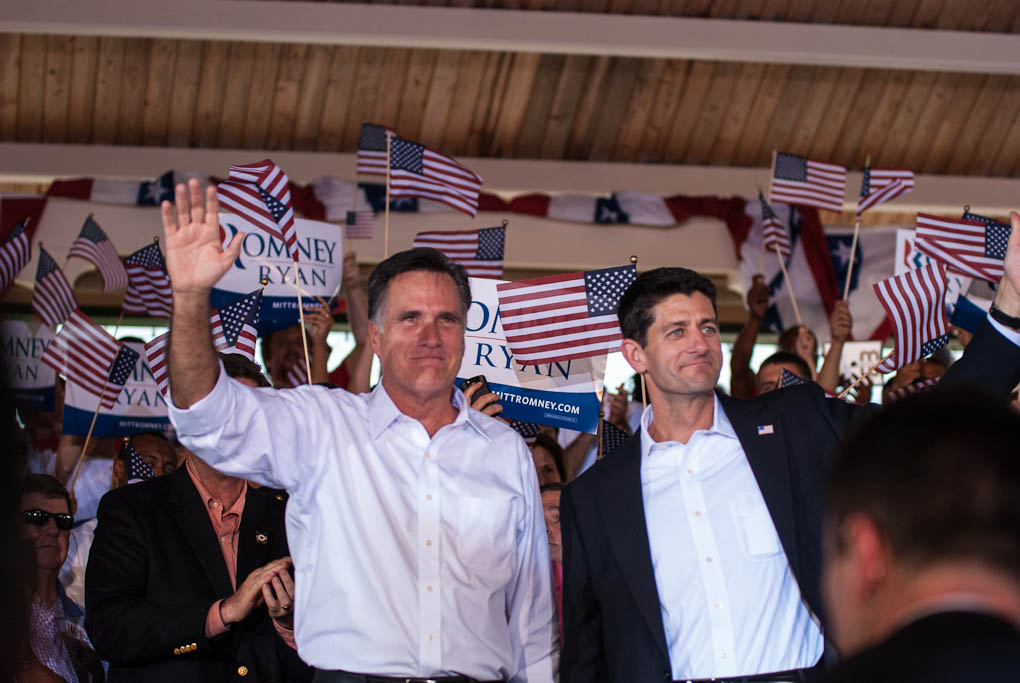
Mitt Romney, the recently official GOP presidential nominee, and his running mate, Rep. Paul Ryan (R-WI), have put out an energy policy document. We take a look.
Oil, gas, coal, nuclear, wind, solar, efficiency. Which are the Republican hopefuls’ priorities?
This week, it's convention time for the Republican presidential and vice presidential nominees. Last week, the Romney-Ryan team rolled out its energy policy [pdf] for the nation. Entitled "The Romney Plan For A Stronger Middle Class: ENERGY INDEPENDENCE," the new plan, running 21 pages, replaces Romney’s energy policy paper from September 2011.
The new blueprint is a mix of policy points and criticisms of the Obama administration along with "Did You Know?" sections comprised of quotations from sources ranging from the Manhattan Institute to the New York Times. It turns out that the white paper devotes more space to the quotations than to Team Romney's own statements.
In the Clouds with Romney-Ryan
The plan's goal of achieving energy independence, writ large in the report’s title, is a bold vision. Bolder still when it is understood that the goal is for North America by 2020. But of course the devil is in the details.
So what are the details? One objective way to get a sense of the plan is through a word count. After all, the prominence of a topic or term, such as oil, wind or energy efficiency, is a reasonable proxy of its import.
The word cloud shown below provides some interesting insights: "U.S." and "energy" are front and center and "Obama" is pretty prominent -- although it's a safe bet that he's not being mentioned or discussed in a positive light. In terms of energy sources, "oil" is by far the dominant player and "gas" is no slouch.
After that, slim pickings. "Coal," "wind" and "solar" do show up, but finding them is a bit like the old needle-in-a-haystack challenge. And I never did find "nuclear." Ditto "conservation," "efficiency," and "biofuels."
Big on Crude, Short on Green and a Little Nasty
Want to be a little more quantitative? Then take a look at the table below. Of the words we counted, "oil" is the winner, appearing 154 times. Averaged over the length of the document, that's more than seven times per page.
You green types may be relieved to know that "environment" gets a fair showing with 24 appearances. For example, here's one item that suggests that the Romney team would seek a balance between environmental protection and economic development:
"Implement measured reforms of environmental statutes and regulations to strengthen environmental protection without destroying jobs, paralyzing industry, or barring the use of resources like coal."
But contrast that with this direct frontal attack on enviros:
"But statutes and regulations that were designed to protect public health and the environment have instead been seized on by environmentalists as tools to stop development altogether."
Alternative Energy Not Much of an Alternative
Making brief appearances, cropping up once or twice in the plan, are "clean energy," "alternative energy," "conservation," efficiency," "green energy," and "biofuels."
Climate. What Climate?
And get this. The number of times the word climate appears in the Romney-Ryan plan: 0.
So the Romney team's energy plan is huge on oil, big on gas, and everything else is pretty much an also ran. Drilling down (sorry, couldn't resist), it's pretty clear that the plan's path to North America's energy independence is to ... drill -- to exploit domestic sources of oil and gas as quickly and as comprehensively as we can.
A number of analysts (see here and here) have pointed out that even if such an approach for North American crude allowed the United States and its would-be Mexican and Canadian partners to meet their domestic needs for oil, it would still not free us from international price instability or dependence on politically unstable nations. Why? Because oil is fundamentally a global commodity and even countries that are net exporters of oil (think Canada) still suffer price swings due to unrest and other volatility elsewhere. And so in that sense, the whole notion of energy independence when it comes to petroleum is illusory, and the real issue should be energy security.
And when it comes to energy security, many -- including George W. Bush -- have argued that that is achieved by reducing our consumption of oil, a move that would begin to decouple our economy from unstable, oil-rich parts of the world. And how would we do that? By growing our use of renewable energy and becoming more efficient. (See here and here.) Clearly these goals are not central to Team Romney's plans, at least at this point in the campaign.
And then there's the whole problem of energy and climate. How do Romney and Ryan plan to solve that conundrum? Apparently, for now at least, by ignoring it.
_________________________
Note
An interesting bit of trivia related to the energy plan can be found in the PDF of the plan under the "properties" menu. There, Anna Gatlin, the Romney campaign's domestic policy advisor who has a master’s degree in education policy and management from Harvard University’s Graduate School of Education, is listed as the author.