More

Featuring fresh takes and real-time analysis from HuffPost's signature lineup of contributors
C. M. Rubin

GET UPDATES FROM C. M. Rubin
 

The Global Search for Education: Australia on the Move

Posted: 06/14/11 10:49 AM ET

2011-06-13-CMRUBINWORLDACARAK1_Students_presenting_to_class_413.jpg
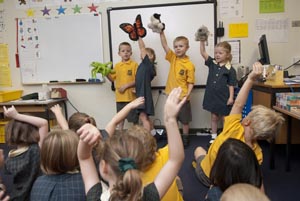
Young Australians present to their classmates


In Vicki Abeles' movie, Race to Nowhere, we met U. S. kids who were so overscheduled they had no time to be kids. The film suggested we were preoccupied with testing and performance, undermining what our kids should be doing in the classroom, let alone in their down time. So what is happening down under?

I've been to Australia six times for business and personal reasons (my ancestors, who were academics, once owned Geelong College in Victoria). The only thing that's consistent about each trip? When I have to go home, I cry and then console myself with the promise, I shall return!

Professor Barry McGaw returned in 2005, leaving his position as Director for Education at OECD, responsible for the PISA test -- the test U. S. Education Secretary Arne Duncan downloads when someone mentions The Global Achievement Gap. Did you know Arne Duncan played professional basketball for Australia's National Basketball League and in the process met his wife Karen, an Australian high school teacher?

Australia is on the Move! Professor Barry McGaw, Chair of the Australian Curriculum, Assessment and Reporting Authority (ACARA), has a brand new national curriculum to explain to me, among other things.

Barry, when I mention your work, educators bring up student assessment. Why?

What I am going to say is in the context of Australia and in an effort to produce a national curriculum. We are, like the United States, a federation, but one in which the responsibility for education is at the state and not the local level. There are six states and two territories with separate curricula, so the task of developing a national approach is much simpler than it would be in the United States. There have been several attempts since the late 1980s to move to a national curriculum but this time we have made significant progress. In December 2010, the Council of Education Ministers endorsed an Australian Curriculum for Kindergarten through Year 10 in English, Mathematics, Science, and History.

The national curriculum includes knowledge, understanding and skills, and sets our students' learning entitlements. The 'content descriptions' set down the entitlements but we have provided 'content elaborations' as well for those teachers who would welcome additional guidance about how the content might be dealt with. The elaborations also serve to meet the expectations of those states and territories that traditionally specify their curricula in more detail than others.

When it comes to specifying achievement standards by grade level for learning areas, it is difficult to do it unambiguously. We do it but illustrate them with annotated samples of real students' work collected in response to real tasks set by teachers. The assessments and annotations are provided by panels of teachers and the samples chosen illustrate various levels of achievement. The states and territories have been using this approach for a number of years, as are people in other countries as well. We think that this is the best way to help teachers use specifications of achievement standards consistently.

What kind of education system provides the human skills to compete globally in the 21st century?

In the Australian curriculum, we are taking a different approach to incorporation of what some call 21st century skills. First, we have not abandoned the traditional disciplines. We recognize that there are thousands of years of intellectual development behind the current ways of thinking about and representing knowledge. The disciplines that have been created are rich in their capacity to help people understand the world. So we have a curriculum that is discipline based but that is one of only three dimensions.

We include the so-called 21st Century skills as a second dimension. We do not call them that, however, since most of the skills typically nominated are ones that were clearly relevant in earlier centuries. We call them 'general capabilities'. We started with eight but now use seven: literacy, numeracy, ICT competence, critical and creative thinking, ethical behavior, personal and social competence, and intercultural understanding.
2011-06-13-CMRUBINWORLDACARA34_History_513.jpg
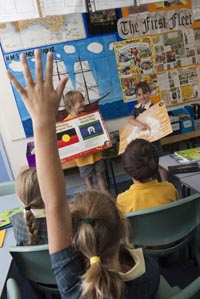
Young Australians explain their history


On a third dimension we have identified three current priorities that we believe need special attention. They are Aboriginal and Torres Strait Islander histories and cultures, Asia and Australia's links with Asia, and Sustainability. These are in addition to and not instead of things already secure in the curriculum such as Australia's historical connections with the United Kingdom and their expression in Australia's political and legal systems.

When our curriculum writers are developing the discipline based curricula, they are obliged to pay attention to where the general capabilities and the current cross-curriculum priorities could be addressed. The curriculum is presented electronically (see www.australiancurriculum.edu.au) and that enables users to view the curriculum content from the perspective of any one of the three dimensions: disciplines, general capabilities and cross-curriculum priorities. The electronic display lets us have it all ways. We can embrace general capabilities that are particularly important in the 21st Century without abandoning well established discipline based ways of knowing. We can also provide protection to current issues, such as those captured in our cross-curriculum priorities, that we believe should be an important part of the world view offered to young Australians.

Technology knowledge in today's world could almost be a special extension to curriculum. Would you agree?

Yes, but not as a separate subject in the early years. It has to be developed alongside everything else as reflected in our general capability, ICT competence. By the time you get to Grades 8 to 10, schools will offer a range of technology studies.

Can schools teach ethics?

Schools are institutions in which values and ethics have to be addressed. It's tricky territory because it's easy for people to mischaracterize teachers as pursuing particular political agendas if they do address them. Our 'general capabilities' include 'ethical behavior', 'personal and social competence', and 'inter cultural understanding' quite deliberately to address the issue you raise.

More students applying to higher education. More pressure?

We have the same problem. We have parents as well as students feeling this pressure. We have had a huge shift of students from government to private schools. Our research shows that the performance of those private schools is not necessarily better than public schools but parents feel the pressure to buy what they feel might give their children an advantage.

We see the pressure building earlier too. We have national assessments of students in Grades 3, 5 , 7 and 9 in the basic skills in literacy and numeracy. Parents receive reports on their own children but we now publish school results on the My School website (www.myschool.edu.au). On that site, we provide direct comparisons amongst schools with students from similar socio-educational backgrounds. That avoids unfair comparisons with schools in much more advantaged circumstances but it does put pressure on schools and students.

Enough emphasis on the arts in curriculum?

There is always a risk when some things, such as literacy and numeracy, are given such special prominence that other things might be downgraded. There is a case for special attention to literacy and numeracy because they are basis to so much other learning, but we need to protect other areas from too much focus on them. The protection for the others lies in clear, publicly available information on the curriculum to be implemented in all schools. Furthermore, we require teachers to report to parents students' achievements in all areas of the curriculum.

World Wisdom -- The Goals of Australia's New Curriculum

Support students to become successful learners, confident and creative individuals, active and informed citizens by promoting equity and excellence in education. Equip students with the essential skills, knowledge and capabilities to thrive and compete in a globalised world and information rich workplaces of the current century. Curriculum will be accessible to all regardless of their social or economic background or the school they attend.
2011-06-13-cmrubinbarrymcgraw2.jpg
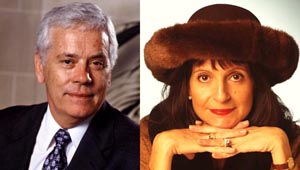
Professor Barry McGaw, Chair ACARA, and C. M. Rubin


In The Global Search for Education, join C.M. Rubin and globally renowned thought leaders including Sir Michael Barber (UK), Dr. Leon Botstein (US), Dr. Linda Darling-Hammond (US), Dr. Madhav Chavan (India), Professor Michael Fullan (Canada), Professor Howard Gardner (US), Professor Yvonne Hellman (The Netherlands), Professor Kristin Helstad (Norway), Professor Rose Hipkins (New Zealand), Professor Cornelia Hoogland (Canada), Mme. Chantal Kaufmann (Belgium), Professor Dominique Lafontaine (Belgium), Professor Hugh Lauder (UK), Professor Ben Levin (Canada), Professor Barry McGaw (Australia), Sridhar Rajagopalan (India), Sir Ken Robinson (UK), Professor Pasi Sahlberg (Finland), Andreas Schleicher (PISA, OECD), Dr. David Shaffer (US), Chancellor Stephen Spahn (US), Yves Theze (Lycee Francais US), Professor Charles Ungerleider (Canada), Professor Tony Wagner (US), Professor Dylan Wiliam (UK), Professor Theo Wubbels (The Netherlands), Professor Michael Young (UK), and Professor Minxuan Zhang (China) as they explore the big picture education questions that all nations face today.


Follow C. M. Rubin on Twitter: www.twitter.com/@cmrubinworld


  • Comments
  • 73
  • Pending Comments
  • 0
  • View FAQ
Comments are closed for this entry
View All
Recency  | 
Popularity
08:33 AM on 07/18/2011
This year I have been involved in a curriculum research project, comparing curriculum in six countries: New Zealand, Scotland, Sweden, Finland, Denmark and Norway. I find Professor Barry McGraw’s presentation of the new curriculum in Australia very interesting and convincing. I wonder whether cross-curricular topics could be global. From the comparative project it seems that learning capabilities like literacy and numeracy are standardized across nations more often than conceptual themes and topics.
12:59 PM on 06/16/2011
Very interesting article, thanks.
HUFFPOST SUPER USER
JAdams77
03:39 PM on 06/17/2011
Indeed, thank you!
photo
HUFFPOST SUPER USER
Joshua Ricardo Smith
12:29 PM on 06/16/2011
I wonder what provisions or guidelines there are for the gifted and talented students to help them reach their maximum potential. A good curriculum will incorporate a degree of differentiation between the lowest and highest achieving pupils.
12:50 PM on 06/16/2011
Hadn't thought of that. I suppose this is one area where teachers can individualise their lessons to cater for the ability of the kids in each particular class.
HUFFPOST SUPER USER
JAdams77
03:41 PM on 06/17/2011
I suppose the concern is that the guidelines are too strict and narrow and don't allow any room for manoeuvre. I think that's unlikely to be the case, though...
07:18 PM on 06/15/2011
This series of articles, The Global Search for Education, highlights significant issues for the U. S. to address. Unfortunately, in addition to the educational problems, we have several hurdles to overcome, including our collective short term focus on immediate gratification, the inability of our politicians to address common issues, and the post-recession environment wherein budgets are shrinking. China, however, our long term competitor, does not have these major hurdles in their way. We need the strongest possible leadership for education now.
11:51 PM on 06/15/2011
Yes, these are not small issues. The political deadlock has made things worse.
12:46 PM on 06/16/2011
The political deadlock needs to be sorted before we can start thinking about change.
12:02 AM on 06/16/2011
So where does this leadership come from? Mitt Romney? He doesn't care to make education a priority from what I can tell. I haven't heard much from Arne Duncan. Great idea, but where's our hero?
07:18 PM on 06/14/2011
He doesn't elaborate very much on the arts and other subjects so I do not know exactly what to say about that.
photo
HUFFPOST SUPER USER
Peter Crosby123
12:03 PM on 06/15/2011
I thought that too. In the final question we are simply told that information about the arts is available in publicly accessible documents but it would have been nice for him to talk a bit more directly on how the arts will be protected.
06:14 PM on 06/15/2011
Basically he only says that parents will be informed on how the students do in other subjects...
11:51 PM on 06/15/2011
Agree. Doesn't seem as comfortable in this area.
12:55 PM on 06/16/2011
I don't think it matters that much. Being able to write properly and count properly are fundamentally much more important than being able to play an instrument or painting.
HUFFPOST SUPER USER
JAdams77
03:38 PM on 06/17/2011
I think we've got to disagree on this one. Yes numeracy and literacy are important but with just those two you'll end up with an army of clones who have very little cultural and worldly knowledge that arts subjects give.
photo
HUFFPOST SUPER USER
Julie Aldridge
06:20 PM on 06/14/2011
Nationalising the curriculum is good move as everything across the country can be standardised much easier. Instead of the process being: have an idea for a change -> convince 6 different states and two territories of the benefits -> change implemented, with a nationalised system the middle step is completely removed. From the answer to the first question, the US system is done on state level rather than a national level? Is that right?
photo
HUFFPOST SUPER USER
Peter Crosby123
12:00 PM on 06/15/2011
I'm pretty sure you're correct. It really isn't a set up that's conducive to change as you pointed out.
07:21 PM on 06/15/2011
A clear explanation of the way things work. Well said.
12:47 PM on 06/16/2011
Agreed
photo
HUFFPOST SUPER USER
Julie Aldridge
06:05 PM on 06/14/2011
Ah Australia, what a fantastic country, I'd love to visit one day. It just seems to get things right, and if something isn't right then they aren't afraid to change it. They seem to have developed a very well rounded system, particularly with their "general capabilities" dimension. I've never heard of such a solution before but if implemented properly in the curriculum I think it will go down very well.
07:23 PM on 06/14/2011
I suppose there are pros and cons to a nationalized curriculum. Some of the cons would be that teachers would have to follow more strict guidelines... I do think that the teacher who individualizes his or her way of teaching the class is a better teacher.
07:41 PM on 06/14/2011
I believe that the teachers will obviously maintain their individual style of teaching just with a set of guidelines.
photo
HUFFPOST SUPER USER
Peter Crosby123
11:59 AM on 06/15/2011
I agree with your final statement but I don't think that having stricter guidelines will make the teachers worse. It just means they'll have a clearer idea of exactly what the kids do and don't need to learn and they can still put their individual spin/style on each bit.
HUFFPOST SUPER USER
JAdams77
05:58 PM on 06/14/2011
Very interesting (and good) how one is able to compare schools with similar socio-educational backgrounds. What a good way of being able to instantly see which schools are lagging and which are excelling within their own socio-economic groups.
08:00 PM on 06/14/2011
Yes. This is good.
12:48 PM on 06/16/2011
Pointless comparing a school in an affluent area with a school in an impoverished area. This is a good way f doing it rather than numerically ranking every school regardless of socio-economic background.
03:54 PM on 06/14/2011
Impressive transformation of the Australian system.
HUFFPOST SUPER USER
JAdams77
05:43 PM on 06/14/2011
A good example of how change CAN happen when the powers that be put their mind to it.
photo
HUFFPOST SUPER USER
Peter Crosby123
06:30 PM on 06/14/2011
Yes, but as Ian says below, the transformation should be overseen by those who actually know and live the system which is being changed, the politicians should be merely facilitators.
12:57 PM on 06/16/2011
It's great what a change they've made. Super job :)
03:32 PM on 06/14/2011
Education left to the educators, not the politicians.
HUFFPOST SUPER USER
JAdams77
05:54 PM on 06/14/2011
Quite right, politicians need to stop thinking they know what's best for the country and ask the very people who elected them what THEY think is best for the country (in this case, educators having their views listened to on the topic of education).
photo
HUFFPOST SUPER USER
Peter Crosby123
11:57 AM on 06/15/2011
...and what a good outcome we've seen. This should be done more often.
12:57 PM on 06/16/2011
Absolutely!
03:14 PM on 06/14/2011
As a former head of PISA, Barry McGaw is one of the most knowledgeable educators in the relative strengths and weaknesses of global education systems. The new Australian system seems to be structured to address the learning needs of students today and in the future.
03:57 PM on 06/14/2011
The U. S. needs to empower educators to come up with systemic solutions.
08:05 PM on 06/14/2011
ahhh if only
photo
HUFFPOST SUPER USER
Julie Aldridge
06:09 PM on 06/14/2011
The third dimension concerning "current priorities" is a perfect way of keeping the education system dynamic and up to date. Great idea and hopefully something that will be incorporated into other countries' education systems when they are up for reform.
02:34 PM on 06/14/2011
Australia seems to have a number of similarities to the U. S. Same language of course, but also racial issues (aborigines), immigration issues (asians), a structural complexity (states/provinces), although the latter not as layered as in the U. S. They are far more internationally minded than the U. S., being their own continent with less than 30 million people, which will serve them well in this global century.
03:35 PM on 06/14/2011
Let me guess. On the dissimilarity side of the field, the Australians probably show far more respect for their teachers.
photo
HUFFPOST SUPER USER
Peter Crosby123
12:06 PM on 06/15/2011
A likely scenario!
06:38 PM on 06/15/2011
I think that America is just very unique in that it is the least bit internationally minded.
04:00 PM on 06/14/2011
There seem to be several comparables between the U. S. and Australia. But in any case, even if there are many differences, the bottom line is that the U. S. is behind. And whatever our issues, unique or not, they must be addressed soon.
07:47 PM on 06/14/2011
You can say that but really, the US is still far different from Australia
01:52 PM on 06/14/2011
This represents a new, 21st Century educational framework, incorporating knowledge, mental skills, and social capabilities. It makes use of technology to allow for seamless implementation. I think that Professor McGaw's background in developing the PISA global assessment tool has helped him with this enormous effort to reform the Australian educational system.
03:17 PM on 06/14/2011
I agree with you completely about the usefulness of Professor McGaw's knowlege of global educational systems.
photo
HUFFPOST SUPER USER
Julie Aldridge
06:14 PM on 06/14/2011
It's an excellent idea to embrace technology and incorporate it in the school environment. It is second to none as a research tool and it is an ever growing part in modern life. If kids are exposed to it from a young age then they will become technology savvy and this will help them in their future lives/careers.
photo
HUFFPOST SUPER USER
Peter Crosby123
06:28 PM on 06/14/2011
I remember when in my local authority the council restricted access to youtube from schools because students kept abusing it by watching videos of dogs on skateboards etc. Cue: the French teacher marching to the council offices down the road and gave them what I imagine was a furious lecture on the advantages of youtube as an educational tool and lo and behold youtube became unblocked soon after!

The man was hailed as a hero, of course.
07:26 PM on 06/14/2011
Kids are being taught these things in the US as well of course... Computer lab and all.
01:25 PM on 06/14/2011
Interesting, how other countries look at the system and their weaknesses to initiate changes, and the US always goes on a teacher hunt to fix their own failures. I should have moved to Australia (or anywhere) a long time ago.
02:38 PM on 06/14/2011
Such a shame that you seem to be one of the teachers that have been shouldering the burden of teaching students as well as being the brunt of witch hunters who are focusing on the wrong dimensions of our educational system.
03:14 PM on 06/14/2011
I was for 33 years. Now retired I am looking for ways to stop the executioners that are looking to put the final nail in the public school coffin.
03:36 PM on 06/14/2011
Politically convenient to blame the teachers.
photo
HUFFPOST SUPER USER
Peter Crosby123
12:08 PM on 06/15/2011
Funny how it's the politicians who set up the system and when it clearly isn't working it's the teachers who get the blame...