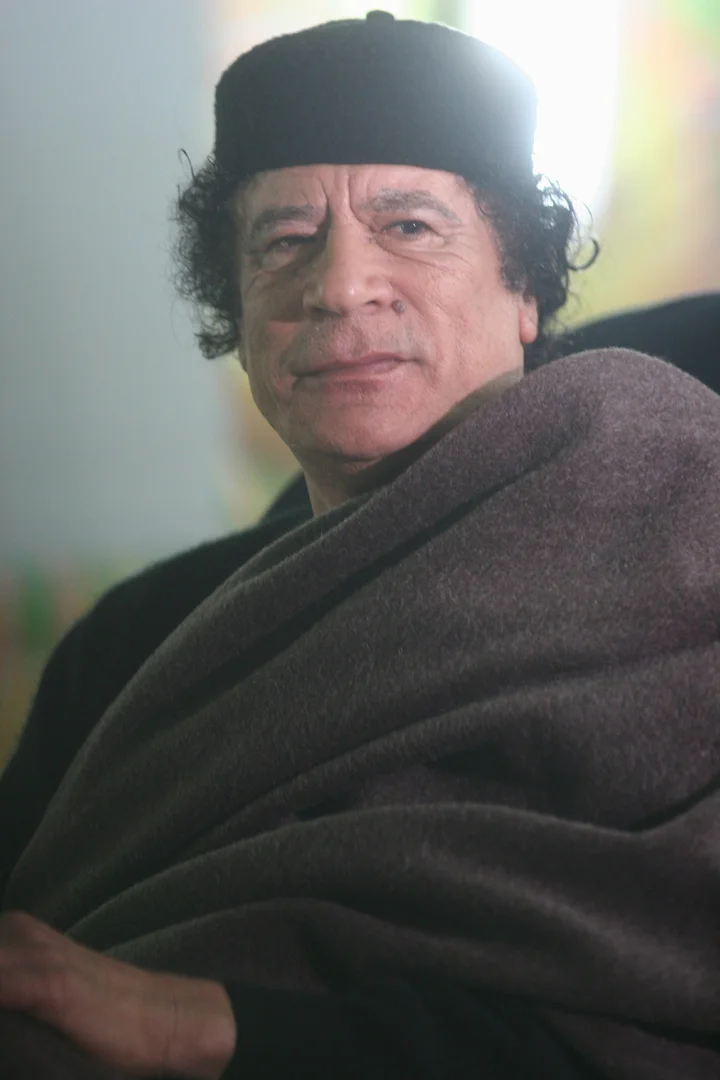
One of the biggest headlines to emerge in the early days of the battle for Libya was that Muammar Gaddafi had unleashed Black African mercenaries to put down the revolution. This turned out to be a largely bogus claim, but it nonetheless found traction among many ordinary Libyans. Why?
The mercenary myth was successful in galvanizing popular support for the rebels because it contained a tiny of kernel of truth. More importantly, it tapped into the smoldering resentment that many Libyans harbored against Gaddafi's gradual shift away from the Arab world in favor of Africa.
For decades Gaddafi used Libya as a base for training fighters from across the Sahel and West Africa. Most returned home, but some remained in Libya, often acquiring the right of abode. Others, particularly trans-Sahelian Tuaregs from Mali and Niger moved back and forth across the region's porous borders. Amidst their precarious desert existence, Gaddafi and Libya emerged as lifelines.
In the mid 1990s Gaddafi moved to quell the very Tuareg insurgencies he had once promised to support. A decade later he awarded Libyan citizenship to diehard Tuareg rebels who rejected the negotiated peace settlement in Niger and enlisted many of them in the Libyan army. It is among the Tuareg, according to Frederic Deycard and Yvan Guichaoua, that Gaddafi is likely to have secured troops to defend his crumbling regime.
Deycard and Guichaoua estimate that pro-Gaddafi elements recruited roughly 1,500 Tuaregs from Mali and Niger, most of who were already resident in Libya, over the course of the six-month conflict. In short they comprise a tiny fraction of the Libyan armed forces. To put this number in perspective, at the beginning of the conflict Gaddafi's army was estimated to be 76,000 strong. Defection and death have greatly reduced this number, but attrition has also been high among foreign combatants, both African and non-African.
So yes, Sahelian, if not Sub-Saharan Africans played a tiny role in extending Gaddafi's shelf life. But this does little in the way of explaining why Black Africans became scapegoats for an entire regime's brutality.
The answer to this lies in Gaddafi's reinvention as an African leader and his re-orientation of Libya's foreign policy and oil dollars towards Africa. Neither garnered the support of most Libyans. Like much of Gaddafi's history, his involvement in Sub-Saharan Africa was idiosyncratic and contradictory. As early as the 1970s, he was already meddling in the region's affairs, most notably in Chad, where he sought to gain control of the uranium-rich Aozou Strip.
By the mid to late 1980s, he emerged as a key player in a number of West African conflicts. Gaddafi not only provided funding and weaponry to a number of rebel groups there, he also trained their leadership in Libya. He backed Liberia's Charles Taylor and Sierra Leone's Foday Sankoh in the deadly civil wars that ravaged both countries throughout the 1990s.
But the real turning point came in the wake of the 1992 U.N. embargo against Libya. Dismayed by the lack of support he received from Arab countries, Gaddafi responded by turning his attention and seemingly endless supply of oil-money toward sub-Saharan Africa. He now sought to firmly position himself as an African leader and a Pan-Africanist.
As a historian of race in modern Africa, and a pan-Africanist, I watched Gaddafi closely as he reinvented himself. His African adventures weren't cheap. They cost him both cash and credibility. For most Libyans, already predisposed to seeing themselves as part of the Arab world, Gaddafi's new predilection for Africa and for asserting Libya's African identity, came at the expense of national priorities and pride. Things soured further when part of Gaddafi's transformation included opening up Libya's borders to sub-Saharan migrants who were a convenient source of cheap labor, willing to do jobs that most Libyans frowned upon.
Exploitation would turn out to be the least of their worries. In October 2000 a wave of xenophobic violence led to the deaths of hundreds of sub-Saharan Africans, and caused thousands more to flee Libya. Gaddafi responded to Libyan and European Union discontent over immigration, by tightening border controls and establishing detention camps where thousands of black African migrants awaited deportation in squalid conditions. Human Rights Watch has documented instances of migrants being dropped off in the desert by Libyan officials and left to die. Gaddafi's pro-African ideologies could be dispensed with at will.
After being disinherited by Gaddafi, these men now find themselves accused of being pro-Gaddafi mercenaries. Libyan rebels have exploited this myth to great effect. Their fear-mongering tactics whipped anti-Gaddafi Libyans into a nationalist frenzy, reminiscent of Germany's Black Peril propaganda in the wake of France's decision to garrison the Rhine with African troops at the close of World War I.
But common sense, along with a lack of credible evidence indicating otherwise, suggest that the majority of dark-skinned Africans detained, beaten, or killed by Libyan rebels aren't mercenaries. No mercenary worth his salt would remain unarmed in plain site of an invading army. This raises the unsettling possibility that Libya's rebels branded black Africans as mercenaries in an attempt to legitimize their abuse. An Amnesty International report released a couple week ago verified some of these violations.
The mistreatment and murder of blacks by rebel forces in Libya is an extension of long-simmering anti-immigrant sentiments that are directed specifically at sub-Saharan Africans. Xenophobia and racism are both at play here.
But there is another dimension to the racism that is now tainting the Libyan revolution.
Despite the popular image of Libyans as light-skinned Arabs, there has long been a significant population of black Libyans, particularly in the south of the country. Their origins date back to the earliest days of the trans-Saharan trade, which provided highly sought after black slaves to the Arab world.
Today, their descendents are widely viewed as Gaddafi sympathizers. The town of Tawergha, populated primarily by black Libyans, was an early casualty of rebel forces. Questions still remain about the whereabouts of the towns nearly 10,000 inhabitants. Indications suggest that rebel forces have exacted their pound of flesh from Tawergha. For many light-skinned Libyans, to be black and Libyan is an oxymoron.
But no amount of racial purging will erase the fact that Libya is an African country and that Libyans are Africans too. Post-Gaddafi Libyans must reckon with the complexity of their Arab and African identities in order to avoid reproducing the same brand of divisive rule that fractured Libyan society under Gaddafi.