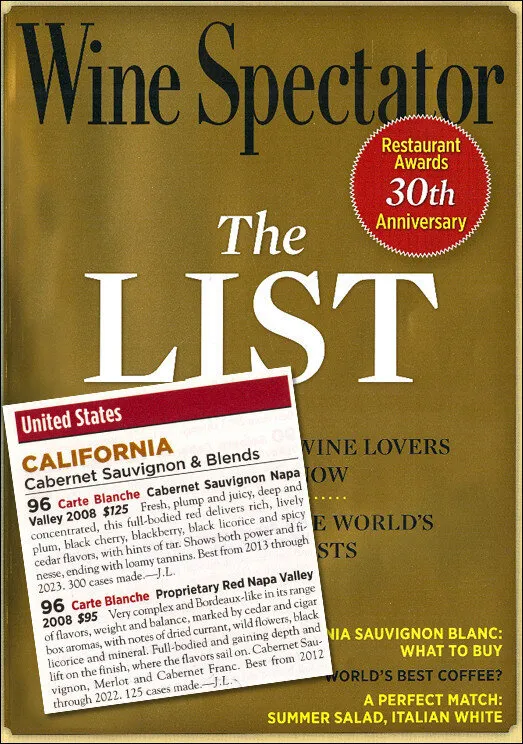
Last year, my very first post here was a takedown of the 100 point wine rating system as employed by mainstream wine writers. It was written in the form of an explanation of its inherent worthlessness and irrelevance in the contemporary wine market coupled with an assertion of the net harm that its use causes in this market.
In the ensuing months, my opinion hasn't changed but I thought the debate was worth another look because of a couple of somewhat recent high profile defenses of the system from writers whose work I otherwise admire, including San Francisco Chronicle Wine Editor Jon Bonné and freelance writer and Wine Enthusiast West Coast Editor Steve Heimoff. Both of these men I consider among the most thoughtful and cosmopolitan journalists writing about wine today, so it was discouraging to see their defenses of the system utilizing those same tired arguments used by lesser critics.
I'll save the point for point rehashing of their respective arguments, as there's far too much writing about other writers' writing going on in the wine blogs these days. Instead, I'd like to quickly address the fundamental fallacies which most of these "defenses" share. I encourage readers here to explore the links above and come to their own conclusions on the matter.
- The "Wise Consumer" Fallacy. Arguments in the defense of the 100 point wine rating system almost invariably assert that a score is merely one piece of information that the "wise consumer" factors in to his or her purchasing decision. While the "wise consumer" might be a sizable minority of wine buyers, to use that as a defense for the 100 point system specifically and quantitative wine rating in general is silly: it is simply not borne out by the economic impact of wine scores which are clearly visible in the wine market when a wine receives a score of 90 versus 89 or 96 versus 94 by an influential publication. The score becomes more than just a shorthand for a narrative review, it becomes the entire review itself.
- The "It's Not Objective" Fallacy. Defenders of the 100 point rating system are also quick to note in their defenses that there's nothing meant to be objective about their score; that it is always intended to be subjective. While perhaps theoretically true, in practice there is of course an implied objectivity in any quantitative rating system: that, within that system, a wine receiving more points (or stars, or hats or whatever) is of course better than a wine with fewer. The critic can protest all he wants that that might not be his intention, but as any student of Post-Modernism would tell you, the writer's intention has nothing to do with it and we can only assess value in its application.
- "The Readers Want It" Fallacy. Many defenders of the system, especially those who claim to use it grudgingly, insist that "my readers want it, therefore I should use it." But rectitude doesn't come from acclamation, not to mention that the readers of those magazines and blogs who use the system are probably disproportionately predisposed to supporting it. Not to draw too broad of an analogy, but we're all welcome to smoke cigarettes, guzzle corn syrup, overindulge in alcohol, or engage in any innumerable popular, pleasurable impulses but that doesn't mean they don't also cause damage.
And fundamentally, the quantitative rating of wine damages the effort to broaden consumers' palates and hampers the introduction of a broader range of wines from all over the world into the American wine market. It reduces wine discourse to numbers and stars and pits wines from certain parts of the world, particularly those that were not established in America when Wine Advocate and Wine Spectator began issuing scores, against others. And so far, nobody has come up with a credible argument in favor of quantitative rating (of which the 100 point system is most prevalent and influential) being in any way superior to a clearly subjective system of narrative criticism. The arguments in support all eventually devolve into some form of "well, we like it" or "it's just what we use."
Thankfully, we've seen a drastic decrease in the influence of point scores from major publications on wine sales, a trend that should continue as more and more new wine drinkers see the wine rating system in particular and the magazines and writers employing it in general as increasingly out of touch, that its use is indicative of a way of thinking about wine that is outmoded.
And isn't that the best argument against its use? If you want to be a wine critic who remains relevant for the next thirty years you might want to ditch the rating system now, lest you be stuck wearing the wine writing equivalent of acid-washed jeans and feathered hair a decade too late.