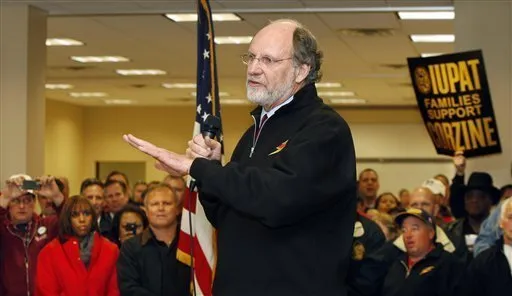
All of America watched New Jersey's gubernatorial election. Some interpreted the result as a referendum on Barack Obama's leadership, but everyone voting in our state understood that the Democrat on the ticket was Jon Corzine, and Corzine alone, not a stand-in for our president.
Corzine's loss was not an acid test, but perhaps it should serve as a cautionary tale. Political lives can be short, and leaders may wake up to find their terms over before that perfect moment arrives to carry out their agenda.
Even in the face of controversy, Corzine implemented important changes. Under his watch, New Jersey abolished the death penalty, installed permanent monitoring over a state police force with a long tradition of entrenched racial profiling, and rejected federal "abstinence only" funds that would have spread half-truths about health and sexuality to some of our most vulnerable youth.
Governor Corzine's accomplishments are impressive, but he had much more left to do: reforming unfair criminal justice policies, securing marriage equality for gay couples, increasing government transparency and legalizing medicinal use of marijuana, just to name a few.
A number of factors hindered Corzine's efforts, some outside of his control -- such as the country's dire economic problems and a devastating car accident early in his term. Other factors reflect his inexperience with state-level politics -- like turnstile staffing (and the attendant lack of focus in policy implementation) and a shortage of moxie in working with our idiosyncratic legislature. These shortcomings undermined his agenda and also diminished enthusiasm among legislative leaders for his reelection bid.
New Jersey's political culture has its quirks -- big decisions are as likely to be made in a diner as they are in the State House. But as in most places, political progress here ultimately depends on building relationships and bringing people along. To the extent Corzine made efforts to collaborate with legislators and community members, they were generally too little, too late.
Trenton will scramble during the upcoming lame duck session to finish what our defeated governor started. From now until January, the legislature will try to pass bills -- like marriage equality -- that it failed to take up until now. The frenzy of lame duck is not ideal for making sound law. Corzine has weeks to seal his legacy, and the Democratic legislature has to push through its most powerful members' agenda items as well, before it faces unknown terrain in the new year with Republican Governor Chris Christie.
Progressive politicians nationwide can learn from Corzine's long, unfinished wish-list: Passion and promises are not enough. From City Hall, to the State House to the West Wing, Corzine's tale offers this takeaway: Take bold action now, because "later" may never arrive.
A year ago, President Obama won the presidency promising to restore the Constitution, on life support after an eight-year assault. His pledge to close Guantanamo Bay was an important step, but the military base still holds detainees deprived of their fundamental rights guaranteed by the Constitution. He also promised to end the Iraq war and repeal the "don't ask, don't tell" policy that has cost thousands of honorable soldiers their careers and deprived the military of their services. Issues like these, which helped Obama win the election in 2008, seem to have fallen by the wayside in 2009.
President Obama holds the hardest job in the world. He wrangles with an economic disaster, a health care fight, a swine flu epidemic and two wars. Like Corzine, he may hope to fulfill his promises after he addresses the current emergencies. But also like our governor, he risks slipping into a state of complacent caution.
The courage to act on a bold vision distinguishes the great leaders who change history from the placeholders.
The fate of Corzine's progressive agenda represents a cautionary tale for progressive Americans as well as progressive politicians. We, too, have a challenging job: to keep our President focused on the electoral promises that inspired Americans to vote him in with a mandate.
Rather than counting on Obama's promises to effect change, we must push social justice to the top of the White House's priorities ourselves. This means holding Obama's feet to the fire while doing our part to strategically ignite change.
Taking a page from our president's community-organizing past, we must work together to create a climate that supports a progressive agenda. We must know our communities, build bridges, and work in coalition with allies outside of our usual circles. Only then can we push our leaders into action.
President Obama has three years to make his dreams our reality. We know he can't do it alone. When our leaders' hearts are in the right place, but their hands aren't getting dirty, we are the ones who must sow the seeds of progress.