iPhone app iPad app Android phone app Android tablet app More

Featuring fresh takes and real-time analysis from HuffPost's signature lineup of contributors
Federico Barriga

GET UPDATES FROM Federico Barriga
 

What to Expect From a New Chávez Term

Posted: 10/08/2012 12:10 pm

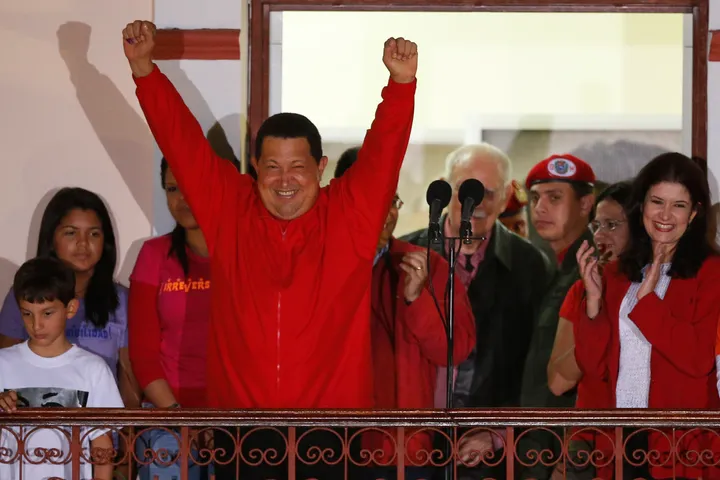
With the official vote count almost finished, it is now clear that Venezuelan president Hugo Chávez has delivered another resounding victory, winning a new six-year term with around 54 percent of the votes and 1.3 million more than the main opposition contender, Henrique Capriles. Among others, the results suggest that the Chávez camp was more successful in attracting independent voters than what some polls and the opposition had originally envisaged. It also implies that the president's campaign strategy to appear moderate and conciliatory vis-à-vis undecided voters delivered positive results -- in fact Mr. Chávez was quick to emphasize his centrist position during his victory speech.

But does this mean that we are likely to see a more moderate Chavismo in the next few years? The answer is a resounding no, for some of Mr. Chávez's electoral promises and past experience suggest that the president is likely to take an even more radical stance. Most importantly, Venezuela might see the emergence of a "sub-system" of political and economic organisations that will grant the executive even greater power at the expense of institutional stability and political plurality.

Power Grab

Some of the most important changes that are likely to take place in a new Chávez administration are constitutional reforms and faster implementation of controversial laws that have already been approved. The most likely reform is a change of the current succession mechanism to ensure that the ruling party, the Partido Socialista Unido de Venezuela (PSUV), retains the presidency in the event that Mr Chávez needs to step down because of health reasons -- at present the constitution demands new elections if a president steps down in the half of a six-year term. But other reforms to increase the power of the executive (or of organisations dependent on the president) would also be key, as the president's desire -- expressed at different points of the campaign trail -- to establish Chavismo as a viable long-term political option would depend on the ability to control those who remain in opposition.

Enter the communes. Although originally based on ideological precepts, Mr. Chávez's increased interest in communal entities stems in large part from political calculations, specifically in trying to erode the power of the opposition at the state and local levels. Thus far, the president has sought to tame regional and local authorities by denying them the share of the national budget to which they are entitled under the constitution -- mainly by understating oil revenue. A next stage could potentially involve the transfer the existing political responsibilities (as well as economic resources) that local authorities still enjoy to the communes. In fact, the laws that would enshrine the basic forms of communes are already on the statute book and would essentially replace local democracy with communal assemblies created specifically for the "construction of socialism" and controlled by the national executive.

Other actors who have opposed Mr. Chávez's policies in the past are also be likely to be targeted, with various tactics and degrees of radicalism. The local private sector is particularly vulnerable, as it already suffers from price and exchange controls and overregulation. Although a move to a fully state-controlled economic model is highly unlikely, expropriation would remain a constant threat, with certain industries, such as food-processing and the financial system, as potential short-term targets. Moreover, the government would also try to accelerate the implementation of alternative economic structures -- tied to communal organisations, referred to as Empresas de Producción Social (EPS) -- that will reduce the scope of private participation even further.

More challenging will be to reduce the influence of groups such as autonomous universities, student groups, NGOs and the church. In contrast to Venezuela's traditional political parties, they have operated as an effective counterweight to chavista hegemony in the public sphere. To move definitively against any or all of them would be to take a more open authoritarian style, and it is uncertain whether Mr Chávez would be willing to risk making that step. Moreover, despite its recent withdrawal from the Inter-American Commission for Human Rights, Venezuela is still bound by constitutional and treaty commitments that are not so easy to evade, including those derived from its recent entry to the Mercosur trading bloc. That said, the government is still likely to use judicial intimidation and financial repression to reduce the sphere of influence of these groups.

Institutional instability

Perhaps Mr. Chávez's most difficult relationship will be with the armed forces. Although the president claims that the military are chavista, these sentiments have been echoed by only a few of his most loyal generals, with a significant portion of officers ascribing to other views. Therefore, a main objective is likely to be to promote military officers based on political loyalty, while giving more power and representation to the socialist militia, which the government claims is already composed of 125,000 people. However, the risks involved are substantial, as the integrity and institutional solidity of the armed forces would be severely dented, potentially opening the way for social conflict and a further deterioration in the country's poor security environment.

Overall, the re-election of Mr. Chávez represents a serious challenge to what remains of Venezuela's weakened institutional framework, and to the further erosion of political plurality. The health of Venezuela's democracy would depend on society's capacity to maintain a counterweight to the executive, and to a lesser extent on international pressure. While the economy, and in particular movements in the international price of oil, will continue to play a role, Mr Chávez has proved that he can withstand periods of austerity and economic contraction, suggesting that political considerations -- and in particular the push to advance his radical agenda -- would take precedence over all else.

Federico Barriga is a Latin America Economist for the Economist Intelligence Unit.

 
FOLLOW WORLD
With the official vote count almost finished, it is now clear that Venezuelan president Hugo Chávez has delivered another resounding victory, winning a new six-year term with around 54 percent of the...
 
 
  • Comments
  • 17
  • Pending Comments
  • 0
  • View FAQ
Comments are closed for this entry
View All
Favorites
Recency  | 
Popularity
05:55 PM on 10/10/2012
PART IV (FINAL)

Then there are the voters with multiple ID numbers, as shown on a video in You Tube. In theory, there is one vote per ID and per fingerprint. Problem is that the fingerprint file is separate from the voter data so you can create many voters by assigning the same fingerprint to the same person with different identities.

So with this and many more tricks you get 55.1% of the votes. Yes, many people voted for Chavez but many also were coerced and an unknown number just had many identities to vote several times for him. Still, against all of that the Opposition pulled 6.5 million votes.
05:55 PM on 10/10/2012
PART III

There were also a very high "assisted vote" numbers in some balloting centres. An "assisted vote" is one where the voter is too old or sick to vote for him or herself, so under the electoral law it is permitted to have another person (the assistant) join them at the balloting station to help them vote. Then, the names of the voter and the assistant are recorded on a sheet of paper. In all previous elections you got a few names on one single sheet, many times not even 8 names.
Well, it turns out that this time in many centres countrywide there were as many as five pages of "assisted" voters. One opposition witness at a balloting centre commented many were not old nor sick to require assistance and that the assistant seemed very keen on making sure they voted "right" (i.e. for Chavez). However, other than reporting this abuse in writing there was nothing an opposition witness could do.

Meanwhile, only 100,000 or so so Venezuelans abroad faced all sorts of obstacles to be able to cast their votes, like those in Florida, that were forced to drive nine hours to Oklahoma in order to vote. On top of that, some 800,000 Venezuelans living abroad have not been allowed to change their voting "address" to their new domicile and remain as voters in their previous residential area in Venezuela, effectively prevented from voting.
photo
GarethJonesLives
תיקון עולם
02:21 PM on 10/13/2012
"In all previous elections you got a few names on one single sheet, many times not even 8 names.
Well, it turns out that this time in many centres countrywide there were as many as five pages of "assisted" voters."

What was the voter turnout in those previous elections?
05:53 PM on 10/10/2012
PART II

Then there is coercion. A chavista friend of mine had the job of bringing people to vote on Sunday based on a list of recipients of government aid. She had their names, addresses and phone numbers. She went to pick them up at their homes in the slums with cars supplied by PDVSA national oil company and made sure they got the right idea of who to vote for. This pulling of reluctant voters took place throughout the day but mainly after 5.00 pm, so the balloting centres could not close at 6.00 pm under the rule of "keep open as long as there are voters in line." It should be noted that many balloting centres were empty between noon to 4-5 pm.
05:46 PM on 10/08/2012
Chavez will now take aggressive measures against the opposition in all areas and completely destroy them before the nexy election.
photo
Dan McCall
Satirist, Artist, Dad.
03:01 PM on 10/08/2012
Chavismo is burying his country and will continue to do so. But he's not remarkable in any sense. He's simply a statist "being a statist." Once the psychedelic eye wear that was bolted to your face as a kid in the schools, media, and els
ewhere, is taken off, you see all these criminals for what they are... a drab shade of the same depressing grey.

Communist, fascist, socialist, corporativist, conservative, liberal, republican, democrat, red, brown, black, blue, green, whatever. It's all unremarkable and stupid. I really don't care what sort of master that slaves want to shackle themselves to. I'm only interested in people recognizing their chains and taking them off.
photo
GarethJonesLives
תיקון עולם
02:19 PM on 10/13/2012
"Chavismo is burying his country and will continue to do so."

By what metric? Be specific.
HUFFPOST SUPER USER
TRUTHHURTS500
02:54 PM on 10/08/2012
Well, Venezuela is doing better than the US. Very few articles about Chavez say anything positive about what he had done in Venezuela. From what I read, poverty is down, there healthcare and education for all.

The thing about people like Castro, Chavez and Qaddahfi, the US call them dictators, make them out to be evil people. But when you read the history of these countries and how American greedy capitalism tried to interfere and influence the governments, you can than understand why they nationalise their oil and want very little to do with the US.

Look at Libya. There was no humanitarian mission, that was a planned regieme change. The US and France, so thirsty to gain control of the resources in Libya, didn't know who they were supporting. Now the people they supported turned on them. Massive amounts of weapons are missing. Everything there is now out of control and everyday people are paying the price for it. The American media if feeding the public propaganda. At the end of the day, the people were better off with Qadafhi in power. They will regret the day they thought the American government was helping them.
This user has chosen to opt out of the Badges program
03:50 PM on 10/08/2012
Actually, Venezuela is doing very badly.
It has the highest murder rate in the south America and one of hte highest in the world.
Its healthcare sector is worthless, Chavez made a deal to import Cuban doctors but that is merely a band aid solution. At the end of the day, healthcare in venezuela is fundamentally broken.
There are constant shortages in goods (which affects hospitals and schools), food, and consumer goods.
Inflation has skyrocketed to the highest in the world with a price increase of 29% a year, making food so expansive that it is hard to get to AND meaning that any rise in the purchasing power of people is automatically erased by the higher cost of goods. People's real socio-economic has not changed.
Nationalising oil is not a bad thing, but being a bad leader IS a bad thing.

Castro has a similar record. His country became so focused on Soviet subsidies and aid that when the USSR collapsed its economy did to and has not yet recovered. Though, unlike Chavez, Castro DID invest in health and education.

Gaddafi was hated for being a terrorist. Yes, he publicly gave it up. However, people do not forget his past actions. Neither Castro nor Chavez made their state a supporter of terrorism (though Chavez may or may not have helped the FARC in Colombia, which he denies).
HUFFPOST SUPER USER
TRUTHHURTS500
04:22 PM on 10/08/2012
Well, Chavez must be doing something right. He received over 50% of the vote and won!
photo
HUFFPOST SUPER USER
Bob Metcalfe
Caught at 1st. slip trying to cut
07:31 PM on 10/08/2012
I wonder then how hes managed to get poverty down from 50 odd percent to 30? Better than the US has done in the last 30 years.
photo
WhatName
Beauty is in the eye of the beer holder.
01:49 PM on 10/08/2012
Great work Chavez is doing empowering the indigenous and the poor in Venezuela is marred by his disastrous foreign policy. Too bad.