More

Featuring fresh takes and real-time analysis from HuffPost's signature lineup of contributors
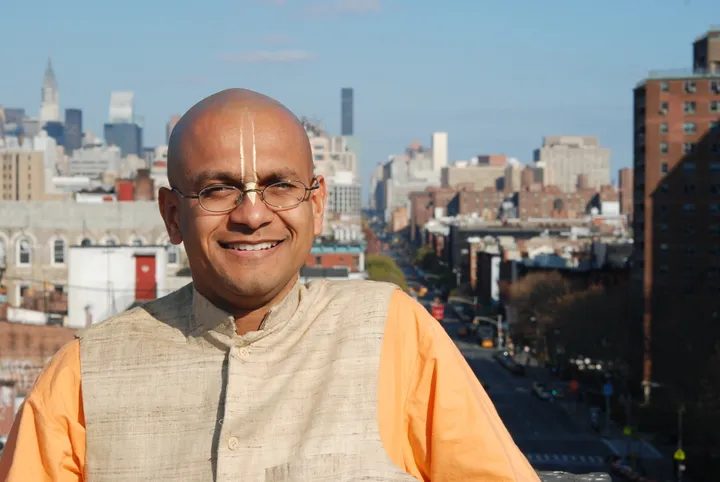
Gadadhara Pandit Dasa

GET UPDATES FROM Gadadhara Pandit Dasa

Being a Monk in New York City

Posted: 07/26/11 07:36 PM ET

Most people I encounter are quite fascinated by the idea of monks living in Manhattan. I suppose the fascination is quite natural. Most people engaged in monastic life are expected to live away from a busy city. A place that allows for focused meditation and reflection on spiritual life. Wouldn't a busy city like New York, which is seen by many as the height of materialism, seem quite counterproductive to the monastic life?

It all depends on one's purpose. If one is aspiring to focus only on one's own individual meditation and spiritual practice, then a busy city environment can definitely be counterproductive. However, if one is residing in a city for the purpose of helping people, then there's no better place.

Within the Bhakti tradition of Hinduism, the tradition that I have adopted, it is recommended that some monks live in the city because that's where people are most stressed and therefore need the most spiritual guidance. The city is a very intense place where everyone is constantly scrambling from one activity to another, always keeping themselves busy, often times leaving their spiritual pursuits by the wayside.

The Bhakti tradition teaches that making oneself available to assist others helps one develop greater levels of compassion, which is a very important tenet of Hinduism. This tenet applies to monks and laypersons.

The city can actually push one to greater levels of focus in one's meditation. There are so many distractions everywhere and to prevent oneself from getting sucked into the ubiquitous materialism, one really needs to take greater shelter of the meditation and other focusing practices.

For example, when you're driving at high speeds, you need to be more attentive, otherwise the chances of an accident are much greater. I like to compare the city to a high-speed highway which requires a greater level of focus.

Being a monk in New York City can definitely be challenging. I'm more comfortable in a city environment than some of our monks. I was born in Kanpur, which is an extremely busy, industrial city. Then, at the age of about five, we moved to New Delhi, which is also insanely busy. By age seven, I was living in Los Angeles.

When I first moved to New York, I found it to be an exciting place. Because of my conditioning, I like busy places. People, cars, trucks, and other city noises don't really bother me. I do like to get away once in a while, but for the most part, I'm fine with it.

The monastery, located in the Lower East Side, is right on First Avenue, and from the outside, it looks like just another New York brownstone, so one could walk right past it and not notice anything special. We're surrounded by bars, nightclubs, restaurants, tattoo shops, and a variety of eclectic establishments. It's probably one of the busiest areas in Manhattan on Friday and Saturday nights. The action actually starts on Thursday nights and goes until early Sunday morning till about 4:00 a.m.

I know the timings so well because I usually wake up at 4:00 a.m. and can hear the boisterous discussions taking place on the avenue after the bars have closed and flushed out their clients. Once, I even saw a couple of guys with their shirts off, in a total drunken stupor, having a fist fight right in the middle of the street. It's quite a scene out there with people yelling and bottles smashing against the sidewalk.

The natural question arises: What in the world are monks doing in a place like this?!

There's about 15 of us and we all wake up between 4:00 a.m. and 4:30 a.m. Our morning meditation starts at 5:00 a.m. To refresh ourselves from the night's sleep, everyone is required to shower, put on a clean set of robes and then enter the temple room for the meditation and worship. According to the teachings in Hinduism, the mind has the easiest time focusing during the early morning hours. The mind responds to all the stimuli around us -- people, traffic, noises, and activity in general. There's not a whole lot of activity going on at 4:30am. Stilling the mind is close to impossible, but the morning hours do help when you're trying to focus the mind.

Morning Meditation

Our morning services move through a variety of moods and flavors. We start with the more grave mantra meditation and after an hour, we move into a very devotional practice of song and devotional dance. We sing different songs glorifying the previous teachers and God. The use of traditional Indian instruments such as cartals (cymbals) and a double-sided Bengali drum allow the sessions to become quite rhythmic and ecstatic. The beautiful melodies enable one to pour their heart into the prayers being sung while all the monks move back and forth and side to side and eventually dance in a circle. It's an incredibly powerful, devotional, and spiritual way to start the morning. It's easily more energizing than a double espresso and the experience stays with you the entire day.

The monks rotate lecturing from Hindu scripture elucidating the philosophy and explaining how it can be applied into our daily lives. During the lecture part of the morning program, some of the other monks are taking notes on the class, while others are cutting up vegetables for the day's cooking and some are stringing garlands of fresh flowers to be offered on the altar.

Whenever anyone hears about the morning service, a common question arises "how often do you guys do this?" and I tell them "everyday -- seven days a week." The look on most people's face is priceless when they hear my answer. It's anything but boring. There's quite a bit going on and the three hours, from 5:00 a.m. to 8:00 a.m., flies by. Of course, if you haven't had a good night's rest, it can get kind of rough at times. After the morning program and before breakfast at 9:00 a.m., some monks will continue to do additional meditation, while others will do some yoga, and some may even take a quick nap.

The morning meditation and prayer service is our food for the soul. It gives us the much needed nourishment we need to handle the madness of the city and it gives us the spiritual strength we need for our various activities -- teaching, counseling, lecturing, cooking, cleaning, and going out to engage with the local population.

Being a monk in New York isn't easy by any means, however, if the principle of service to humanity is adhered to, it can be very satisfying and even blissful. Due to length constraints, I am only able to describe the first five hours of our day. In a future piece, I will go into further details of our monastic life, which will reveal more about the inner workings of the monastery and some of the challenges the monks face, individually and collectively.


Follow Gadadhara Pandit Dasa on Twitter: www.twitter.com/nycpandit

Most people I encounter are quite fascinated by the idea of monks living in Manhattan. I suppose the fascination is quite natural. Most people engaged in monastic life are expected to live away from...
 
 
  • Comments
  • 33
  • Pending Comments
  • 0
  • View FAQ
Comments are closed for this entry
View All
Favorites
Recency  | 
Popularity
04:03 PM on 08/01/2011
Haribol!!!!!

Jai Sri KRSNA!!

Glories to Kesava!!
09:44 AM on 07/31/2011
Thank you for a lovely article....it's kind of calmed down my morning. Keep up what you're doing, it's inspirational. :o)
04:34 PM on 07/30/2011
I really enjoyed reading this ... While I live in the heart of Washington, D.C., I often spend a few days in NYC and find it both exhilarating and exhausting ... how nice to read about people living there, doing good works and striving to find balance in life...please do write more ... I would love to read a series of your pieces describing the entire 24 hours...
12:20 PM on 07/30/2011
THE MANTRA FOR PEACE AND WELL-BEING FOR ALL PEOPLE OF THIS AGE:
HARE KRISHNA HARE KRISHNA KRISHNA KRISHNA HARE HARE
HARE RAMA HARE RAMA RAMA RAMA HARE HARE
TRY IT! AND BE HAPPY AND PEACEFUL!!
04:53 PM on 07/29/2011
Whatever happened to the Hare Krishna's out there in the airports and parking lots selling books and flowers? I thought the movement had folded. Kinda miss them.
04:00 PM on 08/01/2011
Since Srila Prahbupada (founder and leader of ISKON- also known as the Hare Krishnas) died in 1977, the movement has continued to dwindle. There were also quite a few internal conflicts along the way. Not to mention much of how the society changed after his death resulted in a lot of members leaving or starting other traditions. There is also a lack of legitimacy since ISKON leaders are all Westerners and there is debate as to whether they were properly initiated by Prahbupada before his death. What legitimate teachers that remained left in 1983 when a key tenet of the faith was misrepresented by ISKON leaders, causing many Sanskrits scholars involved to leave the group. Then it became more cult-like. For more info read this book..The Hare Krishna Movement: The Post-Charismatic Fate of a Religious Transplant.
06:32 AM on 08/02/2011
Thanks. I will check out that book. The movement had a lot of influence during the 70's and 80's then it seemed to die out.
11:27 PM on 07/27/2011
I think its very nice that even in a busy city like New York, one can find spiritual sanctuary and be provided the means to have calmness of mind and spirit.
This user has chosen to opt out of the Badges program
03:23 PM on 07/27/2011
So your life is preparing yourself daily to be good to enable you to do good for others?
Who pays for all of this good? Free bread is not always easy to come buy.
researcher
researcher
01:03 AM on 07/28/2011
not easy when a nation spends 40% of its federal budget on wars for corp profits.

it always amazes me how americans get in a hot over free bread and feeding the poor but spend trillions on their war machine. I suspect rome was the same way near the end of their run as a super power, indeed the only super power in the world. kind of like us the only super power left in the world.
This user has chosen to opt out of the Badges program
09:21 AM on 07/28/2011
researcher

You may need to do even more research. Those corp profits you disparage so vengefully are very important to the social welfare coffers.

Are you pleased that islam is successfully infiltrating your super power cities and universities from within, crying victimhood and whining, without firing a shot, yet?
researcher
researcher
02:49 PM on 07/27/2011
being a hindu monk in new york has 11 comments in two days. interesting.
08:21 AM on 07/27/2011
Thank you for reminding us that it is all about one's purpose: to live to serve others definitely is at a higher level than serving one's own (right, it is great that this person is self-actualized but how about the rest of the people?). That is a lot of sacrifice one has to make! At least, one has to be compassionate to think about others' well-being.
05:46 AM on 07/27/2011
How many Christians could live in a Hindu country, wear a cross, and practice their religion in safety?
This user has chosen to opt out of the Badges program
07:33 AM on 07/27/2011
Your statement says more about any organized religion's levels of intolerance than what you smugly thought it said about Hindus. A Christian native just took a bomb and a rifle in Norway to other humans simply because they didn't practice his blond, blue-eyed version of being "his brother's keeper."
Thanks for playing.
photo
ZenSufi
There is a secret in the Heart of Man.
10:22 AM on 07/27/2011
Christians have been doing that for 2000 years.
04:26 AM on 07/27/2011
Wonderful article Prabhuji. Thank you. I hope you write more.

Das anudas, Madhavananda Das
Gopaljiu Publications, ISKCON Bhubaneswar
This user has chosen to opt out of the Badges program
photo
02:59 AM on 07/27/2011
Thank you - a wonderful article, and a lovely insight into your experience.
HUFFPOST SUPER USER
ZENNEPHI
08:18 PM on 07/26/2011
The Zen-Hindi Transmission from Contemplitive Buddha Monk [Bhagwan] has allowed
me my service in the "Market-Place" to be fruitfull.
In Home Vocational Scribe LDS-Priest 3rd Order, I'm not in "Community" with fellow religious.
I do not "convert", but engage empowerment in the extended Church family of any religious
denomintation. I wear plenty of hats, however my primary emphasis is one the Chrisitan
ethics of Mormonastic and the compassionate engraftments of fr. [Charles Merton], the
Benedictene Monk, who had Buddhist Training with His Holiness the [Dalai Lama].
No Hand Outs, Only a Hand-up. Religiousness versus Religion.
photo
ZenSufi
There is a secret in the Heart of Man.
10:24 AM on 07/27/2011
Charles Merton, or Thomas Merton.

I've never seen a Buddhist-Mormon before.
07:55 PM on 07/26/2011
Thank you for this wonderful article. I look forward to your future articles on monasticism. The pictures and your description of the first three hours upon awakening are inspiring. A trace of that feeling of love in devotional service has come across to me.

Namaste
researcher
researcher
07:53 PM on 07/26/2011
when the oneness became many, ignorance was born and with that ignorance became suffering but without that ignorance there is no many. ie no expressions of oneness. ie us. :-)

we are divine expressions of the isness of infinite oneness.

the Hindu mystic Sri Aurobindo: “The world is manifestation of the Real and therefore is itself real.”

those that state that all is an illusion lack understanding of the meaning and purpose of ignorance for oneness to become many. without ignorance there is no us just isness. ie god.

we owe our unique souls to the necessity of unawareness for oneness to became many.

the origin of suffering is ignorance or unawareness, the origin of that ignorance or unawareness is revealed in the above first two sentences. even after reading them still unable to grasp by most. ie 99.999%

“We see imperfections with our limited awareness whereas the gods see innocence” researcher

“When I give the poor food they call me a saint; when I ask why do the poor have no food they call me a communist”. Helder Pessoa Camara: catholic priest.
photo
ylobrkrd
outoutdamnspot
02:25 AM on 07/29/2011
“When I give the poor food they call me a saint; when I ask why do the poor have no food they call me a communist”­. Helder Pessoa Camara: catholic priest.

This is all too familiar today. The idea of inclusion of fellow man instead of inclusion of only those you approve of has overtaken this nation.

The freedom is to worship or not as a person sees fit. The freedom is not to use choice of worship or not to denigrate your fellow human beings.