

Iran's favorable ratings are in a "freefall" across the Arab World, with Iran's behavior in Iraq, Bahrain and the Arab Gulf region being viewed negatively by most Arabs. These are a few of the key findings of an Arab American Institute poll conducted by Zogby International during the first three weeks of June, 2011.
The poll surveyed over 4,000 Arabs from Morocco, Egypt, Lebanon, Jordan, Saudi Arabia, and the United Arab Emirates, and has a margin of error of 3.5 percent (in Morocco, Egypt and Saudi Arabia) and 4.5 percent (in Lebanon, Jordan, and the U.A.E.).
Back in 2006, Iran was viewed favorably in every one of these Arab countries -- and in five of the six Iran received a greater than 80 percent positive rating. Since then, the decline has been steady and sharp. For example, in 2006, Iran was rated favorably by 85 percent of Saudis and 82 percent of Moroccans. By 2008, that had dropped to 72 percent in Saudi Arabia and 65 percent in Morocco. By 2009, only 35 percent of Saudis and 57 percent of Moroccans had a favorable view of Iran. And in our 2011 poll, positive views of Iran have plummeted further to a scant 6 percent in Saudi Arabia and 14 percent in Morocco.
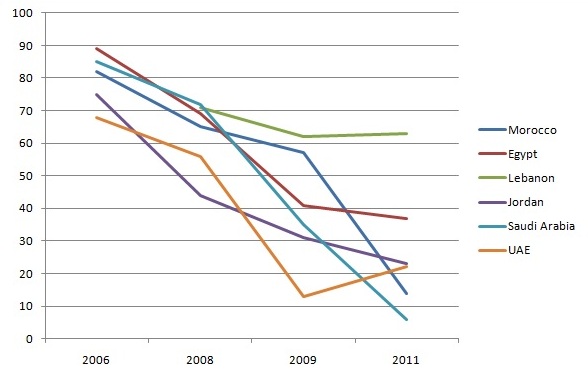
The poll further demonstrates widespread Arab concern with Iran's behavior in the region, with strong majorities in every country but Lebanon saying that Iran threatens the peace and stability of the Arab world. Special concern is expressed for Iran's role in Iraq and Bahrain, and with Iran's nuclear aspirations.
In most Arab countries (again, all but Lebanon) the overwhelming preference is for the Middle East to be a nuclear free zone. But when asked "if they had to choose one country, other than Israel, to be a nuclear power in the Middle East," the preferred choice, by a wide margin, is Egypt. Turkey is a distant second, followed by Saudi Arabia and the U.A.E. Iran is dead last, receiving little or no support from the publics in almost every Arab country.
Because there is widespread Arab concern with Iran's quest to be the region's dominant power and because its role in Iraq and elsewhere in the Gulf is viewed negatively, pluralities in most countries express support for the GCC's new assertiveness, wanting the GCC to reject Iran's push for regional dominance. Pluralities also give positive grades to the GCC's role in Bahrain and its efforts in trying to hasten an end to the conflict in Yemen and transition to a new government.
Clearly, Iran's behavior has contributed to this stunning turn-about in its fortunes in the Arab World. But there are other factors, as well. To a great degree, in the past, Iran has been able to play off of U.S. bellicosity and blunders in the region. During the Bush years, for example, there was widespread outrage at the U.S. for its invasion of Iraq, its support for Israel's devastation of Lebanon and Gaza in 2006 and Gaza, again in 2009 and the horrors committed at Abu Ghraib. Iran was able to turn that region-wide rage to its benefit, especially when the Bush administration and Israel then directed so much hostile rhetoric against the Islamic Republic.
During the past few years, the U.S. hostility to Iran's role hasn't diminished, but the dynamic in the Arab World has changed. President Obama's policy of "engagement," while falling short of its stated goals, has somewhat reduced the decibel level of the threats. And with the "Arab Spring" underway, the attention of the region has turned inward. The U.S. has become less focused on Iran, and a bit disoriented -- having to deal simultaneously with: turmoil in Pakistan, Yemen, Syria and Bahrain; a failed Israeli-Palestinian peace process; and the need to withdraw from a still deeply troubled Iraq.
In the face of all this, Iran's behavior is seen by Arab public opinion not as a counter to America's hostile domination, but as source of instability seeking to exploit troubled areas for its own gain. Add to this the Iranian regime's brutal confrontation with the Green Revolution, and whatever positive characteristics frustrated and alienated Arabs may once have attributed to the regime in Tehran have now all but evaporated.
It was once believed that it was only Arab governments that feared Iran's push for hegemony, while Arab public opinion viewed Iran quite differently. Our polling demonstrates that while that might have been true in 2006 and 2008, by 2011 this is no longer the case. Iran is not now seen through the prism of the confrontation with the U.S. and Israel. Increasingly, it is seen and judged as it is -- a country ready to exploit every opportunity to become a regional hegemon.
A cautionary note: the one thing that could upset this evolving Arab attitude toward Iran would be an Israeli or U.S. attack on that country.
Dr. James J. Zogby is the author of Arab Voices: What They Are Saying to Us, and Why it Matters (Palgrave Macmillan, October 2010) and the founder and president of the Arab American Institute (AAI), a Washington, D.C.-based organization which serves as the political and policy research arm of the Arab American-community.