Friday morning's GDP data reveal that growth in the second quarter was a little slower than we thought -- revised down to 1% from 1.3%. With 0.4% in the first quarter, that means growth in the first half of the year amounts to about 0.7%. Recall that it takes growth at trend -- about 2.5%-to just keep unemployment from rising, and you will understand my incessant clamoring for someone to do something. Like FAST!, for example.
There's another reason for the urgency. You can also see in these data the resurgence of income and wealth inequality. There's quite a lag to the inequality data, so no one knows what the trends in income or wealth disparities look like post-2008, e.g. What with high unemployment and weak middle-class earnings, along with solid corporate profits, one assumes that after taking a hit in the downturn, wealth accumulation is "back on track" as it were. That's certainly been the pattern of the last two recessions/recoveries.
Today's data provides some evidence in support of that expectation. The first figure below shows the recent trends, up through last quarter, in corporate profits and workers' compensation as a share of GDP.
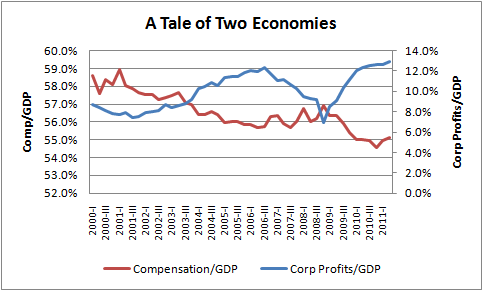
As you can see, corporate profits have not only recovered their post-recession highs, they've surpassed it. And compensation as a share of the economy is far lower. You can also compare how different these patterns look compared to last recession in 2001, when the income shifts were not nearly so sharp.
It's truly a picture of two very different economies, one for those who depend on their paychecks and one for those who depend on their portfolios. And yes, there's an intersection of those two groups -- corporate profits do not solely enrich the haves -- but that's more of nuance.
The key point remains that even at less than one percent growth, stagnant real wages, and a sharp decline in the compensation share, corporate profits have more than recovered. Clearly, these corporations are selling into emerging markets, tapping productivity gains without hiring, and trading financial instruments. Nothing inherently wrong with that, unless it's the only thing that going right in this economy. Which it kinda is.
A few weeks ago I discussed the deeply corrosive impact of such extreme wealth concentration, as it shuts down new ideas that can correct this destructive trend. And just last night, I worried that we're losing our ability to self-correct.
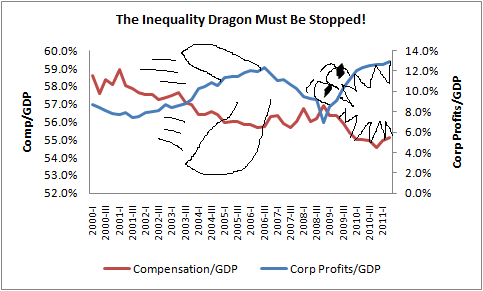
The image of the above figure should be viewed as a big, scary dragon of sorts, as in the next figure. And we must stop its flight before it devours what's great about America.
This post originally appeared at Jared Bernstein's On The Economy blog.
The enviroment is contributing to the problem.
When Dems are in power they buttress the "downtrodden" amongst us. Oftentimes the downtrodden feel inferior and perpetuate thier own "self worth" imagery based on liberal vision of their "downtroddenness" (if that is a word?).
When gop is in power they oftentimes give tax breaks in hopes that more Fed taxes will eventually "flow" from expansionary business growth. This worked for JFK and to a certain extent for other presidents; however, now is not the time this will work. Giving more cash to the businessmen means they make even more money exploiting "BRIC" nation investments.
Demonizing the "rich" for a while, and, then "demonizing" the "poor" for a while is a game we have to stop playing.
What we need now is a way to raise compensation without damaging profits or further adding to our indebted federal government. Some stimulus spending may be necessary, but our debt and deficits are already out of control. In fact, the Congressional Budget Office projects that by 2021 federal debt will be over $20 trillion (http://eng.am/nviSti).
a) Wouldn’t Wage-to-National Income be a better measure of labors share of national income than, say, Comp-to-GDP? Pre-recession research shows that it has stayed stable over the last several decades, wouldn’t that make it a non-problem?
http://papers.ssrn.com/sol3/papers.cfm?abstract_id=1121743
b) Wouldn’t you expect corporate profits to go up, in an uncertain economic environment in which Keynesian stimulus is dumped into the market allowing corporations to profit take? After all, who in their right mind would expect corporations to hire for long-term sustainable jobs, based on short-term unsustainable Keynesian stimulus? Throw in the disincentives to hire, like Obamacare, and it is certain that companies will look to do more with less.
c) You keep returning to inequality as a boogieman, but have we seen any proof that America is suffering from income inequality (wealth inequality is a nonstarter issue), even so why is it bad since another phrase for â€income inequality’ is â€meritocratic pay’ or â€effort inequality’, and finally, how would taking from the rich make either party better off?
d) Wouldn’t it be better for you to attack the poor for their contribution to a culture of poverty: poverty of effort, poverty of will, poverty of morals, poverty of individual self determination, etc?
Kai
Now, I supported Obama, but I do think he took a lot of bad advice. From one Larry Summers in particular. And took a lot of tainted money from Wall Street.
Look at how corporate profits have soared and compensation has plummeted.
We need to find an FDR to Obama's Hoover.
http://8020vision.com/2011/02/05/what-feeds-a-revolution/
What feeds a revolution?
"...Worth noting: The real US unemployment rate is about 16%, when considering the more comprehensive U6 Rate. The US has the highest income inequality of all the countries considered in the list above. The US ranks with Rwanda and Uganda. For more on that, see the recent 8020 Vision article When Does the Wealth of a Nation Hurt its Wellbeing?
I am glad Blow listed food as one of the metrics to consider. There is a proverb that governments ignore at their peril:
“Lo que separa la civilizaciĂłn de la anarquĂa son solo siete comidas.”
(Civilization and anarchy are only seven meals apart.)
—Spanish proverb..."
I will not vote for another "public criminal" this election to save my soul. The need for us to become independently supportive by grass roots foundations is the only message that the government will understand. I recommend as a nation that we do not "vote" this election, that we boycott the "election" booths, and work towards a change in the US Constitution and its amendments to reflect the changes that we the people want.
Huh?!?!?
Change the US Constitution and it's amendments by "boycotting the 'election' booths" !??!?!
Say what?!?!?
Do you even think about this stuff before you say it?
Have you ever wondered why the CPI, GDP and employment numbers run counter to your personal and business experiences? The problem lies in biased and often-manipulated government reporting.
The SGS-Alternate GDP reflects the inflation-adjusted, or real, year-to-year GDP change, adjusted for distortions in government inflation usage and methodological changes that have resulted in a built-in upside bias to official reporting.
Currently real Shadow Gov Stats (SGS) unemployment is at 22%.
The SGS-Alternate Unemployment Rate reflects current unemployment reporting methodology adjusted for the significant portion of ""discouraged workers"" defined away in 1994, during the Clinton Administration.
The BLS estimate of the U-6 unemployment rate includes discouraged workers as currently defined (discouraged less than one year). That measure is adjusted to include the SGS estimate of the long-term discouraged workers -- those discouraged for more than one year -- who no longer are included in the BLS calculations.
http://www.shadowstats.com/
Recourse to petitioning elected officials becomes a fools errand.
Emergence of populist leaders will be impossible given the technology of Black Ops Teams.
Only the masses remain to decide whether to subsist as perpetual debt slaves or flourish as free and independent worrior-citizens fighting not for their present but for their future.
If you're conjuring up millions of dollars a minute by "borrowing from oneself," sure, it's not hard to count yourself rich.
Real wealth, though, comes from and thus belongs to hundreds of millions of people, not a group of less than 750, which, if you actually stop and count them, is about the number of loudmouths we are talking about.
What is happening to 750 people doesn't matter. What's happening to 312 million others, does.
Too bad they're not your advertisers.
You can't fiat the value of labor , but you can the value of executives. Funny how that works , huh? Funny also how other countries manage to fiat labor wages to a much larger degree than we do , and yet are just as competitive internationally , even while their executives are not as richly compensated.
We have a situation where the vast majority of jobs in this country are clustered around a wage level of $15/hr , with little meaningful difference in pay above and below that level - i.e. on the order of a few bucks per hour either way - even as job descriptions and skills required vary considerably.
At the top , however , you move from $500/hr to $5000/hr to $50,000/hr in positions where job descriptions and skill are not meaningfully different , and political connections , insider information , and luck are the determining factors.
In this economy, if the profits structure is improving, and it can be done with fewer employees, employment numbers will remain unaffected.
If you can manufacture "widgets" for significantly less, you keep prices the same or slightly less, profits will rise in proportions despite the fact the the GDP not moving much. Old GDP modelling assumptions are now inaccurate from what I am seeing...