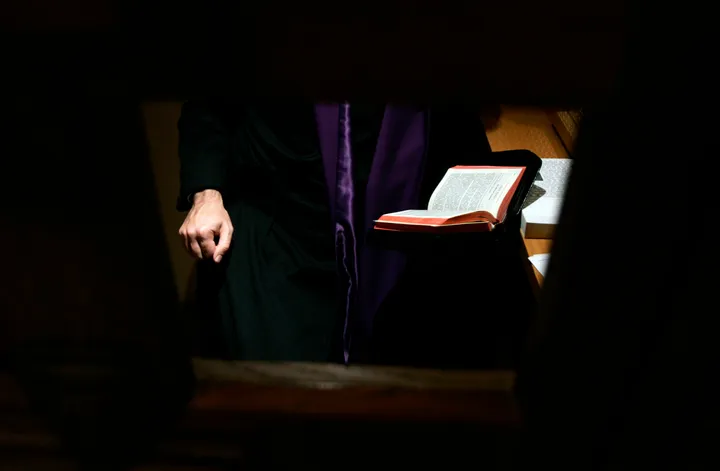
Of the many confessions I have made in my life, one will always stand out in my mind. It was Holy Thursday. I was in my early 20s. I was working as an associate at a large law firm on Wall Street, a job I had pursued relentlessly after finishing law school at a young age. Everything in life was going the way I wanted, imagined, envisioned and expected, except for one thing.
I approached the confessional with trepidation. Should I proceed to the traditional kneeler and maintain my anonymity? Or should I take a chance and encounter the priest face-to-face? I chose the latter. I entered, sat down, dispensed with the formalities and faced the 60-something-year-old priest. "Father," I said, "I'm gay."
I did not know what to expect. Fortunately, the priest was understanding and reacted with compassion. Relieved, I found myself telling him what I thought he "wanted" to hear: that my desire was to stay celibate. He listened very respectfully. As our conversation wound down, I prepared myself for the usual penance of Hail Marys and Our Fathers but instead he told me to "pray for an Easter miracle" which I took to mean to pray for my orientation to change.
That confession initiated a dialog that has continued for almost 20 years with many priests, friends, family, colleagues and acquaintances from an assortment of backgrounds who hold varying perspectives. In that time, the message I've heard from priests is that the church's issue is not homosexuality, per se; rather, the church has a highly consistent and singular approach to sexuality that encompasses all sexual expression outside of marriage, contraception and even masturbation. Since that confession, my relationship with the church has sometimes been rocky but it has also been an enduring one.
Memories of my confession flashed through my mind as I walked through the West Village amid much joy and celebration. New York's Catholic governor had just signed a marriage equality bill, a bill that would not have passed the legislature without the support of several Catholic Democratic Senators and one pivotal Catholic Republican Senator. I reflected, also, on the Father's Day blog New York Archbishop Timothy Dolan posted on June 18. In it, he asserted, "We would just as vigorously defend marriage from a demand by a heterosexual, or anybody else, to redefine the very nature of marriage to accommodate a relationship beyond that of one man and one woman." But in contemplating the presumed consistency of the words and actions of church leaders regarding gay rights, I realized this really isn't true.
Though I left the practice of law years ago to do church related work, I often approach issues that affect me personally from a legal angle, as if preparing for a trial. But after reading the Archbishop Dolan's message I found myself imagining what it would be like if I were entering that same confessional today as I did 20 years ago and the Archbishop - -or any church leader for that matter -- was my confessor. On that day almost two decades ago, my point of view was very similar to his. I embraced the seeming consistency of the Church's position. Today, as a more mature and, hopefully, wiser man, my own questions and insights regarding his and other church leaders' stances would be much more pointed.
The confessional conversation I imagined went something like this: "Archbishop, you said in your recent '60 Minutes' interview that marriage is 'one man, one woman, forever.' If marriage needs to be defended from modern adaptations, what is the church doing to outlaw civil divorce and remarriage? Where is the political mobilization to prevent avowed adulterers like Hugh Hefner and Charlie Sheen, who flout notions of marital fidelity, from obtaining civil marriage licenses? How vigorously is the church calling for constitutional amendments and voter referenda to confirm, or deny, these modern versions to an institution once considered irrevocable, eternal and exclusive?"
As the conversation progressed, I imagined asking even harder questions: "Is there any rational basis, either from the experience of states and countries where same sex marriages are legal or from peer-reviewed studies, that marriage equality has or will diminish marriages between heterosexuals? Isn't the church taking special aim at society's growing acceptance and recognition of same sex marriages and, more fundamentally, homosexuality?"
I imagine my confessor responding with concerns about children and child rearing, to which I would say, "You suggest there is not only a preference, but a right for children to be raised by a mother and a father. If that's true, why hasn't the church fought state adoption laws that allow single parents to adopt? What's more, gay couples with children exist (and will continue to exist) irrespective of whether marriages are legal or not. Denying the benefits of marriage to same-gender parents has been shown to detrimentally affect the children of these relationships but it doesn't prohibit their existence. Aren't you really arguing that gay parenthood should be outlawed?"
The Archbishop's response might then drift from "protecting marriage" to defending religious liberties against the state dictating that institutions must support behavior contrary to their religious beliefs. To which I would reply, "But it is widely understood that no priest, minister, rabbi, imam or other religious leader can be compelled to perform any marriage among any two people under any circumstance. There is zero case law under such a scenario as there is no legal basis to demand that a religious leader perform a marriage."
The archbishop responds, "If gay marriages are legal and a Catholic adoption agency that receives state funding does not want to place children in the homes of married gay couples, the agency is precluded from discriminating, thus trampling on the religious liberties of the church."
"But, Archbishop, would the church support the right of an adoption agency receiving state funding to refuse to place children with Catholic families on the grounds that it violated their consciences to do so? Would it be OK for such an agency to impose a blanket policy that it is always morally inappropriate to place a child with any Catholic family, presuming that all Catholic families are incapable of imparting the values such an agency might hold essential for the good moral development of children? Would Catholic taxpayers passively acquiesce to the use of their tax dollars by service agencies that blatantly discriminate against them? My understanding is that there were at least three confirmed cases of the Archdiocese of Boston having placed children with gay parents prior to pulling out of the adoption business altogether and the agency was compelled to articulate an actual policy which, by fiat of the local Archbishop, could not be promulgated in such a way to condone adoptions by gays and lesbians under any circumstances?"
The last line of defense would likely be the "slippery slope" argument. If we have same sex marriage, what comes next? People marrying their pets, as Brooklyn Bishop Nicholas DiMarzio has suggested? Bigamy? Polygamy?
Putting aside, for a moment, the inability of animals to form consent, a principal component of any valid contract, I would respond by distinguishing between behaviorial and status-based identity. One cannot be bigamous or polygamous without being in a bigamous or polygamous relationship. One can be gay irrespective of whether or not he or she engages in sexual behavior -- as many religious and non-religious people can attest -- and even if he or she is in a heterosexual relationship. Accordingly, prohibitions against bigamy and polygamy may be applied equally, irrespective of status-based orientation, while prohibitions against marriage discriminate on the basis of an immutable status.
All of this would lead our confessional conversation back to my original question: "Why is the church throwing scarce financial resources at fighting same sex marriage and not at other challenges to more traditional notions of marriage if, in fact, all are of equal concern to the church? Do you expect that by prohibiting gay marriages there will be fewer gay people? Will perpetuating disapproval of gay relationships stop people from being gay? Is homosexuality a contagion that needs to be circumscribed with societal disapproval? And if we accept, as science, medicine, psychiatry and even church leaders have concluded, that homosexuality is something that is neither chosen nor changeable, how will the denial of marriage benefits to gay couples serve to advance heterosexuality?"
Needless to say, my imaginary confession would probably not end as satisfyingly as my real encounter 20 years ago. In the intervening years, I've come to understand that the Easter miracle my original confessor asked me to pray for was not for God to change my orientation but for my ability to embrace who God created me to be. If I were given the same penance in my imagined encounter today, I can only conclude that would not be what the Archbishop intended. Fortunately, it's too late. That miracle has already occurred.
This column original appeared in CathNewsUSA.
John Mattras is a micro-credit financier and advocate who also organizes service projects and religious pilgrimages. He may be reached by email at john@franciscanspirittours.com.