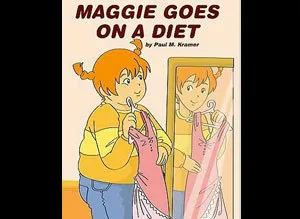
No, this is not an after school special on eating disorders; it's the cover of a (disturbing) new children's book with the (possibly more disturbing) title, Maggie Goes on a Diet. And, this will be in bookstores October 16.
The Amazon description of Paul M. Kramer's self published book reads:
This book is about a 14 year old girl who goes on a diet and is transformed from being extremely overweight and insecure to a normal sized girl who becomes the school soccer star. Through time, exercise and hard work, Maggie becomes more and more confident and develops a positive self image.
In the land of hypothetical, there could be some rationale behind the plot.
Teaching kids to make healthy lifestyle choices from an early age is a worthy endeavor (one that first lady Michelle Obama has taken on as her own), and childhood obesity is a serious public health issue nationwide. According to the CDC, approximately 17 percent of children and adolescents are obese in the United States, over triple the rate a generation ago.
But Maggie isn't looking at an imagined reflection of herself dominating the soccer field. For this little girl, it's all about the dress. The book is promoting skinny first, with a side of healthy slipped in later.
Just as childhood obesity is on the rise, eating disorder rates are climbing, and affecting younger and younger kids. Last year, the American Academy of Pediatrics reported a 199 percent increase in the number of eating disorder-related hospitalizations for children under the age of 12 between 1999 and 2006. A 2011 study found that nearly one in 60 adolescents has anorexia, bulimia or binge eating disorder. Over half of little girls aged 3 to 6 think they are fat.
Disturbing, yes. Surprising? With infant's onesies that were selling for $23.95 that read, "Nothing tastes as good as skinny feels," unfortunately not.
Follow Laura Stampler on Twitter: www.twitter.com/laurastampler
Laura Collins Lyster-Mensh: Why Maggie's Diet Is a Bad Idea
Jowita Bydlowska: Little Girls Wearing Bras
Anything that gets kids to leave the computer/cell and become more social through activity, is a positive message.
We have lost our way -- thank you, corporate America -- and kids are paying the price...because "real" food is considered laboratory substances. It's over, Holmes...
For example, I didn't know what an eggplant or head of spinach was until I was 17---- because mom never cooked it. With a book like Frujunga Gets Spiced, children learn to question various fruits and veggies their parent may have never introduced. If more parents learn to choose more wisely about what foods are prepared for meals, --- kids will learn to live better by parent example.
Out of a child's curiosity for taste, their parent may begin to add more healthy varieties to the table. The book, Frujunga Gets Spiced, educates children using positive characters like Applelue, Banana Anna an so on. Check out the link below:
http://www.amazon.com/s/ref=nb_sb_ss_i_0_20?url=search-alias%3Daps&field-keywords=frujunga+gets+spiced&x=0&y=0&sprefix=frujunga+gets+spiced
This book does exactly that, for not only is weight made to be important, but it's the catalyst for the girl to lead a successful life.
I'm not denying the fact that the obesity epidemic is rampant, and it needs to be solved. But for the last 10 years we have been telling people the very simple message of "eat less and exercise more," yet the obesity rates continue to rise. Perhaps we need to think about what our messages about this - what are we saying to the obese that encourages this behavior? Could it be that our "helpful" comments telling them to lose weight are actually hurting them?
"Those with healthy BMIs simply had parents who would cook healthy, balanced meals for them and then let them eat what they choose."
Of course. That's why kid's "hear less comments" from their families; there's nothing to comment on, as they're already healthy!
"Those who had problems with their weight (either too much or too little) were surrounded by people who made a big deal about their size."
That's because the majority of these kids' parents don't "cook healthy, balanced meals for them". Hence why, when they obviously gain weight, they hear more comments.
"But for the last 10 years we have been telling people the very simple message of "eat less and exercise more," yet the obesity rates continue to rise."
The message is simple because it's the truth. The problem isn't the message, the problem is people AREN'T doing it, THAT'S why obesity rates are rising. Like you said, parents who cooked healthy meals for their kids had "healthier BMIs". Of course comments don't work, eating healthier does. Therefore, we know that "eat less" works and it's the right message, but people just aren't doing it for a plethora of reasons.
http://rajpatel.org/2009/10/30/obesity-and-moral-panic-in-the-guardian/
http://www.scidev.net/en/opinions/obesity-researchers-must-understand-how-capitalism.html
http://rajpatel.org/2009/11/02/obesity-researchers-need-to-understand-capitalism/
one lot fed me chocolate and the other put me on a diet [ different relatives and foster parents ]
in some ways the worst though was my mother buying me a corset when i was11 or 12 or so to make me look more contained.
that really got to me. as if i hadn't felt ugly and different enough.
so i tread gently with my daughter.
That was not necessarily the case. For some, they did have higher weights when they were younger, despite the fact that parents cooked healthy foods for them. The issue was that when their weights were not so healthy, no one said anything about getting healthy or changing behaviors. Those that were surrounded by families that had "rules" about what they could and could not eat (i.e., healthy foods vs unhealthy foods) ended up not being so healthy has women.
"The message is simple because it's the truth. The problem isn't the message, the problem is people AREN'T doing it, THAT'S why obesity rates are rising. Like you said, parents who cooked healthy meals for their kids had "healthier BMIs". Of course comments don't work, eating healthier does. Therefore, we know that "eat less" works and it's the right message, but people just aren't doing it for a plethora of reasons."
Yes, but the issue is WHY people aren't doing it. From my research, I found that one of the reasons why is that weight is more than behavioral. While behavioral components are definitely involved (i.e., eat less and exercise more), there are cognitive and affective issues at work here that prevent people from doing it. Yes, the message is true, but if we only focus on one aspect obesity, we are missing the mark.
"Those with healthy BMIs simply had parents who would cook healthy, balanced meals for them".
Therefore it would naturally be gathered that "those" with "unhealthy BMIs" didn't. Regardless of your study, I think it's safe to say that this is the case with the majority of families who are obese in today's society.
That said, I think the problem is that we're coming at it from 2 different angles. I'm looking at it from a more "preventative, proactive" angle, and you're looking at from a more reactive "standing in the middle of the problem," angle. Therefore, I still firmly believe that the message "diet and exercise" rings true, it's just begin praticed too late, when "Maggie's" parents have let her become obese before doing something about it. It is impertive that we instill this message from the get go in families, BEFORE the host of "behavioural", "cognitive" problems arise from said not practising aforementioned "diet and exercise".
It breaks my heart to imagine a little girl receiving this book from her parents and putting two and two together. Instead of putting your children on a diet, encourage them to lead a healthy life style. If they are chubby, LOVE THEM AS THEY ARE. If they love themselves, hopefully they will have the confidence and mental health required to lead a healthy lifestyle.