iPhone app iPad app Android phone app Android tablet app More

Featuring fresh takes and real-time analysis from HuffPost's signature lineup of contributors
Lawrence Lessig

Lawrence Lessig

GET UPDATES FROM Lawrence Lessig

An Open Letter to North Carolina Gov. Bev Perdue: Support Community Broadband

Posted: 05/20/11 06:09 AM ET

Dear Governor Perdue:

On your desk is a bill passed by the overwhelmingly Republican North Carolina legislature to ban local communities from building or supporting community broadband networks. (H.129). By midnight tonight, you must decide whether to veto that bill, and force the legislature to take a second look.

North Carolina is an overwhelmingly rural state. Relative to the communities it competes with around the globe, it has among the slowest and most expensive Internet service. No economy will thrive in the 21st century without fast, cheap broadband, linking citizens, and enabling businesses to compete. And thus many communities throughout your state have contracted with private businesses to build their own community broadband networks.

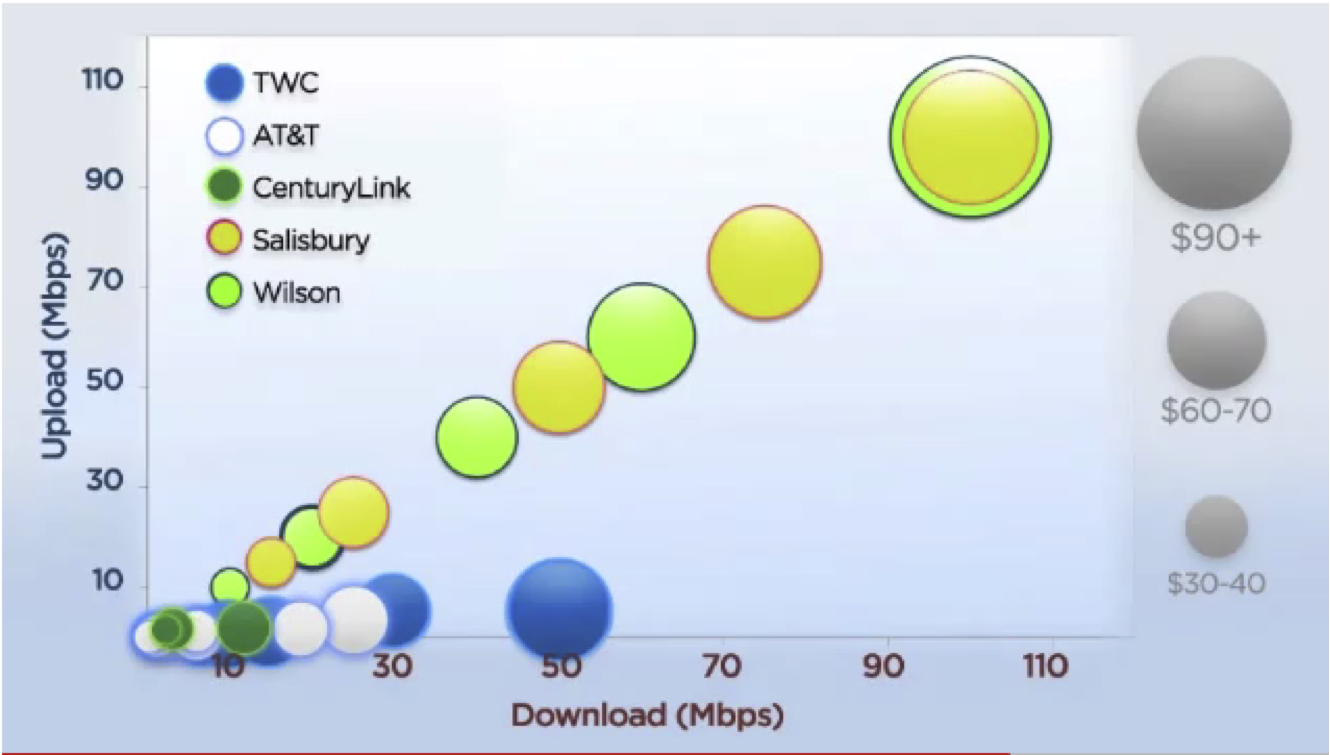
These networks have been extraordinarily effective. The prices they offer North Carolinians is a fraction of the comparable cost of commercial network providers. The speed they offer is also much much faster.

This single picture, prepared by the Institute for Local Self Reliance, says it all: The yellow and green dots represent the download (x-axis) and upload (y-axis) speeds provided by two community networks in North Carolina. Their size represents their price. As you can see, community networks provide faster, cheaper service than their commercial competitors. And they provide much faster service overall.
2011-05-20-broadbandgraph.png

Local competition in broadband service benefits the citizens who have demanded it. For that reason, community after community in North Carolina have passed resolutions asking you to give them the chance to provide the Internet service that the national quasi-monopolies have not. It is why businesses from across the nation have opposed the bill, and business leaders from your state, including Red Hat VP Michael Tiemann, have called upon you to veto the bill.

Commercial broadband providers are not happy with this new competition, however. After spending millions in lobbying and campaign contributions in North Carolina, they convinced your legislature to override the will of local North Carolina communities, and ban these faster, cheaper broadband networks. Rather than compete with better service, and better prices, they secured a government-granted protection against competition. And now, unless you veto H. 129, that protection against competition will become law.

Opponents of community broadband argue that it is "unfair" for broadband companies to have to compete against community-supported networks. But the same might be said of companies that would like to provide private roads. Or private fire protection. Or private police protection. Or private street lights. These companies too would face real competition from communities that choose to provide these services themselves. But no one would say that we should close down public fire departments just to be "fair" to potential private first-responders.

The reason is obvious to economists and scholars of telecommunications policy. As, for example, Professor Brett Frischmann argues, the Internet is essential infrastructure for the 21st century. And communities that rely solely upon private companies to provide public infrastructure will always have second-rate, or inferior, service.

In other nations around the world, strong rules forcing networks to compete guarantee faster, cheaper Internet than the private market alone would. Yet our FCC has abdicated its responsibility to create the conditions under which true private broadband competition might flourish in the United States. Instead, the United States has become a broadband backwater, out-competed not only by nations such as Japan and Korea, but also Britain, Germany and even France. According to a study by the Harvard Berkman Center completed last year, we rank 19th among OECD countries in combined prices for next generation Internet, and 19th for average advertised speeds. Overall, we rank below every major democratic competitor -- including Spain -- and just above Italy.

In a world in which FCC commissioners retire from the commission and take jobs with the companies they regulate (as Commissioner Baker has announced that she will do, by joining Comcast as a lobbyist, and as former FCC Chairman Powell has done, becoming a cable industry lobbyist), it is perhaps not surprising that these networks are protected from real competition.

But whether surprising or not, the real heroes in this story are the local communities that have chosen not to wait for federal regulators to wake up, and who have decided to create competition of their own. No community bans private networks. No community is unfairly subsidizing public service. Instead, local North Carolina communities are simply contracting to build 21st-century technology, so that citizens throughout the state can have 21st-century broadband at a price they can afford.

As an academic who has studied this question for more than a decade, I join many in believing that H.129 is terrible public policy.

But it is as a Democrat that I implore you to take a stand on this issue, and veto this bill.

Many of us Democrats have been enormously disappointed by the failure of our party to stand for principles that matter. There's always an excuse for ducking a fight -- which it seems only our side ever sees. Ideologues on the far right have radically remade public policy throughout the nation, while moderates and progressives keep their heads low. And many of us are now embarrassed to even read the slogan that earned the Democratic Party the presidency and control of Congress in 2008 -- "Change you can believe in." The only real change that we have seen is in the extraordinary effectiveness of the far right to define the nation's agenda and, though a minority party, force it upon the nation. And when the far right aligns with the endless stream of corporate lobbying and campaign cash, it seems that there is no issue that the majority of citizens can actually prevail upon.

Be a different kind of Democrat, Governor Perdue. I know you've received thousands of comments from citizens of North Carolina asking you to veto H.129. I know that given the size of the Republican majority in the legislature, it would be hard for your veto to be sustained.

But if you took this position of principle, regardless of whether or not you will ultimately prevail, you would inspire hundreds of thousands to join with you in a fight that is critical to the economic future of not just North Carolina, but the nation. And you would have shown Republicans and Democrats alike that it is possible for a leader to stand up against endless corporate campaign cash.

There is no defeat in standing for what you believe in. So stand with the majority of North Carolina's citizens, and affirm the right of communities to provide not just the infrastructure of yesterday -- schools, roads, public lighting, public police forces, and fire departments -- but also the infrastructure of tomorrow -- by driving competition to provide the 21st century's information superhighway.

With respect,

Lawrence Lessig


To contact the governor, you can email her. If you're from North Carolina, this link will take you to a tool to call the governor's office. You can follow this fight on Twitter at @communitynets
You can follow similar fights on Twitter by searching #rootstrikers.


Follow Lawrence Lessig on Twitter: www.twitter.com/lessig

Dear Governor Perdue: On your desk is a bill passed by the overwhelmingly Republican North Carolina legislature to ban local communities from building or supporting community broadband networks. (H.
 
 
  • Comments
  • 221
  • Pending Comments
  • 0
  • View FAQ
Comments are closed for this entry
View All
Favorites
Recency  | 
Popularity
Page: 1 2 3 4 5  Next ›  Last »  (5 total)
08:09 PM on 05/22/2011
Why don't you people who want broadband pay for it yourselves. I'm already taxed too much.
12:44 PM on 05/23/2011
They are paying for it themselves. So are you. You seem to prefer paying more to get less.
08:02 PM on 05/22/2011
Thank goodness for the NC legislature. The government has no business in the broadband business--They want another excuse to tax us and control us.
This user has chosen to opt out of the Badges program
photo
10:09 PM on 05/22/2011
You seem to want the people informed only according to their purchasing power. That would serve the anti-intellectual movement and right wing ideology, not society.
HUFFPOST SUPER USER
xanas
libertarian, voluntarist, anarchist
06:08 PM on 05/22/2011
I have no problem with the idea of internet services which are paid for voluntarily through charitable donations or people agreeing to pay for a common cause. But the moment you force some people to pay against their will there is no high ground to talk about the supposed evils of quasi-monopolies.

I don't like the bill, but neither am I a fan of public services. "Public" police enforce laws for actions which don't infringe upon the rights of others such as drug laws. "Public" schools mandate one-size-fits-all education and feed children pro-state propaganda.

Services can be cheaper if they are voluntary because there is still individual incentive (insofar as the the members are voluntarily choosing to pay, if they don't like the service they can not pay and choose another provider or no provider at all).

They can even be cheaper if they are involuntarily, but this is because they are subsidized by people who aren't really interested in using the service but are still forced to pay for it. Additionally, these services temporarily gain the benefits of laborers that have worked in the free market and thus carry over the same customer service skills and attitude.

Over time, incentives that come from government-provided services lead to workers with a sense of entitlement. Because they don't answer to individuals (since everyone is forced to pay), those persons who have an issue cannot expect resolution for it if it doesn't affect the right people.
HUFFPOST SUPER USER
samtee
Shankapotomus.
09:50 AM on 05/22/2011
She's history the next election anyway, she just vetoed a bill for teachers to pay $11.00 for their health insurance and the people are p'ed at here and she vetoed the repeal of Obamacare 2 days after she met with Obama after she had already told the state she wouldn't.
photo
HUFFPOST SUPER USER
SickHippie
No, YOUR micro-bio is empty.
04:16 PM on 05/22/2011
But if it's not vetoed now, it will be law and it will take years to repeal - if you're even able to with the amount of cash flowing right now.
08:03 PM on 05/22/2011
You need to look at the retirement system in NC. Some pensioners are receiving 200,000 per year.
nbb
332-206
04:57 AM on 05/22/2011
Perdue disappoints more than she does the stand-up thing. I will be pleasantly surprised if she comes through with the veto.
08:23 PM on 05/21/2011
I guess this is the opposite of a 'pocket veto.' By doing nothing, Perdue's non-action speaks volumes. She has really tipped her hand on what we can expect from her on the rest of the draconian teapublican agenda in NC. Of course we all know she is a blue dog political animal positioning herself for re-election by being pro-corporate. She does not deserve re-election, but the alternative sucks worse. Way worse..
This user has chosen to opt out of the Badges program
photo
Ma Lucille
a crack ~ that's how the Light gets in
07:56 PM on 05/21/2011
I live in rural NC, my small business ATT wireless bill runs slightly under $500 a month. Right now my blackberry has 2 out of 5 bars of signal & my netbook has 1.
This user has chosen to opt out of the Badges program
12:45 PM on 05/22/2011
I live in a rural community in arizona, and the local mini-mart gas prices are about 10% than in the nearest town and maybe 15% higher than in the nearest city, and I get poor cell phone reception as well. But isn't that an aspect of living 'rural'? Do I have some 'right' to have those in the city to subsidize my services? You make it sound like all these things are part n parcel of your rights as an american citizen... sorry.
02:48 PM on 05/22/2011
>> You make it sound like all these things are part n parcel of your rights as an American citizen... sorry
03:23 PM on 05/22/2011
Um, actually, when folks in a local community band together to provide for themselves and their children the speedy and efficient delivery of information, then yes, this truly IS a right of theirs! Last I checked, that's a prerequisite for a healthy democracy. It's also good for attracting and keeping businesses. They're talking about situations where the vendors either did not want to provide service, or the service was sub-standard. Go back and look at the chart. By providing their own broadband, they did a better job, for less cost to the consumer. I believe this says a great deal about the efficiency and ingenuity of the corporations in this field.

Did you notice I said "local"? This is an issue of LOCAL government, not big gubmint'. And why do you think these folks want to do this anyway??? In this day, when budgets are being slashed and staffs are being reduced, do you think folks in local government WANT to go out and undertake such a project? You need to ask yourself ... "Just how SORRY does service have to get before a bunch of local officials take it upon themselves to research, study, plan, organize, and implement such a project"?

As for me, I'm for informed, participatory rural communities. And I'm willing to sacrifice the profits of indifferent, middling corporations to achieve this.
HUFFPOST SUPER USER
dustbunny44
05:22 PM on 05/21/2011
Equally troubling is her quote in the local paper:
'The governor said there is a need to establish rules to prevent cities and towns from having unfair advantage over private companies."

If people truly believe that then democracy is over. Let's sign our property and power over to corporations and get it over with.
photo
HUFFPOST SUPER USER
jabailo
(Participant) Texeme.Construct()
01:51 PM on 05/21/2011
Rural is best, and most easily served by Wimax.

Clear, a private nationwide wimax ISP, can cover 30 square miles with a single tower.

So, many small towns and agricultural areas can be covered without expensive wires, cables or fibers having to be laid.

And wimax is true 4G.
This user has chosen to opt out of the Badges program
01:00 PM on 05/22/2011
if its so inexpensive, the why haven't companies done it? I would gather that it might be less expensive than running wires, except there are also many less people so the price per person ends up being more, so much so that companies probably figure that the folks won't pay for the service. Which means that, again, you are advocating for 'others' to pay for these services (through subsidy) for the rural areas.
12:46 PM on 05/23/2011
They have done it, and it is a huge profit center. That is why they are fighting so hard against community networks.
08:05 PM on 05/22/2011
It's not right for the taxpayers to be forced to pay for broadband.
photo
HUFFPOST SUPER USER
Tanker10a
Retired Aviator
09:45 PM on 05/23/2011
Point well taken when I look at my monthly TWC bill to realize the enormity of taxes and fees that are levied upon us as consumers...it's sickening to realize that we have reached such an impasse as far as not potentially having a viable choice in this.
12:30 PM on 05/21/2011
Why does this sound suspiciously like the same line of reasoning that led to ObamaCare for health care?
photo
HUFFPOST SUPER USER
librldem
Snarking for Merika n jebus! Glory!
11:54 PM on 05/21/2011
what?!
12:17 AM on 05/22/2011
The whole dispparaging of private enterprise as being somehow intent to stick it to the consumer. The notion that government (and only Big Gov) can rectify the situation by legislative action. The still unexplained manner the legislative requirements will be funded. The shortsightedness that will be evidenced when, if this idea become fact, the Bandwidth is overburdened, cause frequent crashes because everyone can access it.

Yep, sounds a LOT like the whole mess of Obamacare.
photo
HUFFPOST SUPER USER
ZeraLee
A Citizen's View from Main Street
08:05 AM on 05/21/2011
The Internet is the "Post Road" of the 21st century. The productivity, competitiveness, and future prosperity of this country require easy and wide-spread access to high-speed broadband.

The corporate opposition of local broadband is a clear sign that the free market is a myth, and all the conservative praise of capitalism is a fraud.
07:23 AM on 05/21/2011
North Carolina isn't a "overwhelmingly rural state". While there is still a large rural population, the majority of people lives in urban areas and its economy is overwhelmingly dependent on activities from the urban areas of Charlotte, Asheville, Raleigh, Durham, Chapel Hill, Wilmington, Greensboro, High Point and Winston Salem. Please get your facts right before you go around trying to get involved in other people's business.
08:25 PM on 05/21/2011
Your comment indicates that you have totally missed to point.
photo
HUFFPOST SUPER USER
librldem
Snarking for Merika n jebus! Glory!
11:55 PM on 05/21/2011
So did none of his fans also too!!!LOL
07:23 AM on 05/25/2011
I was basically commenting on his deceiving stereotypes in trying to push a picture of a poor, rural southern state in need of government subsidies to become modern. I won't get in the actual law he's criticizing and, based on his comments, didn't read or really understand. The law doesn't prohibit community broadband or even government broadband. It just disallows taxpayer subsidized broadband. While there are worse subsidies in the world, his article was extremely deceiving and partial to his social agenda.
nbb
332-206
04:53 AM on 05/22/2011
Taken county by county, of the 100 in NC, there's much more square mileage that can be deemed rural than urban. There is an urban corridor that runs down the center Piedmont of the state. It's a push to call Asheville urban.
07:18 AM on 05/25/2011
What you just said applies to pretty much every state - I wouldn't be surprised that it applied even to California. According to 2000 numbers, 60% of the population in NC live in urban areas, and it's certainly significantly higher now, 11 years later, with the major influx of people from other states into NC. There is no question NC has large rural areas, but the article's characterization uses stereotypes to try to paint a picture of a struggling rural state trying to enter the 21st centruty through government subsidized Internet.
This user has chosen to opt out of the Badges program
photo
03:14 AM on 05/21/2011
'We The People' need to start [petition's] in every state to demand Broadband or Wi-Fi and place them on the roof of our government buildings. This would not only be a symbol of who these politicians work for but what our people deserve.
photo
HUFFPOST SUPER USER
Sheldon archer
Facebook name is Yuyun Archer
07:57 AM on 05/21/2011
Sorry, you are too late. It is now "We the Corporations..."
This user has chosen to opt out of the Badges program
photo
Ma Lucille
a crack ~ that's how the Light gets in
08:04 PM on 05/21/2011
thanks to the Supreme Court
Michael Norkus
Boring Moderate & All Around Shy Guy
01:29 AM on 05/21/2011
So big companies don't find it cost effective to create infrastructure for these customers, but this bill would make it illegal for these customers to take initiative and contract someone to create a network for them?
So...they just don't get internet then? They're simply stuck in the last century? Basic logic would suggest that this is the exact opposite of what these representatives' constituents would want.

More disappointing: 19th in Internet Worldwide?
photo
HUFFPOST SUPER USER
kfodom
02:27 PM on 05/22/2011
F&F.
kenergy599
banned for speaking my mind
12:21 AM on 05/21/2011
Good commentary Mr. Lessig