
 From the fantastic public transportation system to the exploding Toyota Prius sales to the eco sex clubs and streets without a lick of trash, Japan is a formidable force on the green front. But after a 20-day trip, four social norms stuck out that made me go WTF? And wonder if pledges for extremely ambitious greenhouse gas emission cuts are realistic.
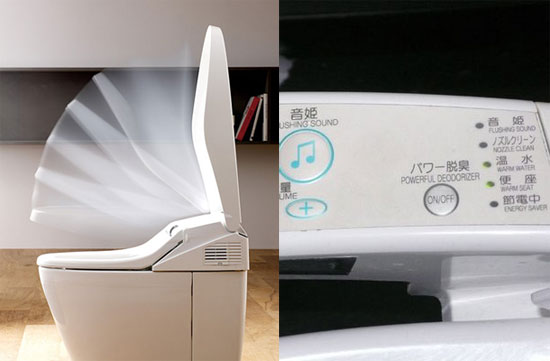
Photo left via International BS Blog. Photo right via Design Linguist.
1. The Washlet: Toilets With Super Powers
In Japan, more than 70 percent of homes come with a Washlet, what The Economist dubs "the Lamborghini of lavatories, the Cadillac of commodes." This toilet, from Japanese bathroom manufacturing giant Toto, is teched-out with energy-sucking options including automatic lid opening, warm water washing, heated seats, drying, and noise to cover your, um, noise--ranging from chirping birds to gurgling waterfalls. Surprisingly, energy consumption aside, the Washlet may actually save water, and not just because it is low-flow: "Japanese girls are really shy," a native explained, "and without background noise, may flush three-four times with one go."
2. Air-Conditioned Outdoor Spaces
We've already covered Japan's shocking "air conditioner in a can," but what's really over-the-top and un-TreeHugger in this country is how often cold air is blasted in spaces open to the outside. It's not uncommon to see air-conditioned storefronts completely open to the street, and, unlike on New York's lovely MTA, you can arrive at the office without breaking into a sweat, thanks to chilled air flowing out like there's no energy crisis over entire subway platforms.
3. Packaging...and More Packaging
A plastic bag ban has clearly not hit this East Asian island country. Even small, measly items like a pack of gum can be double- or triple-bagged, unless you say "fukuro wa irimasen" (I don't need a bag)...or just shake your head frantically.
4. A Gift Giving Culture
Speaking of packaging: Presents (temiyage) in this country are given at the drop of a hat. While it is admittedly touching to discover that even the chef of a sushi restaurant may suddenly break down bowing and give you a sample of seaweed snugly cushioned in pink tissue paper, Japan takes gift-giving to a whole new level. In fact, it is considered seriously impolite to go to someone's house without a gift in hand. Unfortunately, while gifts don't have to be expensive, they are all expected to be beautifully wrapped.
Clearly, the U.S. has its own set of absurdly wasteful social norms. Yet it's interesting to note what is a priority in one country is considered unnecessary or downright excessive in another. Chirping toilets aside, we've got to change ourselves, and our ideologies to make a difference in this battle.
More From TreeHugger and Planet Green on Japan
Japan's Election On Sunday: Massive Win For Opposition, How About Green Policies?
Air Conditioner in a Can from Japan
Youtube Japan Goes Green On World Environment Day
More From Mairi Beautyman on Huffington Post
Anti-fungal Drugs Could Save Endangered Frogs Around the World
Hurry Up and Kill the CD Already
Creators of the Hydrogen 'Urban Car' Attempt to Crush Hydrogen Car Challenges
Germans and Their Scornful View of Tap Water
Could You Live Without a Refrigerator?
The Octuplets and their Massive Carbon Footprint: 30,400 Disposable Diapers and Counting