
At the recent TEDWomen conference in Washington D.C., one of the presenters was Dr. Deborah Rhodes, an internist who has become a leader in assessing breast cancer risk. She delivered her talk in quiet and measured tones. Her passion and intensity underscored her commitment to a new diagnostic tool she has developed with a group of colleagues. Rhodes became immersed in the challenge of how to effectively detect breast tumors in women with dense breast tissue when one of her pregnant patients, in her forties and with a family history of breast cancer, asked her for an honest appraisal of the odds of finding a tumor in its early stages.
Rhodes understood that for women with dense breast tissue, "the mammogram doesn't work well at all." In fact, as she wrote to me via e-mail, "Breast tissue density poses a higher risk for breast cancer than having a mother or sister with the disease, but nine out of 10 women don't know this -- or how dense their breast tissue is."
Breast density is genetically determined. Rhodes qualifies it as the "culprit" for inadequate readings of mammograms. She explained that two-thirds of women in their forties have dense breast tissue. If a mammography cannot detect the early onset of cancer in one out of six women in the age range of 40-49, this is a major issue. Although breast density usually declines as a woman ages, up to one-third of women retain breast density for years after they reach menopause.
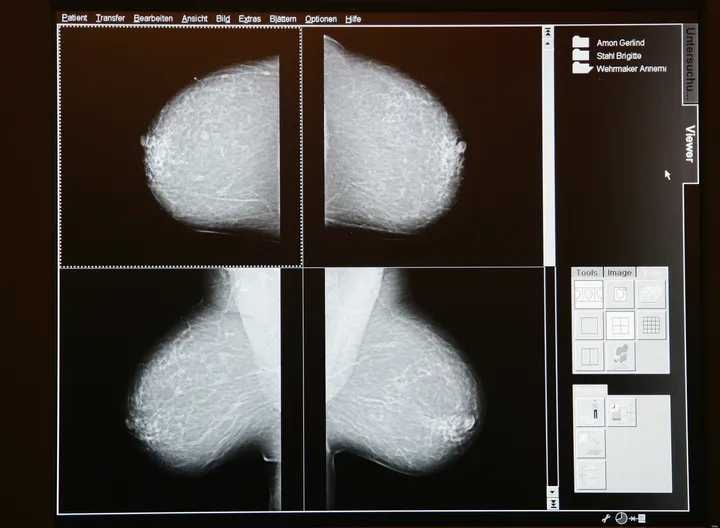
How important is it for women to know about their breast density? Very. You can learn this information from your mammogram report. Rhodes showed slides that illustrated the four categories of breast density. There are two groups who are at greater risk for not having a tumor detected. They are those in the heterogeneously dense group (51-75 percent density) and those in the extremely dense group (over 75 percent density). Both tumors and dense breast tissue appear as white on mammograms. For those with fatty breasts there is an 80 percent probability of finding a cancer, as opposed to the 40 percent likelihood of finding a cancer in a dense breast.
There has been little change in the field of mammography since the 1960s other than the development of digital mammography -- which is still an x-ray of the breast. Ultrasound is used, as are MRIs --which are costly.
The aha moment for Rhodes came when she was introduced to Michael O'Connor, a nuclear physicist. He told her about gamma technology. Gamma rays are not affected by breast density. Rhodes and O'Connor, along with a core hub of two radiologists and a bio-medical engineer, have formed the Molecular Breast Imagery (MBI) Research Team at Mayo Clinic. They are currently working on a "dual-head" gamma camera that can detect tiny tumors in dense breast tissue.
For imaging, a patient receives an intravenous injection of a radiotracer, which is then picked up by tumorous cells. Rhodes explained, "MBI exploits the different molecular behavior of tumors" which is unaffected by breast density. In addition, unlike the traditional mammogram, the MBI delivers "light pain free compression."
With chances for a cure dropping off as the size of a tumor increases, finding a tumor at one centimeter gives a patient a 90 percent chance for successful treatment. The work that Rhodes and her group are doing got them a major nod in 2004, when they received a grant from the Susan G. Komen Breast Cancer Foundation. They were funded to study 1,000 women with dense breast tissue, and compare the results with mammography. (The women chosen were already in the Mayo Clinic system.) With mammography, 25 percent of cancers were detected; with MBI, the result was 83 percent. A combination of the two yielded a 92 percent detection rate.
Concentrating on lowering the radiation dose, they have achieved using an amount that is "equivalent to the effective dose from one digital mammogram." With this reduction, they have moved forward with their screening study. Rhodes showed an example of how a 67-year old woman who had received a clean bill of health with a digital mammogram was found to have a 3.7-centimeter tumor with an MBI.
Getting their findings published in the January 2011 issue of the Journal of Radiology has helped them gain traction and exposure in the larger medical community. Now they need to finalize the screening studies using the low dose. Protocol demands that the study has to be "replicated" at other institutions. That could encompass a period of five or more years.
Although the MBI unit has been FDA approved, it is still not widely available. Rhodes referenced "economic and political forces," in addition to the science, as contributing factors.
While this technology is continuing to be advanced, Rhodes recommended the following guidelines to women:
•Know your breast density (only the state of Connecticut has mandated that
women receive notification of their breast density after taking a mammogram).
•If you are pre-menopausal, try to schedule your mammogram during the first two weeks
of your menstrual cycle, when breast density is relatively lower.
•If you notice a persistent change in your breast, insist on having additional imagery
screening.
•Have a mammogram every year for women with dense breasts 40 and older.
Via e-mail, Rhodes also expressed what she considered four important features to consider when developing a screening technique that is "well suited to women with dense breasts."
They are:
1. It has to be better than what we have (mammography -- which
works beautifully in women who don't have dense breasts, but
much less well in women with dense breasts).
2. It cannot generate too many unnecessary biopsies.
3. It has to be safe and comfortable (not too much radiation, adverse
reactions, etc).
4. It has to be affordable.
Rhodes advised that women with dense breasts should discuss all options with their doctors. For those specifically with "at risk factors" for breast cancer, Rhodes suggested exploring if they are eligible for a breast MRI, which has a higher rate of sensitivity. She pointed out that not only is an MRI expensive, but that most insurance carriers require that patients meet specific criteria (Typically 20 percent or greater estimated lifetime risk of developing breast cancer).
A strong believer in women's self-empowerment through learning about their breasts, she wrote, "I think it is important for women to understand the limitations of a test that they are having year after year -- so we can collectively advocate for developing [such] an alternative."
Rhodes ended her talk at the conference with a final reference to her patient, whose child was now in middle school. After losing her sister to breast cancer, she made the choice to have a prophylactic mastectomy. Rhodes concluded, "We can and must do better."
This article originally appeared on the women's health site Empowher.