The discovery that many people with life problems or occasional bad moods would willingly dose themselves with antidepressants sailed pharma through the 2000s. A good chunk of pharma's $4.5 billion direct-to-consumer advertising has been devoted to convincing people they don't have problems with their job, the economy and their family, they have depression. Especially because depression can't be diagnosed from a blood test.
Unfortunately, three things dried up the depression gravy train for pharma. Blockbusters went off patent and generics took off, antidepressants were linked with gory and unpredictable violence, especially in young users, and they didn't even work, according to medical articles.
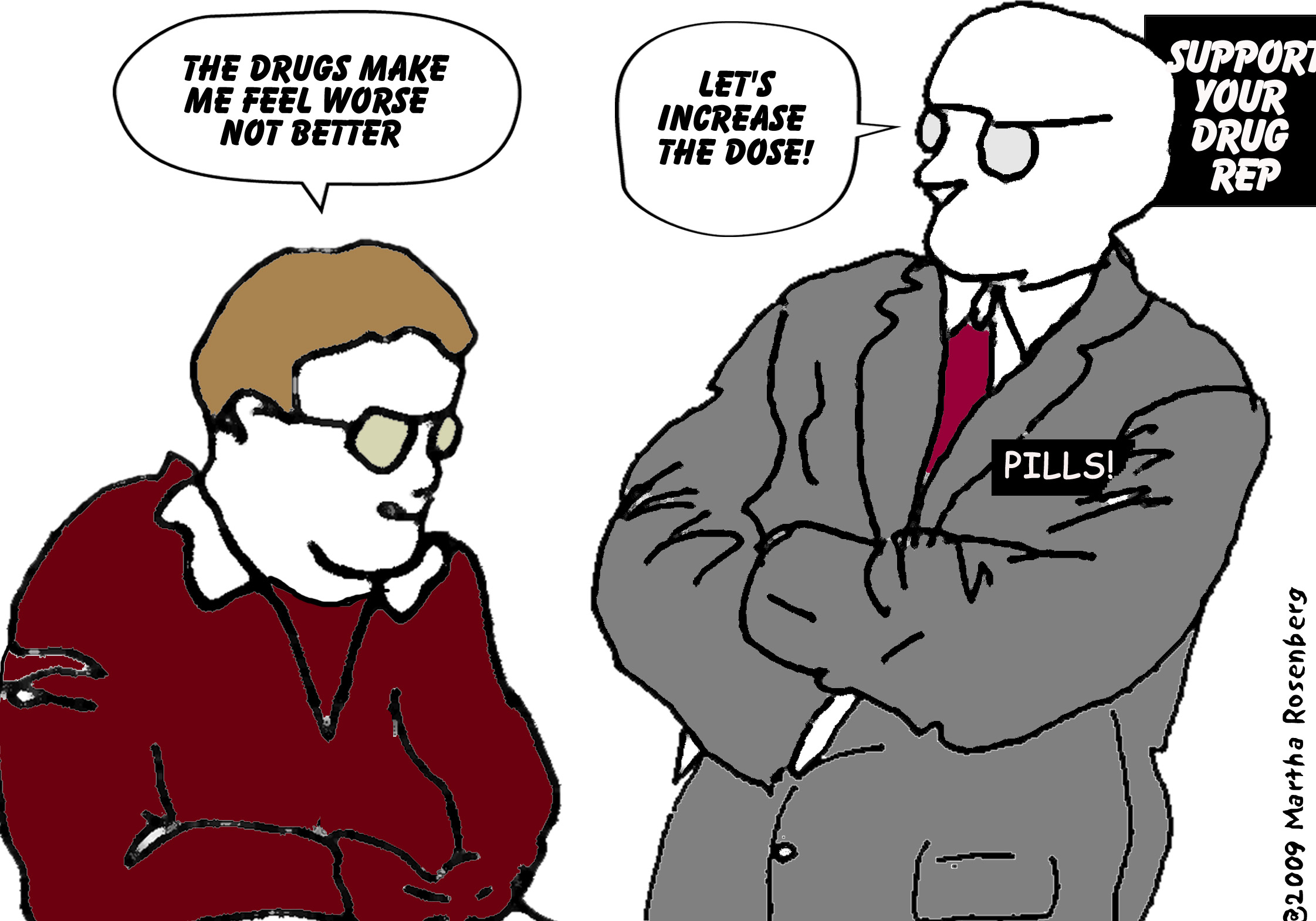
That's when pharma began debuting the concept of "treatment resistant depression." It wasn't that their drugs didn't work (or you didn't have depression in the first place), you had "treatment resistant depression." Your first expensive and dangerous drug needed to be coupled with more expensive and dangerous drugs because monotherapy, one drug alone, wasn't doing the trick.
You've got to admire pharma's audacity with this upsell strategy. Adding drugs to your treatment resistant depression triples its take, patients don't know which drug is working so they'll take all of them and the defective drugs are exonerated (because the problem is you).
Now pharma has a new whisper campaign to keep the antidepressant boat afloat. Your depression is "progressive." Once upon a time, when depression was neither seasonal, atypical, bipolar or treatment resistant, it was considered to be a self-limiting disease. In fact, just about the only good thing you could say about depression was it wouldn't last forever.
But now, pharma is giving depression the don't-wait scare treatment like coronary events (statins), asthma attacks ("controller" drugs) and thinning bones (Sally Field). If you don't hurry and take medication, your depression will get worse!
"Depressive episodes become more easily triggered over time," floats an article on the physician website Medscape (flanked by ads for the antidepressant Pristiq). "As the number of major depressive episodes increase, the risk for subsequent episodes is predicted more from the number of prior episodes and less from the occurrence of a recent life stress." The article, unabashedly titled "Neurobiology of Depression: Major Depressive Disorder as a Progressive Illness," is written by Vladimir Maletic, who happens to have served on Eli Lilly's Speaker's Bureau, says the disclosure information, and whose co-authors are each employees and/or Lilly shareholders.
Before direct-to-consumer advertising, the health care system was devoted to preventing over-treatment and assuring patients they were probably okay. Who remembers, "Take two aspirin and call me in the morning"? Now patients are assured they probably aren't okay but probably have a progressive disease. Luckily, their disease can be treated with progressive prescriptions from pharma.