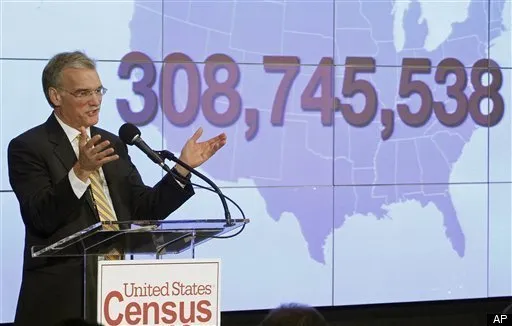
Last week, the Census Bureau provided the first peek at the results from the 2010 census. As of April 1, 2010, there were 308.7 million people in the United States. Census Bureau Director Bob Groves also announced state population totals that are used to determine how many congressional seats each state gets. This story dominated the news headlines, but these numbers have other purposes, too.
The federal government uses these population counts to distribute federal dollars to the states. According to Andrew Reamer at the Brookings Institution, in 2008 the federal government distributed $866.5 billion in funds to the states based on the census population counts. Your state gets its share of the federal pie based on the number of people that are counted by the census. If there were $866.5 billion in funds to disperse in 2010, each person would be worth $2,807 in federal money to your state.
Note that I say "people" not "citizens." This is where Arizona may have lost as much as three-quarters of a billion dollars annually in federal funding. The Arizona state government could have easily put this money to good use, as according to the New York Times, the state faced a $2.6 billion shortfall in fiscal year 2011.
I come to this conclusion by comparing what the Census Bureau expected Arizona's population to be and what it really was -- or at least who was counted. Throughout the decade, the Census Bureau demographers estimate each state's population. The most recent estimates give a sense of what the Census Bureau thought the April 1, 2010, population of Arizona would be.
So, the Census Bureau demographers projected Arizona's population to be 6,668,079 but the actual number was 6,392,017 or 276,062 fewer people than what the Census Bureau expected to find. This was the largest shortfall of any state in absolute numbers. Since Arizona is a mid-sized state, as a percentage of the population this shortfall was nearly twice that of the next nearest state, Georgia.
So why was the Census Bureau wrong? Or were they wrong? It is not unreasonable to surmise one of two things were contributing factors: Either Arizona's undocumented population did not want to stick around in the state or they did not think it was wise to fill out a government form -- even if their confidentiality is strictly guarded by the U.S. Census Bureau. If the shortfall was due to the latter, then at $2,708 a person, Arizona lost out on $775 million in federal grants per year.
I suspect that this lost revenue is a high estimate. Likely the true number lies somewhere between zero and $775 million, as reluctance to fill out a census form was one among many contributing factors to the difference between what the Census Bureau demographers expected and what the actual number was. But, we will never know for sure since it is impossible to go back in time and count again.
i admire you wanting to help other, but other countries have governments also. start there.
What this article does not address however is the cost of those illegal immigrants to our state finances. The costs of illegal immigration to Arizona has been estimated to be 1.3 billion dollars a year. When you combine even the article's admittedly high estimate of lost federal money with the very generous estimate that illegal immigrants put about a quarter of a billion dollars a year back into the state's economy through sales and other taxes, losing that population block through deportation or voluntary emigration would still put our state about 300 million dollars into the positive each year.
Measures that reduce the population of illegal immigrants are still a net financial gain for Arizona despite the loss of federal money. There are other issues raised when people discuss irregular migration and these other topics should be debated, but since this article is about dollars the author should at least be honest enough to work through all of the math.
You should read this: http://papers.ssrn.com/sol3/papers.cfm?abstract_id=881584
Heck, southern whites still don't like northern whites, er, Yankees. Residents of Washington and Oregon don't like Californians that look like them moving in to their states.
Accusations of racism may or may not factor into the xenophobia but it's not always the case.
Rash generalizations about who does or does not like such-and-such group mask fear and intolerance.
Quit trying to act smart.
I was pointing out how pervasive it is to jump to the conclusion that 'racism' is behind every case of xenophobia when there are many cases of people resenting impacts by their own kind. People don't like what they perceive as 'negative' impacts on their communities or lifestyles from whatever source. You might call it 'impactism'.
You can't repudiate that.....
This does get complicated, though, when you start determining how many of the persons in a district (based on total population) are citizens, and adult voters vs. children/non-voting adults.
Furthermore, if foreclosures have moved people from the suburban areas that were typically GOP these areas might require an expansion in order to obtain the needed population size for their districts.
And much of this is based on 2001 distributions...certainly the legal Hispanic population has increased proportionately since then and most of those people were disproportionately UNRepresented for most of the 2001-2011 period.
Part of what the Feds saw as a problem with the Ariz. law, to profile every suspicious person, is about the reality of our court systems. They are generally overwhelmed with our normal docket of cases. I had a past girlfriend who was here illegally. After the ICE sent out their five people and two SUV's to pick her up, she spent three days with the general population in the county jail. Her family paid $1,500 to bail her out, after which she was given a court date thirteen months in the future. Oh, and by the way, don't work since you're here illegally. But do stick around for the court date over a year away. What would most people do? I don't blame her for running.
I just wonder who's fault is that.
Most of Northern Mexico and its Pacific Coast is sunk deep in a "war on drugs" to stop the drug flow to the U.S., but who stops the cash and weapons flow? Poor people's choices are: join the military and kill their brothers, join the drug cartels and kill their brothers or flee to...yes, you guessed it...
Also, there is plenty of pressure from the American government to have Mexico slow down the migration from Central America, having a de facto Arizona law in South eastern Mexico. The only problem is that in that case it is enforced by corrupt migratory officials, the Zetas and the Maras...
It's certainly not the fault of American farmers who lost their land and livelihoods over the last quarter century that Mexican farmers are now suffering under the same competitive disadvantage that they did and are now enduring a similar result in the loss of land and livelihood.
Small scale farmers who own their own land were once the foundation of both countries, and the loss of this culture is in my opinion a tragedy to both us and the people of Mexico. I really don't like the implication that Americans are responsible for this in Mexico when our own people suffered the same misfortune.