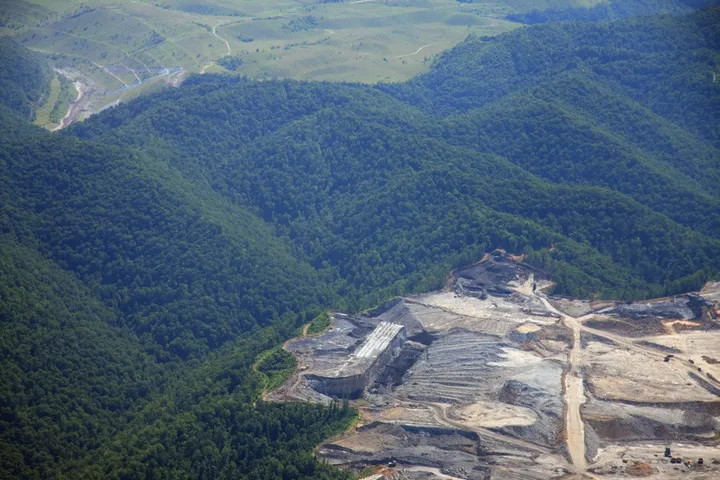
This week an important protest is taking place in the coalfields of West Virginia. The March on Blair Mountain began on Monday as several hundred people embarked on a five-day journey retracing the steps of over 10,000 miners who 90 years ago staged the largest armed insurrection after the American Civil War. Today's march is a protest against both the attack of the union movement in America and the demolition of the Appalachian mountains.
For over 50 years, American unions have served to counterbalance the ascendancy of unsheathed corporate power that threatens now to overwhelm American Democracy. In the past year, the union movement's final redoubt -- the public service unions -- have been vilified and emasculated in traditional union states like Wisconsin, Michigan, and Iowa.
Now one of the biggest union busters in American history, Massey Energy, is launching a final assault on the icon of America's union movement, Blair Mountain.
Blair Mountain's storied history dates back to West Virginia in the 1920s, when the entire state was a company town. Big Coal dominated every aspect of economic life. The industry owned the shops, the homes, of course the mines -- and made sure there was virtually no other source of employment in the state. Working conditions were horrendous: men and their sons worked 12 to 16 grueling hours in dark, dangerous mines dying from a notorious plague of subsurface explosions, cave-ins and black lung.
The companies used local sheriffs to enforce their system of feudal serfdom. When a miner was injured and his family needed to be evicted from their home, the sheriff did the dirty deed. When union organizers appeared, the sheriff arrested, jailed, and routinely beat them, before escorting them to the county line. One sheriff refused to tow the company line: Sid Hatfield, of Hatfield and McCoy lore.
Not only did Hatfield refuse to do the industry's bidding, but he jailed mine operators for mistreating their workers. In the infamous Matewan gun battle, Hatfield helped kill seven mine company private investigators who had evicted union families from their homes.
Hatfield was never convicted for the Matewan shootings, but the mine operators took their revenge and on August 1, 1921 when industry thugs executed Hatfield in broad daylight on the McDowell county court-house steps.
Hatfield's assassination triggered one of the biggest labor demonstrations in American history. Ten thousand miners from the coalfields of Kentucky and West Virginia marched for six days, converging on Blair Mountain to confront their industry bosses. They were met by King Coal's powerful army of thugs and mowed down by Gatling guns.
President Warren Harding, a so-called "friend of coal," like most of the leading politicians of the Gilded Age, authorized the U.S. army to drop bombs and poison gas on the marching miners -- the only time in American History when our military deliberately bombed U.S. citizens. These military measures broke the demonstration but outraged the public, and gave vital traction to the United Mine Workers and the American labor movement.
Over the next 60 years unions became the critical counterweight to corporate power and the principal platform for the growth of the American middle class, which gave our Democracy its wealth, prosperity, and sense of justice as a core value.
Now, as the union movement finds itself battered, beleaguered, and under assault by a legion of corporate toadies in state governor's office from every director to chamber of commerce. Tea Party, talk radio, Fox News and the tsunami of corporate money released by the Citizens United case, Massey Energy has recently announced that it intends to blow up Blair Mountain, the Gettysburg of America's union-based Democracy, to mine it for coal.
For the first time in decades, environmentalists including the NRDC, Sierra Club, Waterkeeper Alliance and local groups have declared common cause with unions in staging a six-day march to retrace the steps of the 1921 Blair Mountain miners. The march convenes Saturday morning June 11 with a final climb up Blair Mountain. Marchers hope to save this historic mountain from Massey by securing its status as a historic landmark.
West Virginia is today's epicenter of one of America's greatest civil disobedience movements. More than 200 people have been arrested protesting mountaintop removal coal mining in the past 18 months. The protesters include college students and local West Virginia marines, former miners, housewives, and an 82-year-old grandmother who was arrested in her wheelchair. They are all calling for an end to mountaintop removal, the extreme form of coal mining that has flattened 500 mountains in Appalachia, illegally buried 2,000 miles of streams, destroyed one million acres of forest, and devastated numerous communities, lives, and towns in the region.
Union busting corporations have commoditized not just the workforce, but the historic landscapes of West Virginia, using great machines and dynamite to eliminate mining jobs. While production has more than doubled in 10 years, industry employment is one-tenth of it what was when my father warned me about strip mining as a 14-year-old boy.
It is time for Americans to march in the footsteps of our union ancestors of 90 years ago to protect our jobs, and save our national patriarchy, the purple mountains majesty, the individual rights and community based values that make our country of the envy of free people.
Robert F. Kennedy Jr. appears in the documentary The Last Mountain (www.thelastmountainmovie.com), currently playing in theaters.
The film reveals the devastating effects of mountaintop removal mining in Appalachia and features the dedicated activists who are fighting to make sure all Americans have access to clean air and water.