- BIG NEWS:
- Pakistan
- |
- Afghanistan
- |
- Iran
- |
- England
- |
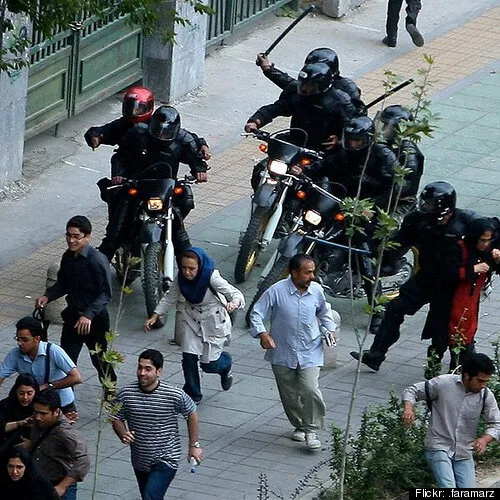
I was sitting in the control room of the Farsi Voice of America TV Channel in Washington (broadcast in Iran) on Saturday before a scheduled appearance to help cover the developing incidents in Iran when one of the people there let me know that the regime had arrested the daughter of Hashemi Rafsanjani, head of Expediency Council, the body that selects and can remove the Supreme Leader. Then we heard the report of the regime opening water hoses on people and shooting people with plastic and real bullets, and a video came in of a woman getting killed that was so graphic that Voice of America refused to broadcast it.
What everyone needs to understand is that what ignited the protests may have been Ahmadinejad's hijacking of the election, but what has been fueling the protests and disobedience by millions of Iranians goes much deeper than this election. Iranians have been repressed for thirty years under the third most brutal theocracy--after the Taliban and Saudi Arabia--ever to rule on earth. But throughout this time, they always believed that although the regime curbed their most basic rights and the most powerful leader in Iran was unelected, they at least had a little bit of control by having at least a few options to choose from for president every four years. But in this election, they saw that last common trait between Iran and liberal democracies taken away and Iran turn from an Islamic Republic to an Islamic fascist state.
Khomeini, Khamenei and other members of Velayate Faghih never truly believed in the value of democracy and saw it more as a threat to weaken, rather than a virtue to strengthen. The establishment of the Guardian Council of clerics to Islamize the Iranian democracy by running candidates for all offices through a Quranic filter was one way of weakening the Iranian democracy. But taking the vote away all together by manufacturing sets of numbers and putting them out as election results two hours after the polls closed was over the top.
As these events developed, President Obama's initial reaction was quite hands off. And even after hundreds of thousands of people began coming out last Saturday and Sunday, and the regime used violence against nonviolent demonstrators, President Obama only made a passing statement about not being able to remain silent, only to fall into silence right afterwards.
All of those actions may have been understandable and even justifiable based on the circumstances immediately following the election. Nonetheless, as I have been following the story and advising activists in Iran throughout the past week, I have seen how quickly the events are developing (and deteriorating) in the streets of Tehran and other provinces. What is critical for the Obama administration to understand is that their one-week-old hands off approach no longer works. Since Ayatollah Khamenei's speech last Friday, the regime has significantly increased violent repression, and I heard from one source a few hours ago that people have spotted at least one tank on a Tehran street. Yes, a tank.
This is no longer a "dispute" to be worked out by the "people of Iran." The Iranian regime may very well be on the brink of committing a mass killing of protesters. What is happening in Iran now is a not an uprising, but a revolution that is shaking the most fundamental pillars of the Islamic Republic and is ending the Islamic Republic as we know it.
In the current conditions, President Obama has two choices: First, he can continue to do what he has been doing--"monitoring" the situation or making passing and softly critical statements on the behavior of the Iranian regime--in order to not offend Ahmadinejad, with whom he hopes to do diplomacy. Diplomacy should certainly be every president's first instinct, and he should avoid burning bridges as much as possible. What an equally legitimate concern is the cost of maintaining that bridge. Even Obama doesn't believe diplomacy is without limits; his policy on Osama bin Laden continues to be based on the goal of capturing and killing him. So there is a line beyond which Obama not only can safely take sides in the internal conflicts of other countries, but at the leader of the free world, he has the responsibility to in order to stop the bloodshed.
The situation in Iran passed that line two days ago. Ahmadinejad no longer has the kind of viability and legitimacy that warrants this level of silence in the face of horrific human rights crimes and killings on the streets. Keeping silent will lead to a future regime in Iran that will have to be anti-American by definition; no Iranian will forget the American silence as they bled and fought for their freedom.
The alternative is for President Obama to acknowledge what is happening in Iran with a sense of foresight and when it matters: right now. Iran is in the middle of a revolution. Accordingly, President Obama needs to put out a statement quickly similar to President Clinton's on Milosevic. It can go something like this: "Iran: the United States wants to have a mutually respectful relationship with you, but not at the expense of its most cherished human rights values and ideals. If you use the power of your military to mass murder nonviolent protesters, the United States will reserve the right to use all of its power and leverage to defend the shedding of innocent blood."
It has become conventional wisdom to think that doing so will turn the Iranians against the United States, but that is simply not true! The majority of Iranians do not consider the army or revolutionary guard as forces that are there to defend them, but as tools the Supreme Leader uses to oppress them. President Obama cannot apply the assumptions he has about the sentiments of people in democratic countries toward their government and military institutions to nondemocratic countries.
This is a critical time not only in the history of Iran, but in President Obama's presidency. He can take swift action and make it clear that America will not accept an Iranian slaughter, or he can stay quiet as a brutal regime kills (as Bill Clinton did on Rwanda), sit this revolution out, pretend it's not happening, watch a new anti-American regime come to power, and say goodbye to the possibility of normalizing relations with Iran under his presidency.
UPDATE: My interview on this topic on CNN from Monday, June 22, 2008:
Follow Sam Sedaei on Twitter: www.twitter.com/SamSedaei
Want to reply to a comment? Hint: Click "Reply" at the bottom of the comment; after being approved your comment will appear directly underneath the comment you replied to
I think our Prez has said all that needs to be said . . . what is happening in Iran is internal . . . we have to stay out of it . . .
America has enough problems to sort out internally . . . . we a rap sheet in Iran . . . going back to 1953 . . . with the CIA over throw of the democratically elected government of Mossedagh . . . if too much is said it could hurt the protesters very very badly . . . unless of course that is what you want to do
I don't want the protesters hurt by anybody much less by what our government does, and I agree, it is their business and very complex. Let's see what Iran does next.
I thought what the President said was fairly strong. It changed our relations the formal government earned him a insult and a threat from the Speaker of the Parliament.
The comments came from ISNA - Iranians Students News Agency. Here's part of it:
"Larijani then emphasized Iran’s Parliament warns the US President, Britain’s Prime Minister, Germany’s Chancellor and France’s President to avoid meddling with Iran’s domestic affairs and doing things that makes Iran respond in other fields."
Just imagine what some of those other fields may be.
I am frustrated with the comments from made by McCain and Graham. Have either of these ever shown evidence of a good knowledgeable of foreign affairs much less any wisdom. Good lord, when did the legislators start thinking they could speak for the whole country themselves. In my opinion our present legislators' expertise falls in the category of stirring up citizens and attempting to gain personal power . I think they have gone way beyond their job description.
Being an independent that is neither hawkish nor a dove, I think the President has said all he needs to at this time and that what he said was necessary and appropriate for the situation.
I strongly support the Iranian's right to the freedom of protest and I know I would be out there with them if I were there because they shown a spirit and courage that I have not seen in quite awhile. Americans used to believe in "give me liberty or give me death" but somewhere along the way that got lost. To see it alive anywhere is great thing to see, but to see it in Iran touches my heart and revives my love of real freedom.
I care nothing about the politics of whether it will be good for us just as I never was a Georgian but with those who would rather die than live with freedom.
It seems to me the Democrats and the Republicans would rather fight each other to the death before they every get a clue of what it takes to keep freedom. I have no hope for us left, but I do have hope for Iran.
Correctlon: "live withOUT freedom".
I agree. The situation has changed, and the US needs to consider alternatives to detachment.
If the US says anything- it will fuel the fire that the current Iranian government is trying to ignite: all bad things happening here are the result os US and Western radicals.
People- please back off=- study the culture and attempt to earn what works and what does not. Everything you may wish for could have very sad and unintended consequences.
All demonstrators will be arrested as "American" sympathizers and thrown in jail long enough to hurt them and their families who rely on a wage earner for ever. The people who could lead an armed militia against the government will be sworn off by this- they want a fair say but they sure as hell will not support a US or Western, non- Islamic movement or protest.
All here is growing pains. America went through them years ago.. Let Iran go through them with oversight and sanctions from the UN/ Europe/ etc. Don't forget that what most Iranians are protesting is a rigged election, not vast freedoms.
well said trying2help . . . totally agree with you
If you truly understand something-you will explain it simply...that the Iranian People are dying for there freedom...they need International support now!
I wrote the president today asking him to step up to the plate. I have been understanding of why he has not done so yet. I recognize that he still believes he can negotiate an nuclear compromise with the current regime, but all that really is in the dumper now. The election was a farce. The response by the Iranian government has been brutal. What communique could there possibly be now with the so-called winner? It would be perceived by the Iranian people as the sham it is.
So.......time to call a spade a spade. I heard a report this morning from a reporter working for the Christian Monitor. The you Iranian woman was energized a few days ago until she was bathed in blood from the death of those around her. Today she is fearful of going back out, not wanting to die for nothing if these protests result in zero improvement. She is waiting for guidance. This is where a leader from the free world can step up and motivate those at the crossroads of some sort of democracy.
Two points:
1) It's not up to Barak Obama whether the Iranians remain in the streets. The guidance shouldn't come from America for a number of reasons. The most prominent being that we can't help or protect them if the regime really cracks down on them. See Hungary 1956. See Chechoslovkia 1968. See Iraqi Shi-ites 1991. The Iranian people have to decide for themselves whether they will remain in the streets. That may sound callous, but it's the only way they can get what they want and deserve.
2) It's conservative propaganda to suggest the unrest in Iran undermines Obama's decision to negotiate with Iran over their nuclear program. On the contrary, his hand is strengthened. Whoever is Iranian president has to recognize the strong urge for modernity and stable relations thaty underlie the unrest. They will have to deal with that anger because they won't be able to trot out the "Great Satan" as easily as they have in the past. Also, the world will have seen how they behaved during this crisis and won't give them the benefit of the doubt. Finally, the Israeli's stand in the wings, ready to take the reqime out.
Right on target. This insistence that Obama to "step up" and say something concrete reminds me of all the Dems who wanted Obama to fight back against the smears of the right during the campaign. He didn't fight back, instead he said, "it's OK if they keep attacking me, I can take it. It's America that's more important." He stayed true to his nature and it served him well. He's doing the right thing now, a very nuanced approach that can neither be used as an excuse by the Iranian dictatorship to crack down nor as a recruiting tool for radical Islamists. We need to trust Obama's judgment here and everyone calm down. If we threatened to go after Iran as Sam S. suggests, then that will put us into 3 wars! Great, just great.
The situation in Iran is reminiscent of another protest: the American civil rights movement of the 1950s and 60s. As that movement absorbed increasing violence from racists, the question arose as to whether the protesters should respond to violence with violence. Dr. King remained steadfast in his determination the movement remain non-violent. The task of the civil rights movement was to change the thinking, on race, of enough white Americans to bring a change in the political, social and economic condition of African Americans. Non-violence proved correct when the 1965 Voting Rights Act was passed and affirmative action became the policy of the land. Had the movement resorted to violence, its opponents could have much more easily portrayed it in a negative, un-American light because there was a long list of stereotypes buried deeply in the psyche of white Americans to draw from. The unceasing violence the movement absorbed helped make their case that a change was needed.
The people in the streets of Iran need to change the minds of enough of their fellow citizens to affect a change in the political situation in Iran. The call from American conservatives for America to become much more involved in the protests is the same call Dr. King resisted 50 years ago. The demonstrators have to absorb the violence that comes their way as they convince their fellow citizens change is possible. The heavy hand of the U. S. would only make their case harder to make.
I agree, and as prominent reformist Iranian clerics speak up in opposition to Khamenei, we see evidence of a similar transformation within the culture of the ruling class in Iran. President Obama's mention of free speech and peaceful assembly as universal rights make perfectly clear, as if it wasn't already, that the United States does not support attacking unarmed citizens for demanding a recount of a suspiciously lopsided "election." He has been just emphatic enough. More would tend to escalate, not contribute to stability or resolution.
The current unrest in Iran is hardly similar to the civil rights movement in the US.
I agree the US should stay out of the Iranian crisis, but for a different reason. There is nothing to be gained by any US involvement. No matter the result somehow the US would end up the bad guy. So, why bother?
Sam, I see your point about the need for a clear sign that Obama is committed to seeing freedom and justice prevail in Iran. But could the threat of military action by the United States really be helpful? Few- if any-- peoples have ever welcomed military engagement by an external power against their regime, no matter how much they dislike it. It's the reason unpopular tyrants always look for outside sources to pass the blame onto...remember Milosevic in the late 90s? Most Serbs loathed him, but when NATO started bombing Belgrade, his popularity spiked. That's why the Serbian pro-democracy movement condemned not just Milosevic's rule, but the US-led bombings there as well.
See Sam Sedaei's Profile
Cynthia, you have to look at things in context. Most of Iranians don't have nationalistic sentiments toward their military and police institutions, because Iran is not a democracy. Iranians are terrified of the Revolutionary Guard, army and police, who are repressing them in the most horrific way. The Serbian case was different because the Serbian anger was more focused on the dictator himself, rather than the military institutions. I think whether we believe the United States should speak up on Iran is rooted in a much deeper and more general question: Should the United States ever speak up when it sees massacre looming in the horizon? If you answer no, then you wouldn't support his speaking up here. But if you say yes, this is the time for him to speak up. It was U.S.'s nonaction and support of the Shah 30 years ago that led to a regime that was fundamentally anti-American, not its support for the revolutionaries. I'm a liberal and love Obama's general instincts on foreign policy, but I don't want the next Iranian regime to turn out anti-American as the previous one did.
Before you can take action there must be something to take action about. Hell, the civil rights demonstrations in the US had more deaths that has happened in Iran so far. What if the power of these demonstrations brings about a recount, or there is another way of resolving the problem, the days ahead are going to give the answers. Its a little too soon for you to instruct Obama on how to handle this Iran problem.
Obama has recognized what is going on in Iran. How about ... why don't you try a little practicing what you preach. Instead of "monitoring" the situation, go to Iran, support those who need support, instead of calling on everyone else to do what you are too timid to do. I'll help pay your airfare.
I disagree with the idea the US has an obligation to do anything concerning the problem in Iran. If the Iranians asked for the US to act as a mediator the situation would be different. But until that happens there is little the US can, or should, do. This is a situation where any US involvement will surely anger one side or the other, I can see no up side to US involvement.
You must be logged in to comment. Log in or connect with