
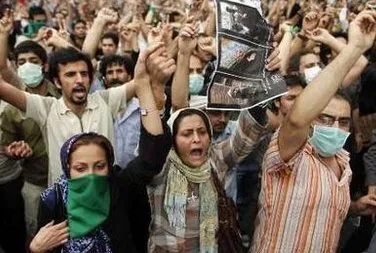
As the fraudulent outcomes in the presidential races of 2000 in the United States and 2006 in Mexico demonstrate, elections can be stolen without the public rising up to successfully challenge the results. There have been cases, however, where such attempted thefts have been overturned through massive nonviolent resistance, as in the Philippines in 1985, Serbia in 2000, Georgia in 2003, and Ukraine in 2005. It is unclear as of this writing how the people of Iran will react to what increasingly appears to be the theft of their presidential election. So far, protests have been scattered, lacking in discipline and therefore easily suppressed. A general strike is planned, however, and a more cohesive and strategic resistance movement may emerge.
Despite the increased repression of recent years, Iran has witnessed a growing civil society movement and increasing calls for greater freedom. Indeed, those in the Iranian regime correctly recognize that the biggest threat to their grip on power comes not from the United States or Israel, but from their own people. Civilian-based insurrections have played a critical role over the past century in challenging Iranian rulers, such as during the Constitutional Revolution of 1907 and the overthrow of the Shah in 1979. Iran's clerical leaders, faced with growing dissent -- particularly among youth, women, the middle class, and urban dwellers -- realize that they may be next.
Already, the clerical leadership has been warning that it is willing to do whatever is necessary to nip a "velvet revolution" -- in reference to the two-week popular uprising that ousted Czechoslovakia's Communist regime in November 1989 -- in the bud.
This may explain the clumsy effort by Iranian authorities to steal last Friday's election. It had been widely assumed that the country's powerful clerical leadership saw incumbent President Mahmoud Ahmadinejad as something of a loose cannon. Meanwhile, his principal rival Mir Hossein Mousavi -- despite his disagreements with Supreme leader Ayatollah Ali Khamenei over the years -- was very much part of the establishment. Indeed, Mousavi would not have even been allowed to run for president otherwise, since the Council of Guardians routinely forbids anyone who is seen to not sufficiently support the country's theocratic system to participate.
Yet, Mousavi attracted such a large and enthusiastic following in the course of the campaign that the ruling clerics may have feared the momentum of his incipient victory could result not just in limited reforms, like those attempted under former president Mohammed Khatami, but revolutionary change. The size and intensity of Mousevi's final rally last week, in which he referred to Ahmadinejad as a "dictator" -- which, by extension, implied an indictment of the system as a whole -- may have tilted the clerics into believing they could not take the risk of allowing the anticipated results to be verified. Despite his candidacy displaying a personality and style closer to Michael Dukakis than Barack Obama, Mousavi came to represent the change so many Iranians, especially young people, desperately desired and appeared determined to make happen.
So far, there are little indications that the diverse opposition in Iran has the organizational and strategic wherewithal to mount a massive nonviolent action campaign that could overturn the stolen election and bring greater democracy to that country. This stolen election may hasten that day, however. Iran today is not unlike Eastern Europe in the 1970s. The people may not be ready to overthrow the system, but the ideological hegemony which had previously maintained that system and stifled freedom of thought has largely vanished. Even among Iranians dedicated to the principles of the Islamic Republic, many now see their country essentially as a police state, recognizing that Ahmadinejad and the ruling clerics are little more than corrupt self-interested politicians who have manipulated their people's religious faith for the sake of their own power.
Most Iranians were born after the bitter struggle against the tyrannical Shah and only a minority remember the bloody war with Iraq which followed, legacies on which the country's leaders have tried to legitimize their rule. It no longer seems to be working. In thousands of little ways -- from satellite dishes hidden behind rooftop cisterns, to clandestine mixed social gatherings of unchaperoned young people, to women incrementally expanding the limits of what is considered acceptable apparel -- small acts of resistance are undermining the authority of the regime. And such resistance is not coming just from affluent educated neighborhoods in North Tehran, but across classes and ethnicities and regions.
The Role of the United States
This begs the question: what can the United States do to speed the process for greater freedom in Iran?
The answer may be to stay out of the way as much as possible.
Despite claims by former President George W. Bush that the United States has always supported "liberty" and "democracy" in Iran, the history of U.S.-Iranian relations during both Republican and Democratic administrations has demonstrated very little support for a democratic Iran. In the early 1950s, the last time Iran had a democratic constitutional government, the United States joined Great Britain and other countries in imposing strict economic sanctions against Iran in response to the nationalization of the country's oil resources, which until then had been under foreign control. Taking advantage of the resulting economic collapse and political turmoil that followed, the CIA helped engineer a coup against Prime Minister Mohammed Mossadegh and returned Shah Mohammad Reza Pahlavi from exile to rule with an iron fist.
Over the next 25 years, the United States armed and trained the Shah's dreaded SAVAK (Organization for National Security and Intelligence) secret police, which emerged as one of the most repressive internal security organizations of the era. Despite claims to the contrary by right-wing critics of the Carter administration, the United States strongly supported the Shah until his final days in power, providing valuable assistance to the regime even as it was massacring protestors in the streets. It comes as no surprise, in light of this history, that the revolution which finally ousted the monarchy in February 1979 was stridently anti-American. Furthermore, since the Shah's U.S.-trained and supplied repressive apparatus had largely succeeded in wiping out the democratic and secular opposition to the regime, it was religious opponents -- who survived as a result of the greater cohesion made possible through the mosques -- who spearheaded the revolutionary movement. Thus, the radical Islamist orientation of the revolution and the severe repression which has hallmarked clerical rule was a direct consequence of the Shah's U.S.-backed efforts to maintain control through repression.
Despite the severing of diplomatic relations in response to the hostage crisis, the United States clandestinely armed and provided other security assistance to the Islamic government during much of the 1980s, both to support the mujahidin fighters against the Communist regime and its Soviet backers in neighboring Afghanistan as well as to suppress leftist dissidents within Iran.
As a result of this history, most members of the democratic opposition in Iran do not take very seriously Washington's claims that it supports freedom for the Iranian people.
Ironically, recent years have witnessed repeated calls by American neoconservatives who, despite having shown little concern for human rights in much of the world (including Iran when it was under the allied regime of the Shah) insist that the United States must lead the way in bringing democracy to that country. Despite being a thinly-veiled excuse for setting up another puppet regime to ensure easier access to the country's oil and natural gas resources, these supposed defenders of Iranian freedom have attacked the Obama administration for its apparently reluctance to pursue military options as well as for its interest in negotiating some kind of rapprochement with Iran regarding areas of mutual concern, such as Iraq, Afghanistan and nuclear non-proliferation.
Some American neoconservative leaders argue that sustained air and missile strikes against Iranian government, nuclear, and military facilities would cripple the regime to a point that it would empower opponents to rise up against the government. In reality, Iranian opposition leaders emphasize that war and threat of war by the U.S. government would certainly unify the population around the regime and would be used to justify further repression.
The widely reported clandestine U.S. support for Kurdish, Baluchi, and other Iranian national minorities launched under the Bush administration runs the risk of igniting violent ethnic conflict and increased political repression in parts of the country, but these efforts are not likely to pose much of a threat to the survival of the regime either. In any case, it appears that the Obama administration has ended these programs.
In addition, the United States cannot realistically hope for a coup, given that pro-U.S. elements in the military were thoroughly purged soon after the revolution. The leadership of Iran's military and security forces, while not necessarily unified in support of the more hardline elements in government, cannot be realistically expected to collaborate with any U.S. efforts for regime change in their oil-rich country.
Strategic Nonviolent Action
What recent history has repeatedly shown is that the most effective means for democratic change comes from broadly based nonviolent movements, such as those that have toppled dictatorships in such diverse countries as the Philippines, Chile, Madagascar, Czechoslovakia, East Germany, Indonesia, Serbia, Mali, Nepal, the Maldives, and elsewhere. Even the relatively conservative Washington-based Freedom House has produced a study that, after examining the 67 transitions from authoritarian regimes to varying degrees of democratic governments over the past few decades, concluded that the changes were catalyzed not through foreign invasion, and only rarely through armed revolt or voluntary elite-driven reforms, but overwhelmingly by democratic civil society organizations utilizing nonviolent action and other forms of civil resistance, such as strikes, boycotts, civil disobedience, and mass protests.
In apparent recognition of this trend, Congress in recent years has approved millions of dollars in funding to support various Iranian opposition groups to promote "regime change." However, most of these groups are led by exiles who have virtually no following within Iran or any experience with the kinds of grassroots mobilization necessary to build a popular movement that could threaten the regime's survival. By contrast, most of the credible opposition within Iran has renounced this U.S. initiative and has asserted that it has simply made it easier for the regime to claim that all pro-democracy groups and activists are paid agents of the United States.
In an effort to head off such a popular uprising and discredit pro-democracy leaders and their supporters, Iran's reactionary leadership has been making false claims, aired in detail in a series of television broadcasts beginning in 2007, that certain Western nongovernmental organizations that have given workshops and offered seminars for Iranian pro-democracy activists on the theory and history of strategic nonviolent struggle are actually plotting with the U.S. government to overthrow the regime. On several occasions, Iranian authorities have arrested and tortured these activists, forcing them to sign phony confessions allegedly confirming these allegations.
Some Western bloggers and other writers, understandably skeptical of U.S. intervention in oil-producing nations in the name of "democracy," have actually bought into these claims by Iran's hardline clerics that prominent nonviolent activists from Europe and the United States -- most of whom happen to be highly critical of U.S. policy toward Iran -- are somehow working as U.S. agents. These conspiracy theories have in turn been picked up by some progressive websites and periodicals, which repeat them as fact. Unfortunately, such accusations do little more than strengthen the hand of Iran's repressive regime, weaken democratic forces inside the country, and strengthen the argument of U.S. neoconservatives that only U.S. intervention -- and not nonviolent struggle by the Iranian people themselves -- is capable of freeing the county.
Historically, individuals and groups with experience in effective mass nonviolent mobilization tend to come from the left and carry a skeptical view of government power, particularly governments with a history of militarism and conquest. Conversely, large bureaucratic governments used to projecting political power through military force or elite diplomatic channels have little understanding or appreciation of mass popular struggles. As a result, the dilemma for U.S. policy-makers is that the most realistic way to democratize Iran is through a process the United States cannot control.
The U.S. government has historically promoted regime change through military invasions, coups d'etat and other kinds of violent seizures of power by an undemocratic minority. Nonviolent "people power" movements, by contrast, promote regime change through empowering pro-democratic majorities. Unlike fomenting a military coup or supporting a military occupation, which are based upon control over the population and repression of potential political opponents, nonviolent civil insurrections -- as a result of being based upon a broad coalition of popular movements -- are virtually impossible for an outside power to control.
In any case, the Obama administration does not seem to be very interested in promoting such a "people power" revolution. On Meet the Press this Sunday, Vice-President Joe Biden spoke about Iran with the assumption that Ahamdinejad would remain president, blithely referring to the incumbent who had just stolen the election as "durable." The most criticism Biden could muster was his observation that even if the election was won "fair and square," Ahmadinejad still had "domestic critics" (quite an understatement for a country that may be on the verge of a popular insurrection.) The most Secretary of State Hillary Clinton could say, even as the extent of the fraud was becoming apparent, was that the United States hoped that the outcome of Iranian vote reflected the "genuine will and desire" of the Iranian people.
Despite the growing repression from its government, the negative consequences of sanctions and threats against their country, and Washington's disinterest in their struggle, the best hope for Iran comes from Iranian civil society. It is the Iranian people alone who have the right and the capability to reform or bring down the country's increasingly illegitimate regime and establish a more just and democratic society. Whether it will be in the short-term or the long-term, freedom will come to Iran. When it does, however, it will likely be in spite of -- rather than because of -- the policies of the United States.