iPhone app iPad app Android phone app Android tablet app More

Featuring fresh takes and real-time analysis from HuffPost's signature lineup of contributors
Tracy Worcester

GET UPDATES FROM Tracy Worcester
 

Resistance to Factory Pig Farming Gathers Steam

Posted: 03/08/11 11:02 PM ET

This week my film Pig Business will have its U.S. premiere on Capitol Hill. As the film's director, I believe this story comes to the United States at a very timely moment -- as unionized workers and other citizens are showing their determination to fight back against being stripped of their bargaining rights, which, I see as part of an international citizens' movement opposed to ever greater corporate greed and control.

The movie tells the tale of pork production's industrialization as it demonstrates the increasing influence corporations exert over all aspects of peoples' lives, including over governments that are supposed to protect their citizens.

But against the huge resources that meat producers' lobby firms, their advisers and a pro-corporate Congress can muster, there is a resistance that the industry fears most, a mounting disgust by consumers as they become aware of the grim realities of factory farming and are beginning to turn away from their products.

Between 2005 and 2009, I made Pig Business (you can watch the USA version or the original film in 12 different languages on our website) by tracking US pork giant Smithfield Foods, Inc. as it swept into Poland and took advantage of cheap labor, poorly enforced environmental laws, and a government fragile in its post-communist years.

Smithfield persuaded the then-government to sell ex-state farms for what its CEO boasted, were 'small dollars'. Using tax payer subsidies and preferential loans secured from the European Bank for Reconstruction and Development (EBRD) (paid for by European taxpayers) and other global banks, Smithfield bought production and processing operations. Subsidies were supposed to help Polish farms modernize to compete with western European operations. This modernization was in reality introducing a vertically integrated, factory farming system that could produce 'cheap' pork by cramming as many pigs as possible into a small space, polluting waterways, poisoning local residents and putting generations of family farms out of business.

The industrialization of hog farming and pork production in Poland resulted in a tide of cheap meat bankrupting farmers throughout the European Union.

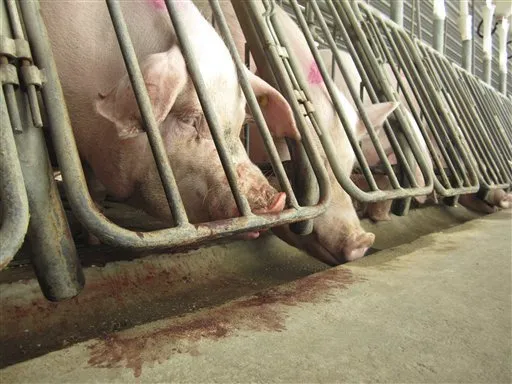
Industrial pig farming has other devastating ecological and social consequences as well. Tens of thousands of densely packed pigs generate massive quantities of manure and overwhelming stenches. Pigs produce up to ten times as much waste as humans, which is stored in festering lagoons then sprayed onto fields, a system that has repeatedly caused contamination of rivers, streams and coastlines, causing massive fish kills, and sickening neighboring residents.

To give just one example: In March 2010 a Missouri court ordered a Smithfield Foods subsidiary to pay local residents $11 million for "odors so offensive that they defied description," said Stephen A. Weiss, a New York attorney who represented the families. "These corporations have chosen to invade traditional family farming communities and construct industrial operations that simply fail to respect the community and the land".

Poland's neo-liberal government of the late nineties welcomed Smithfield Foods with open arms. However, when the government was ousted and replaced by the Law and Justice Party it sought to limit the damage of the pro-corporate agenda by making industrial factory farming adhere to regulations.

Smithfield's response was to move its next wave of operations to a more corporate-friendly country, Romania. "We have been very disappointed by the way we have been treated by the government in Poland," said Richard Poulson, executive vice-president of Smithfield. "The difference between the way the Polish government treats us and the way the Romanian government treats us is like night and day."

In the United States, 80 percent of all antibiotics produced are fed to farm animals to stimulate faster growth and to keep them alive in overcrowded meat factories. Adding antibiotics to pig feed specifically to promote growth, has been banned in the EU since 2003, but is still legal in the United States. The U.S. Center for Disease Control and Prevention, American Medical Association, and American Public Health Association have all warned against the continuation of this practice. Research shows that diseases like Campylobacter and Salmonella are becoming increasingly resistant to treatment with antibiotics. A pilot study in Iowa found the new strain of antibiotic resistant MRSA, which passes from pigs to humans, in 45 percent of workers and 49 percent of pigs.

US agribusiness and pharmaceutical giants increasingly control global agriculture, endangering human health and decimating family farms across both America and many other parts of the world.

But on Monday, March 9, Robert F. Kennedy, Jr., and I will co-host the Pig Business US screening for Congress members and staff on Capitol Hill. Experts in animal welfare, human health and family farming will reinforce the film's findings that the factory farming system abuses animals, threatens human health by over-reliance on antibiotics, and forces traditional farmers out of business.

Bobby and I believe the event will clearly show that now is the time to tell consumers the truth about how their meat is produced. Among other things, products should be labeled about methods of production. This is what the industry fears most -- informed consumers who cannot stomach what is being done to pigs crammed into barren concrete and metal pens with no access to natural light or air. Many consumers who watch Pig Business say they will never buy factory pork again.


  • Comments
  • 26
  • Pending Comments
  • 0
  • View FAQ
Comments are closed for this entry
View All
Favorites
Recency  | 
Popularity
photo
HUFFPOST SUPER USER
KarlaElisa
The atmosphere is Toxic
12:07 PM on 03/25/2011
'Food, Inc.' gets into the CAFO's handling poultry and it's just as horrifying.
photo
HUFFPOST SUPER USER
HealthHabits
07:49 AM on 03/11/2011
A recent report prepared for the UN Human Rights Council may turn out to be a powerful tool against the further expansion of factory / industrial farming.

The report demonstrates that agroecology (aka human scale farming), if sufficiently supported, can double food production in entire regions within 10 years while mitigating climate change and alleviating rural poverty.

The report therefore calls for a fundamental shift towards agro-ecology as a way for countries to feed themselves while addressing climate and poverty challenges.

In short, the report says that factory farming is LESS EFFICIENT than old-fashioned community farming.

More info about the report - http://www.healthhabits.ca/2011/03/10/factory-farming/
02:43 PM on 03/09/2011
As a hog farmer myself I am personally offended by this video. What is a "factory farm" anyway? If you think about it, much of American and our world today is a factory (cars, clothes, toys etc.) Those factories are seen as good, producing a large amount of the product that a consumer wants at a cheaper cost. People in Pakistan pay over 50% of their income on food. Consumers wanted cheap food so farmers gave it to them, and now they are being criticized for producing an abundant, economical food supply. I agree with looking at the negatives that are happening throughout agriculture, but maybe we should all get a farmers perspective as well.
09:24 PM on 03/09/2011
Have you ever heard of Joel Salatin of Polyface Farm in Virginia? He is a farmer who raises pigs, cattle and poultry on his farm and doesn't use growth additives or hormones and slaughters his animals humanely, while making a fine living and caring for the earth. And he doesn't poison our environment at the same time. http://www.polyfacefarms.com/story.aspx His food is more expensive, but maybe Americans ought to stop stuffing their faces with vast quantities of low-quality food and buy lesser amounts of better quality food.
photo
HUFFPOST SUPER USER
KarlaElisa
The atmosphere is Toxic
11:50 AM on 03/25/2011
Fanned for citing Salatin. He has a sensible method of farming and has been one an enormous inspiration to me as a newbie farmer looking to expand. His book 'Everything I want to do is Illegal' is a must read and wicked funny. He's a credit to our cause and a guy with some serious integrity.
photo
HUFFPOST SUPER USER
KarlaElisa
The atmosphere is Toxic
11:53 AM on 03/25/2011
I can appreciate a farmers perspective but I'd bet the farm many will tell you they pretty much lose their autonomy when they join the ranks of factory farming. Not to mention they are continuously driven further into debt by the demands of companies like Smithfield, Foster Farms, Purdue, etc. And once they've got you between a rock and a hard place, you swimming in debt...they push you to constantly produce more for a cheaper price and you've got 2 choices: comply or kiss your farm goodbye. Plenty of horror stories out there.
This user has chosen to opt out of the Badges program
photo
loanshark
“He who knows best knows how little he knows”
This user has chosen to opt out of the Badges program
photo
loanshark
“He who knows best knows how little he knows”
01:58 PM on 03/09/2011
There are millions of wild pigs in the south. maybe they can figure a way to harvest them. Let's have a govment study, should be good for millions....
08:34 AM on 03/09/2011
Fantastic news. We haven't eaten pork for many years because of this problem. PAYLEAN is a growth additive given to pigs that has been shown to have the potential for causing cancer and cardiovascular disease. Pork bought at the supermarket is loaded with Paylean. The pigs become very hard to handle after being injected with Paylean and farmers get sick from handling paylean pigs. Jeez, to think our gov't allows this poison in our food system!
09:26 AM on 03/09/2011
You are right, the problem, at least with the horrendous conditions, has been known for years, and I remember getting petitions way back in the 80's to boycott pork products. I believe P E T A was spearheading the campaign, and they were certainly demonized in the following years. Wonder if the corporate meat- machine had anything to do with that. Maybe now, with instant access to the average Joe to all kinds of information, and with viral campaigns, maybe now, the madness can be stopped.
02:49 PM on 03/09/2011
The FDA and USDA have issued withdrawal periods in livestock. For additives and antibiotics that have been proven to leave residue in the meat there is a specific amount of days that must pass before those animals can go into the food supply. If a packinghouse, or a producer is found to put these animals in the food supply major fines and consequences incur.

"The withdrawal time of Paylean® is 0 days. A withdrawal time of 0 days mean
that the half-life of the product is very short in the animal’s body and that no violative
tissue residues (including in the muscle, liver, kidney, etc.) have been found."
http://animalscience.tamu.edu/images/pdf/swine/new_paylean_use_in_show_pigs.pdf

For more information on modern agriculture please visit www.fivewsoffood.wordpress.com I would be happy to discuss the modern pork industry with you further.
09:19 PM on 03/09/2011
I don't give my kids growth additives and I don't want my food laced with food additives. I want my food to be grown naturally, without chemical additives.

I will never eat pork again. Paylean-fed pork is not even allowed to be exported to China, for pete's sake. Why should I eat it?
11:11 PM on 03/09/2011
Sorry, Bjurg, but I don't think you have our best interests at heart. Or the pigs'.
08:19 AM on 03/09/2011
Part and parcel of factory farming is the over-consumption of meat. Given that the mainstream of America is adamantly disinclined to consider a vegetarian or vegan diet, perhaps we can at least aspire to a climate of moderation.

In other words, maybe the average American doesn't really need to eat a quarter-pound of beef layered in bacon, shrimp and cheese for lunch every day. And maybe the average American can consider doing away with all-you-can eat buffets of antibiotic and hormone-tainted beef, chicken and pork (raised under cruel and disease-ridden conditions on factory farms) and seafood (grown in Asian cess pools) and, instead, aspire to only occasionally imbibe in animal flesh, and then, to eat in moderation and only from animals raised under clean, humane conditions.

Moderation.... America? Nah.
08:24 AM on 03/09/2011
Well said! I have noticed something rather ironic -- as more and more news comes out about the obesity problem America, more and more restaurants and fast food joints are offering up even more obscene and larger fat-laden sandwiches. Could they be in cahoots with the corporate meat-industry? ;)
08:28 AM on 03/09/2011
I said "ironic", but what I really meant was "pitifully sad."
01:02 AM on 03/10/2011
Or maybe, just maybe, they are offering products they think people would want? Or is making money no longer the goal of corporations?
photo
HUFFPOST SUPER USER
KarlaElisa
The atmosphere is Toxic
11:59 AM on 03/25/2011
so true! our pets in america eat more meat the people of the developing world. we have this 'more is better' buffet kind of mentality and it's not just in the food...cars, houses, toys....it's permeated our culture and become the demanded standard rather than the exception. we want to live like kings and feel we're entitled to do so.

i read a book recently called 'the end of food' that was chock full of great and horrifying information about our food system, both globally and here in the states. it suggested we incorporate a food class into our school system at the 1st or 2nd grade level to teach children about farms, food production and sensible dietary habits. i LOVE this idea. often times it's not the old leading the young but the young teaching the old and this would be a fantastic opportunity to shift the world view of the up and coming consumer (god i hate that word!).

thing is, i bet industry would fight it tooth and nail. they don't want their public informed.
07:57 AM on 03/09/2011
I admit, I love pork. But I can not eat it in good conscience any more! This also answers a question that I have been asking for many years: What happened to all the free-range pigs I used to see when I first moved out to the country? My husband and I loved seeing the pigs running free in large fields, sometimes along side cows, horses, and goats. I haven't seen a pig out here in 15 years.
01:02 AM on 03/10/2011
Factory farming is more efficient.
photo
HUFFPOST SUPER USER
KarlaElisa
The atmosphere is Toxic
12:01 PM on 03/25/2011
it's more efficient (profit wise to the company) because the true costs, to the health of the consumer and environment are externalized.
This user has chosen to opt out of the Badges program
photo
ebanks84
Grandma knows best!
07:30 AM on 03/09/2011
Check out the film for yourself:

http://www.pigbusiness.co.uk/the_film/#3
This user has chosen to opt out of the Badges program
photo
ebanks84
Grandma knows best!
07:16 AM on 03/09/2011
It's about time. All factory farming (pigs, cows, chickens, etc.) is just as horrific and should be banned for the health and harmony of mankind. Can't wait to see your film Pig Business. Thank you!
photo
HUFFPOST SUPER USER
lasjazzman
Stress = perfectionist + lousy typist!
05:02 AM on 03/09/2011
Previously, I had seen some horrific footage of Smithfield's operations, but this article filled in some major gaps in my awareness and knowlege of the situation. The way we treat the non-human creatures that inhabit this planet with us, whether or not some of them are raised as a food source, says more about our hearts and souls than almost any other actions we could take!! I will most defintitely seek out your film!!
This user has chosen to opt out of the Badges program
photo
ebanks84
Grandma knows best!
07:11 AM on 03/09/2011
F&F for a thoughtful post.
12:27 AM on 03/09/2011
You're about 15 years too late to salvage the US independent pork producer.