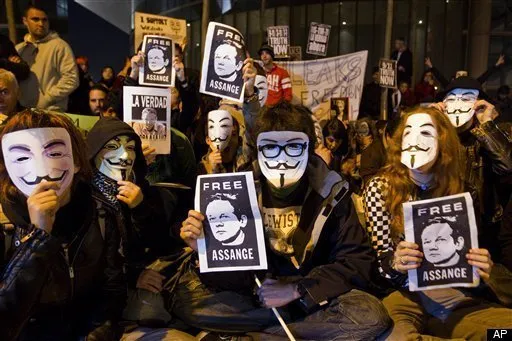
It is disappointing to see the same president who ran on his constitutional law professor bona fides devote so much time and effort to discrediting WikiLeaks and working up charges against its founder, Julian Assange. WikiLeaks, like the New York Times before it with the publication of the Pentagon Papers, has committed no crime. If the law of the land holds true, the administration will get nowhere with the foolish notion that Assange can be tried for conspiracy under the Espionage Act for doing what major media outlets do every day: publishing classified information about the government. The claim that somehow WikiLeaks is different because it allegedly encouraged sources to come forward is a red herring: even if the charge proves true, this is what journalists at every major media outlet in the country do every day.
Still, we wonder at those who assert that the cables "demonstrate no misconduct by the U.S." (Floyd Abrams) or "provide very little evidence of double-dealing or bad faith in U.S. foreign policy" (Gideon Rachman). In fact, the U.S. Embassy cables, like the Pentagon Papers, show our government involved in systemic wrongdoing and wide scale deception. They present irrefutable evidence that this administration and its predecessor have been tampering with other countries' legal systems to prevent prosecutions against government employees for committing human rights abuses and transgressing international law under often-secret post 9/11 policies.
This April 1, 2009, cable reveals the U.S. trying to derail the prosecution of the senior architects of the Bush administration's torture program in Spain. The U.S. frets that "The fact that this complaint targets former Administration legal officials may reflect a 'stepping-stone' strategy designed to pave the way for complaints against even more senior officials." When it looks to Chief Prosecutor Javier Zaragoza to stall or derail the proceedings, he reassures them: while "in all likelihood he would have no option but to open a case" he does not "envision indictments or arrest warrants in the near future." (Untrue, by the way. Zaragoza and the U.S. may have succeeded in stalling the investigation, but this week CCR will take the next steps toward encouraging the judge assigned to the case to move forward despite the failure of the U.S. to respond to his inquiries.)
This February 6, 2007, cable shows the previous administration trying to prevent Germany from prosecuting the 13 CIA agents who abducted German citizen Khaled el-Marsi and flew him to Afghanistan for interrogation as part of the U.S. "extraordinary rendition" program -- only to discover after many months that they had the wrong man. In public, Angela Merkel's office called for an investigation while Munich prosecutors issued arrest warrants for the agents. In private, the German Justice Ministry and Foreign Ministry reassured an anxious US that they were not interested in pursuing the case.
Like the NYT when it published the Pentagon Papers, WikiLeaks has been accused of irresponsibly dumping a large cache of top secret documents into the public domain that compromise the safety of our country and our allies. In fact, despite the hysterical claims of a variety of elected officials, there's been absolutely no documentation of any resulting harm, unless one counts the embarrassment of having Russian Premier Minister Vladimir Putin make fun of U.S. officials for trying to suppress free speech. WikiLeaks has only released 1,974 of the 251,287 cables in its possession, and none were classified as "top secret" (over half were not subject to classification at all). Finally, while its offer to go over redactions with the State Department prior to publication was ignored, the five major newspapers that have been publishing the cables have gone to great lengths to communicate with each other and the State Department regarding redactions.
Our government, as journalist and constitutional lawyer Glenn Greenwald has noted, increasingly wishes to operate through a one-way mirror where all of its citizens' activities are open for surveillance while the activities of the government itself increasingly take place behind a wall of executive privilege, untouchable even by judicial oversight. But democracy demands the cleansing light of openness as a guard against the abuses of power. We should thank WikiLeaks for shedding light on governmental wrongdoing. Now let us hope that the U.S. public, as well as its politicians and media, will consider investigating these abuses at least as important as maligning the messenger.
Vince Warren is the Executive Director of the Center for Constitutional Rights.