
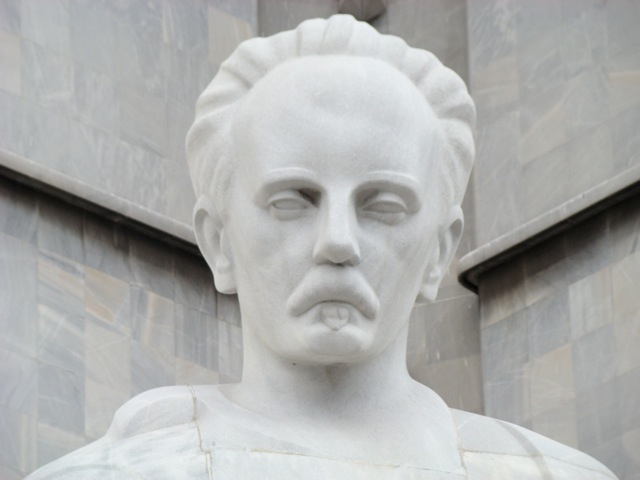
It is rare to find a Cuban who does not know a poem by Jose Marti, at least some bits and pieces of these simple verses that we memorize in elementary school. From the time we are tiny, at the morning assemblies in school, in Spanish classes, and in every political event we attended, we hear countless times the lyrics of this national hero. We are saturated by his person to the point where many identify him with the existing order of things and have even gone so far as to vandalize his busts in the poorest areas where the power frequently fails and there is not enough food.
But to return to the poetry of this man whom Cubans call "the Apostle," his most famous poems in particular have an almost childlike tone, full of ribbons and flowers and images, as in one with the title of "The Little Pink Shoes." Every child under ten can rattle off its eight-syllable lines and narrate the story told in verse. But they have also learned to declaim some of the many parodies of the poem, particularly the political ones that ridicule the system.
In fact, Marti is the most parodied of our authors, which is not a rebuke, but proof of the familiarity people have with his work. Among the many jokes fed by the work of this universal Havanan, are take-offs on "The Little Pink Shoes," in which the protagonist, Pilar, meets a poor little sick girl on the seashore. Without asking her mother, the rich girl takes off her shoes and gives them to the little pauper. She completes the generous gesture with, "Here, take mine, I have more at home."
This brief verse, written almost 150 years ago, is now an infinite source of jokes, parodies and imitations. It is used to mark the social differences that are becoming more evident and traumatic in a society where the official discourse continues to speak of equality.
The joke that has most taken hold among students, obliged to wear school uniforms, turns on the ability of determine everyone's purchasing power by looking at their feet. Although one of the most repeated government slogans is that on this Island there are no children walking the streets barefoot, the big question is where do parents get the money so that their children don't beat their heels against the asphalt. It's enough to look at the display windows and see the high prices for shoes to realize that based only on a salary -- as paid by the State -- no one can afford them.
These days the drama of children's shoes becomes more poignant, given the start of school and the overcrowding in the markets. It's not unexpected, then, that the parody of Jose Marti's poem is on everyone's lips, particularly because on the first day of classes hundreds of eyes will look to see what is below the pants and skirts.
The cost of the cheapest pair of shoes is equivalent to the average monthly wage of any worker. Thus, we must choose between living for thirty days or providing our children with a pair of sneakers, sandals or boots. Luckily people don't give in, and nearly everyone does something illegal to make sure their kids can head off to school fat and happy.
There are also generous family or friends who donate hand-me-down clothes or shoes to those who need them more. Those who have no clandestine business, divert resources from the State of appeal to family who live on the other side of the Straits of Florida. Ironically, it is the exiles who show the unreality of the official propaganda. The phrases echoing off the political billboards are sustained by the millions of dollars that enter the country each year through remittances.
But the parody of Marti's poem does not attack those with better shoes thanks to the effort or inventiveness of their families, but others who have obtained them by way of privilege. "Here, take mine, I have more at home," they whisper sarcastically at the son of colonel or of some trusted diplomat sent on foreign missions. And here the caricature of Pilar is invoked again and again, with her generosity, when someone brags about owning something that ordinary Cubans can barely dream of.
The teenage grandson of a general, for example, driving his own car, will be the target of the charming verse, as he boasts of his four wheels and their blazing tires. It is also a way of saying: we are watching, we know that everything you are showing off today comes by way of ideological loyalty. Sometimes it's enough to say, "Yes, I know, you have more at home," for the boastful to feel exposed and the vain to understand the ephemeral nature of the crumbs that come from power.
Because history is full of irony, and has a way of making fun of everything and everybody. The nineteenth century lyricism is changed, by grace of need and with humor, into verbal material for ridicule, the sweet revenge of those who have less. And at some distant point, the taciturn face of Marti, is thinking of his Pilar with her ribbons and straw hat, would be remembered as an example of goodness, not used as the point of a spear against the false discourse of egalitarianism.
Photo: MJ Porter, Translator
 Yoani's blog, Generation Y, can be read here in English translation.
Translating Cuba is a new compilation blog with Yoani and other Cuban bloggers in English.
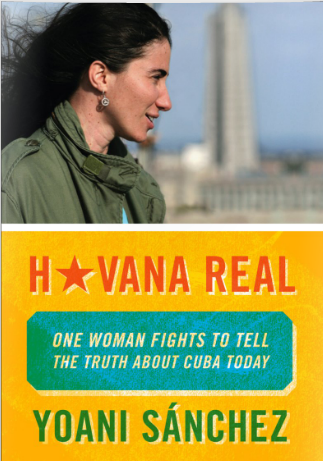
Yoani's new book in English, Havana Real, can be ordered here.