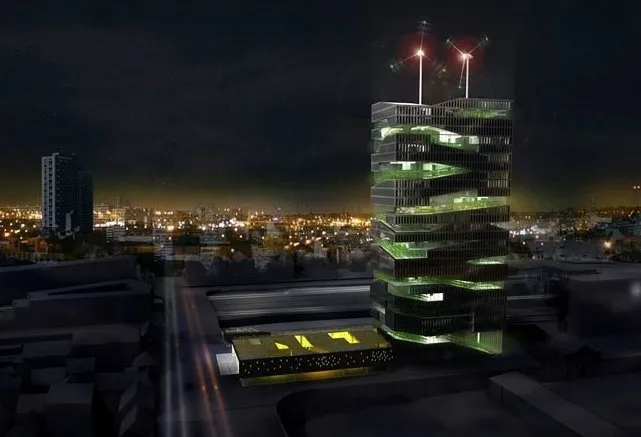
Are "Vertical Farms" The Next Wave In Eating Local?

digg Share this on Facebook Huffpost - stumble reddit del.ico.us RSS

New York Times   |  BINA VENKATARAMAN   |   July 14, 2008 11:08 PM


What if "eating local" in Shanghai or New York meant getting your fresh produce from five blocks away? And what if skyscrapers grew off the grid, as verdant, self-sustaining towers where city slickers cultivated their own food?

Dickson Despommier, a professor of public health at Columbia University, hopes to make these zucchini-in-the-sky visions a reality. Dr. Despommier's pet project is the "vertical farm," a concept he created in 1999 with graduate students in his class on medical ecology, the study of how the environment and human health interact.

The idea, which has captured the imagination of several architects in the United States and Europe in the past several years, just caught the eye of another big city dreamer: Scott M. Stringer, the Manhattan borough president.

When Mr. Stringer heard about the concept in June, he said he immediately pictured a "food farm" addition to the New York City skyline. "Obviously we don't have vast amounts of vacant land," he said in a phone interview. "But the sky is the limit in Manhattan." Mr. Stringer's office is "sketching out what it would take to pilot a vertical farm," and plans to pitch a feasibility study to the mayor's office within the next couple of months, he said.

"I think we can really do this," he added. "We could get the funding."

Read the whole story here.

 
Comments
37
Pending Comments
0
iPhone App Promo

Want to reply to a comment? Hint: Click "Reply" at the bottom of the comment; after being approved your comment will appear directly underneath the comment you replied to

View Comments:
photo

if you go hydroponic for a few months and get some kind of yield
will you then be able to stop growing and get agricultural subsidies
like they do in IOWA AND NEBRASKA AND GEORGIA, ETC.
if so this seems like a good way of getting on the federal subsidy
gravy train where they pay you not to grow which is too cool.
wonderful....the only problem is if everyone quits growing
to participate in the pork barrel everyone will suddenly starve.
there ought to be some laws written to prevent this. in the meantime
you can bet the giant food chains and agribusinesses are going to send one or two or perhaps
more lobbyists to DC to inspire LEGISLATION AGAINST THIS KIND
OF THING......THEY will invent grounds founded on constitutional
premises.........they will argue the constitution was written before
the existence of commercial electricity and therefore ths kind of
activity is essentially unamerican....you know this is coming as sure
as night follows day

    Favorite    Flag as abusive Posted 04:21 PM on 07/21/2008

Fine just don't let the world turn into this

http://en.wikipedia.org/wiki/The_World_Inside

or turn the remaining openspaces into urban sprawl

but maybe wilderness

and hydroponics aren't all that, my folks tried it at home, it took
a lotta effort for little produce.

Quit avoiding the elephant in the room-reduce way down human population growth-better but tough solution.

    Favorite    Flag as abusive Posted 10:49 AM on 07/19/2008
photo

Then your parents were doing it wrong. I have found it yields great results with less work that traditional methods.

    Favorite    Flag as abusive Posted 11:47 AM on 07/19/2008

I always find it funny that, whether right or left, many people tend to dismiss new ideas (I know...30 years old, blah, blah, blah) out of hand. It is absolutely absurd. Any field that will be dealing with the issue of global warming will also be dealing with several other issues. Whether the ideas come from engineers, architects, or city planners, they must answer more than one question when they PROPOSE solutions.

This idea has a lot of merit to it and yet several people here think its dumb. I want everyone here to think about how food comes to us. Figure out how much water, fuel, and labor is wasted in what is an incredibly inefficient process (farming). Find a solution that is a good alternative and reduces the aforementioned waste. And while you're at it, have that solution deal with other issues like pollution, economics, community pride, and population density issues...Not so easy is it?

This idea surely has some drawbacks and problems. But think of the positives. Hydroponics is efficient on water (also, remember they will use rain water collection). Larger plant densities have the capability of filtering our air. You'll need unskilled labor to run them (think putting people back in the workforce). And then there is: WHEN WAS THE LAST TIME A FLOOD DROWNED A SKYSCRAPER? Come on people. Open your minds, and if you can't stay out of the way and don't poo poo every other idea that comes your way.

    Favorite    Flag as abusive Posted 11:05 AM on 07/17/2008

Typical slick architectural rendering completely ignores the fact that plants/crops just don't grow effectively without access to direct sunlight.

The answer is above: stop sprawl and integrate plots of farmland among the built environment.

Architects always foolishly believe that the answer to any problem can be solved with a building.

    Favorite    Flag as abusive Posted 06:01 PM on 07/15/2008
photo

Well Bro, guess YOU have never seen a grow house full of pot get busted, have you? Those plants look pretty green and healthy to me.

Talk about foolishness.

"Better to be silent and thought a fool than to speak and remove all doubt"

    Favorite    Flag as abusive Posted 06:54 PM on 07/15/2008

That also takes a huge amount of electricity to grow those plants. I think hydroponics is a good idea, but buildings of this size are not.

    Favorite    Flag as abusive Posted 11:19 PM on 07/15/2008

Pot farms are horribly inefficient. And last I checked it didn't cost $60 for an 1/8 of tomatoes.

PLUS:

Soil must be constantly recharged, with the right amount of minerals, organic material, etc., and requires 10 times as much water in order to maintain proper moisture levels. Soil adjacent to barriers (plastic, concrete) that would form the walls and floors of this project does not 'breathe' - as this condition prevents the movement of air and nutrients. Soil dies in these areas, as water collects, the organic material in the soil rots. Plants need this precious balance.

All these resources need to be brought into the city somehow. That will require a lot of energy - more than those decorative windmills in the rendering could provide. This building is basically a giant potted plant. Have YOU ever received food sustenance from a potted plant? Nope.

Answer: End sprawl. Maintain farmland adjacent to cities. Done.

    Favorite    Flag as abusive Posted 10:11 AM on 07/16/2008

There are commercial products looking for this kind of home. For example: http://www.valcent.net/s/HDVGS.asp?ReportID=264273

I recall many years ago visiting some future world thinggy at Disney World where they had hydroponic gardens and Talapia tanks, both of which seemed rather productive. They did not smell, but seemed to be producing some good food.

If anything, buildings which are used as vertical farms should produce oxygen as a byproduct; a thing of which urban cores need more.

    Favorite    Flag as abusive Posted 01:14 PM on 07/15/2008

Despommier "created" this in 1999?? Please! This tired old Popular Science fantasy has been around for decades.

So you use concrete, steel glass grow lights hydroponics? Sounds real sustainable. Despite Despommier's claims, this idea has been around for at least 30 years, and has never been omplemented. Why? It's not practical. Please look at this article about a ground up urban farming effort in Detroit. It's inspirational.

http://news.bbc.co.uk/2/hi/americas/7495717.stm

    Favorite    Flag as abusive Posted 08:02 AM on 07/15/2008
photo

We have been smelting metals and making concrete since long before the use of fossil fuels. We will continue to do so in the 'green' era.no doubt about it.

Actually the ideas have pretty much been implemented. We have profitable greenhouse hydroponics operations going on all over the world. This model is novel in that the greehouses are stacked on top of each other , that the only real diffference.

The models have not been implemented to the extent they have because resources such as energy, fertilizer, cropland, water have been relatively cheap. With the need to squeeze the most possible out of ever scarcer resources the economics for this can change pretty quickly.

    Favorite    Flag as abusive Posted 04:47 PM on 07/16/2008

This is pretty silly - you're certainly not going to feed many people with buildings like this.

We have plenty of cropland near cities - we just need to take better care of it, and stop building malls on prime agricultural land.

    Favorite    Flag as abusive Posted 02:39 AM on 07/15/2008

Easier said that done.

Plus climate change doesn't exactly foster stable growing conditions.

A vertical farm is 365/24/7 of prime growing. And I've read that one structure could feed 35,000 people or so. Not bad!

Anything to advance society forward, better a food skyscraper than another banking high-rise.

    Favorite    Flag as abusive Posted 10:43 AM on 07/15/2008

It can feed 35,000 people? I hope you are aware that under the most optimal conditions it takes about one third of an acre to feed a human being. So that means the building we are talking about needs roughly 10,000 acres of area exposed to the sun. Since one square mile is 640 acres, the building you have in mind would need to have a facade of almost 16 square miles. Four miles wide and four miles high...

Sorry... it does not work that way.

    Favorite    Flag as abusive Posted 01:43 PM on 07/15/2008

I disagree. This is not a silly idea. What's silly is failure to look at how the surrounding area's agricultural practices are unsustainable for high density population centers. The economics of just "gourmet" lettuce varieties, over 21 million heads of lettuce consumed in greater NY per month at about a dollar a head, grown hydroponically and in an automated process reveals a payback in less than ten years while reducing the energy spent on transportation and providing benefits of clean water and compost.

    Favorite    Flag as abusive Posted 12:47 PM on 07/15/2008

I hope you are aware that lettuce is not a food. Eating sane amounts of it do next to nothing for the caloric needs of a human being. We add it to our food like we add herbs and spices. It is fun because it crunches. It has a wonderful texture. It can hold a dressing really well. But as a food it is an environmental catastrophe, no matter how it is grown.

    Favorite    Flag as abusive Posted 01:39 PM on 07/15/2008
- huh I'm a Fan of huh permalink

sounds like a good idea. but i wonder what they're going to do about the strong smell of manure/fertilizer. farms are smelly places, i wouldn't want all of that funk to be concentrated in one building where I work.

    Favorite    Flag as abusive Posted 01:55 AM on 07/15/2008

Sounds like you're talking about factory farms, which shouldn't exist at all.

This structure would be entirely self-contained and sustainable, ie no energy needed from the grid and no smeller output.

    Favorite    Flag as abusive Posted 10:47 AM on 07/15/2008
photo

Hydroponics isn't just a system to grow good pot. We should have been building vertical farms for the last 30 years.

    Favorite    Flag as abusive Posted 01:22 AM on 07/15/2008

And the reason we didn't is because it doesn't work for growing real food. Salad is not food. Neither is pot.

    Favorite    Flag as abusive Posted 01:46 PM on 07/15/2008

Hydroponics does work.

    Favorite    Flag as abusive Posted 11:26 PM on 07/15/2008
photo

Kill you simply don't know what you are talking about. Hydro is used all over the world to grow real food. Has for decades.

    Favorite    Flag as abusive Posted 04:38 PM on 07/16/2008

what's you definition of 'real food'?

    Favorite    Flag as abusive Posted 06:33 PM on 07/16/2008
photo

I'd like to see what a person could do with an old 3 story parking garage.

    Favorite    Flag as abusive Posted 11:54 PM on 07/14/2008

They could use it as a parking garage and put solar panels on top. The energy from the solar panels can then be used to make nitrogen fertilizer which then can be used to grow food on a farm. If you do the energetics, you will see that this is about as good as it gets.

    Favorite    Flag as abusive Posted 01:46 PM on 07/15/2008
photo

Your energetics would work a lot better putting those nitrates into a vertical farm as it wastes much less water and fertilizer than conventional methods.

    Favorite    Flag as abusive Posted 04:38 PM on 07/16/2008
Comments are closed for this entry

You must be logged in to reply to this comment. Log in  or  Connect