Corporate Responsibility: How Can U.S. Economy Stay Competitive, Get Greener?

digg Share this on Facebook Huffpost - stumble reddit del.ico.us RSS

Envrionmental Capital   |  Keith Johnson   |   July 24, 2008 09:52 AM


Big U.S. companies obviously want a seat at the table when it's time to draw up America's plan to fight climate change. A year after issuing its "Call for Action," the U.S. Climate Action Partnership--a group of 30-odd companies like Alcoa, GE, GM, Ford, and several environmental groups--released today the list of nine principles it wants policymakers to keep in mind when they're hammering out climate deals. But when it comes to the really tricky stuff, USCAP--like U.S. politicians so far--punted.

The main principles call for global involvement in any climate plan, and lots of carrots for developing countries. But the thorniest issue of all is left for later. That is--when countries move at different speeds to tackle climate change, it creates an uneven playing field for plenty of industries. Dirty industries penalized by restrictive legislation can move where laws are lax, killing jobs while providing no benefit to the environment.

Read the full story here

-OR-

Read about a rare prison sentence for an environmental crime in Oregon. Is this the only way? Or will this put the U.S. economy in even more dire straits?

Big U.S. companies obviously want a seat at the table when it's time to draw up America's plan to fight climate change. A year after issuing its "Call for Action," the U.S. Climate Action Partnership-...
 
Comments
27
Pending Comments
0
iPhone App Promo

Want to reply to a comment? Hint: Click "Reply" at the bottom of the comment; after being approved your comment will appear directly underneath the comment you replied to

View Comments:

It always gives me chills to see any effort involving some of the core of the military industrial complex. Not that they have ever created fake causes and manipulated government programs for their own gain.

    Favorite    Flag as abusive Posted 08:05 PM on 07/24/2008

I am wondering how this will be enforced, once there is agreement. It almost seems hopeless, at times, doesn't it? I am skeptical, especially of the MINDSET of corporate leaders. Unfortunately, I have worked amongst them at one time.. Their conversation indicated more concern on finding a "good wine" than a reverence for nature.

Anthropologist V. Cornue has a post about it at http://www.Vaboomer.com from the perspective of the individual.

    Favorite    Flag as abusive Posted 03:46 PM on 07/24/2008


...This is EXACTLY why I have long argued for field-leveling tariffs.

Simply put, as our industry is "penalized" by being forced to have responsible environmental protections in place, and by being forced to have sensible labor laws (workplace safety, minimum wage, no child labor, etc), tariffs based on product origin level the field by effectively raising the price on goods produced to be where the responsible business' prices are. So, when a product comes from somewhere with equivalent or superior environmental and labor regulation, there is no tariff. at all. And when a product comes from a place without any, or with very poor regulation, the tariff makes up the difference, so the consumer can then buy the responsible product if they wish as it costs about the same as the irresponsible product.

Yes, there will necessarily be some effort that needs to be placed in determining effective tariffs, but final prices in stores can help the process along...
.

    Favorite    Flag as abusive Posted 12:04 PM on 07/24/2008
photo

Putting tariffs on products for whatever reason raises the cost of that product. If a start-up can't afford steel at US prices they might buy Country X steel at a lower price. If the cost of Country X steel is raised to be equal that of US steel then I can't afford any steel at all and my company doesn't get started and I don't hire anyone to work in the building I couldn't afford to build. Or I can relocate to India, buy the Country X steel and the US workers are still unemployed

    Favorite    Flag as abusive Posted 12:33 PM on 07/24/2008

Is it my imagination or have you just essentially written off all American Businesses?

Might I point out that there is a huge difference between "cheapest" and "cheap enough to sustain a business." The race, IMO, is fo rthe former and mischaracterizing it as the latter.

    Favorite    Flag as abusive Posted 01:16 PM on 07/24/2008

If people need your product, they will pay you whatever it takes to build it. The fear that somehow we won't be able to afford anything anymore is completely irrational. It is also a great tool for fear mongers to make the most gullible vote for the republicans.

If you can build something cheaper in India or China, you will do it independently of the price for steel. Steel could cost nothing in the US, if labor is the dominant cost, the labor will leave. This is nothing but a pseudo argument to distract from the real problem.

    Favorite    Flag as abusive Posted 01:38 PM on 07/24/2008

Zzzzzzzzzzzzzzzzzzzzzzzzzzzzzzzzzzzzzzzzzzz

    Favorite    Flag as abusive Posted 01:43 PM on 07/24/2008

why not put "fair trade" laws into all trade treaties, so that we will only trade with countries which adequately protect workers and the environment? Surely there is enough interest in trading with the US in at least some industries in every country to make significant changes. It's kind of like membership in the EU - they demand that genocidal maniacs be brought to justice, that women and children not routinely be sold into sex slavery, that entire races and genders not be reduced to lower-class citizens, etc. Why can't the US take a moral stance over free trade rules? Lord knows we're a bunch of pompous religious nuts - why not be moral, too?

We already have NAFTA which has done nothing to improve life in ANY member nations, except at the very top of the Robber Baron corporate pyramid. They, of course, have access to numerous exploitation opportunities (human and environmental) that they did not enjoy previously, and which have resulted in massive degradation of huge regions, over-consumption of cheap crap by US citizens, and more misery all around. Woops. Time for a do-over.

    Favorite    Flag as abusive Posted 02:12 PM on 07/24/2008


Great idea, but, sadly, it should have been done as a prerequisite to China Most Favored Nation status. And, in fact, at the time (during Clinton), I argued (ineffectually) for much the same as you propose.

Now, however, enacting something like this would require some kind of transition because we and the rest of the similar nations don't make enough products to meet our own needs anymore - not even close. So, we'd be cutting off our nose to spite our face.

I like the goal, though, and, were I "the decider", we'd move to that model at every opportunity. Meanwhile, tariffs are politically possible, if not the ideal.
.

    Favorite    Flag as abusive Posted 01:21 AM on 07/25/2008
photo

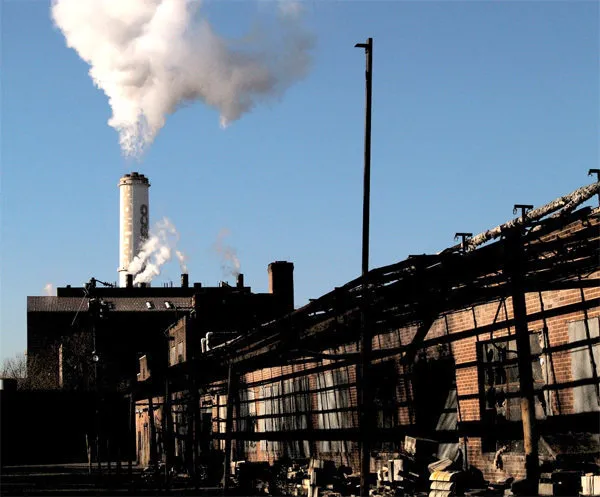
what can corporations do to fight global warming? hmm, they can capture through condensation the water vapor coming out of that ''smoke'' stack in the photo, and others like it.

    Favorite    Flag as abusive Posted 11:06 AM on 07/24/2008


Water emissions are NOT a problem... It's what else is in the plume that's of concern.
.

    Favorite    Flag as abusive Posted 12:08 PM on 07/24/2008
photo

i remember you telling me once that you were a scientist, too.

    Favorite    Flag as abusive Posted 12:39 PM on 07/24/2008

actually, the Rocky Mountain Institute has designed Net Zero buildings which DO capture condensation (in Hawaii, it is a significant resource), and recycle it for use in toilets and irrigation. It will not, strictly speaking, directly help prevent global warming, but one of the results of global warming is said to be droughts and lack of freshwater supplies, so condensation capture should definitely be part of any well-considered program.

that's not to say anything about what is in the photo, because I don't know. but you (accidentally?) hit on an interesting point...

    Favorite    Flag as abusive Posted 02:19 PM on 07/24/2008
photo

hi sheila! thanks for your input. the ''smoke'' coming out of that stack in the photo is water vapor, not smoke (you can tell because of the gap between the stack and the cloud). water vapor being a more powerful greenhouse gas than even co2 ( cold desert nights attest to that), it seems to me that condensation capture should be at the forefront of anthropogenic global warming discussions. i'm encouraged by your post that it has been addressed proactively at least somewhere. thanks again!

    Favorite    Flag as abusive Posted 03:09 PM on 07/24/2008
photo

What I've always wondered about -- but never hear anyone speak of is the heat escaping from houses and buildings' roofs. How might this energy be capture, recycled or otherwise utilized?

    Favorite    Flag as abusive Posted 03:10 PM on 07/24/2008
Comments are closed for this entry

You must be logged in to reply to this comment. Log in  or  Connect