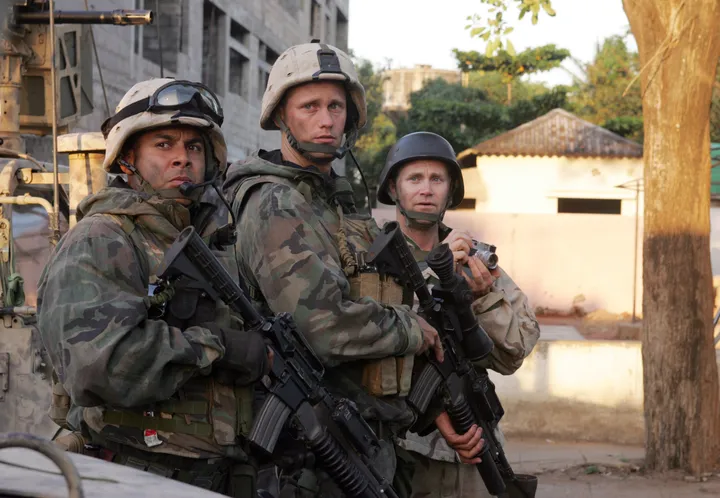
Generation Kill is a new HBO miniseries that follows a platoon of Marines through the first 40 days of the Iraq War.
It's based on a nonfiction book by Evan Wright, a Rolling Stone contributing editor who was embedded with the First Recon Marines during the 2003 invasion. The book won a national magazine award, and was adapted to the small screen by David Simon and Ed Burns, the team behind "The Wire."
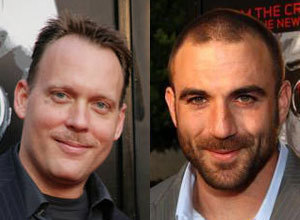
We sat down with Wright (below left) and Eric Kocher, one of the Marines portrayed in the show (below right). They told us about the flack they took when the book was published (hint: Wright got handcuffed by an angry sergeant), what happened to the loony platoon commander known as "Captain America" after the invasion, and shared some of the best moments that didn't make it into the series.
Here's some of what they had to say:
Huffington Post: Evan -- how did you end up covering the war in Iraq?
Evan Wright: My specialty was writing about young subcultures like radical environmentalists, skateboarders, criminals. When the war started in Afghanistan, I went to my editor and said since I write about youth subcultures, the military's another young subculture, so why don't I just write about that? So that was my first job in a combat zone.
Eric, had you been in combat before the Iraq war?
Eric Kocher: I did a tour in Afghanistan. We were down in Australia during 9/11 and pretty much went straight up. We operated in Pakistan for about a month and then in October sometime we landed in Afghanistan.
Evan -- had you actually had any preparation or any training before going into your first war zone?
EW: No. I did live with a half-Armenian girl for six months, I found that was good preparation for combat.
Did you have any idea what you were getting yourself into when you showed up with the First Recon?
EW: Not really. My biggest concern was not getting a story. And what I really I thought I wanted to get was a forward unit, but I believed that the Iraqis would just be surrendering like they had in the First Gulf War.
Eric -- did you expect that too? Did you expect the invasion to be a cakewalk?
EK: I'm not sure what we expected, really. We were doing a whole different mission than what we were trained for. My world was very small there. It was pretty much: keep my team alive and fight to the best of my knowledge. But not until reading Generation Kill did I finally understand the grand scope of what were doing. So much stuff was filtered by the time it gets to us [on the ground]. We were out of the loop.
The first forty days was almost like a prequel to your war, isn't it?
EW: This story is about a different war. It was maneuver warfare. Rumsfeld's plan was actually very successful in those first 20 to 40 days. It totally imploded when you got to the occupation. But sending in a smaller, more mobile force ... we probably did cause many fewer casualties than if we sent in 300,000 troops in at once.
Where the miniseries is actually relevant -- the reason it is not just an ancient history of maneuver warfare -- is that we encountered on the way with our own eyes everything that was going to come. So everything you see in Episode 4, when they liberate the small towns and some people are looting, we saw everything.
Eric -- was there a turning point for you, when everything seemed to start going downhill?
EK: My last tour was pretty rough. I spent a lot of time just south of Falluja. I lost quite a few guys. We have these 22-year-old kids getting paid $32,000 a year to make strategic-level decisions. And we just didn't put the thought into it. That's why Rumsfeld's idea of making more elite units was actually pretty good. The problem is he implemented it during combat. Out of 120,000 guys over there, I can only control 24. In my opinion, we were doing the best we could.
I went into a house once and it kind of shocked me. It was after that guy, that PFC [private first class] raped that girl and burned the bodies. The sheik of the area came up and asked me please not to rape his daughters. I didn't know what to say. We'd been doing such good stuff. It was like, "Goddamn, this is what they think?" They truly did believe that. We're fucking shit up.
Evan, your platoon commander earned the nickname "Captain America" because he emptied a magazine on an abandoned S.U.V., shot an Iraqi in the back and tried to bayonet a couple of prisoners. Why wasn't he reprimanded? What happened to him afterwards?
EK: He was a solid guy. Really sharp, respected by his platoon. The problem is some people just aren't cut out for combat. Somehow he found himself in combat in a leadership position. He made a lot of mistakes but the problem is, he continued that trend of mistakes. Nobody relieved him. Everybody knew about it. The problem is it is a grey area ... did he really cross the line? There were 20 other things he did that were definitely questionable. He progressively got worse. It was subtle. Every firefight he was in, his paranoia snowballed. And then he got to the point where he started acting out. His security blanket was pulling the trigger. I think he's working with the DIA [Defense Intelligence Agency] now. In the military, you get blacklisted. He got back from his deployment, and he was kind of pushed to Florida.
EW: One of the questions I always get is were you afraid? I was terrified. But I learned very quickly my fear manifested itself by trying to become more calm. Because I rationally thought, if I panic then I will become less aware. I won't notice what's happening and I have to understand what's happening to survive. If I was screaming and yelling like I really wanted to do, I would die. With Captain America, his fear made him behave irrationally.
Eric -- why did you and your guys open up to Evan?
EK: It was simple. Your standard reporter goes over there, they survive one firefight or get in harm's way, they pack their bags, [and] go home with their story. They have a little piece of it, or so they think. And that's it. Once a bullet zips by their head they're like, "What the fuck am I over here for?"
After the first firefight you earn a bit little of street cred. Everybody's like, "Fuck, reporter's still here." We were waiting for him to pack his bags. And every firefight he stayed, he could have gone home. But he stayed the whole duration, to see how the story ends. Seventeen firefights, especially when the first one he took 26 rounds in the side of his door. I'm sure inside he was falling apart and pissing himself, but on the outside he carried himself like it was no big deal, like the rest of us.
Evan -- Did you feel useless because you couldn't fire a gun?
EW: On a human level it would have been really exciting to shoot a gun over there. I can hit a target with a rifle generally but that very different from what they do.
There's one moment that's not in the show where they handed me a weapon in the vehicle. We were rolling through a sketchy town. Everyone was like, "You're occupying a seat; you're useless, take a gun." The enormity of the responsibility you have -- it sounds corny here back home -- but if you're really out there with these Marines and you're holding a weapon ... I was like, what if I hear an engine backfire and I pull the trigger? It wasn't [so much the fear] that I'd kill an innocent Iraqi -- that was a problem -- but if I fuck up, I'll get kicked out of the embed. That was my practical reason. When Geraldo was in Afghanistan and he was like, "I'm packing a .45," I was like, "C'mon dude."
Evan -- what's different in the miniseries? How faithful is it to your book?
EW: The film version is different in one key way, and I know it's frustrating for an audience because we don't feed you the info of what's happening. In the book, it's contextualized. I did follow up reporting. There's a little map you can refer to. I explain in the first chapter the overall concept of what they're going to do. I have this artificial omniscience as this narrator. In the movie, we don't give any of that explanation. When you're in that Humvee, you don't really know what's happening. The audience experiences the action of the film in a way that's much closer to the way we experienced it on the ground. In that sense the adaptation is more realistic than the book.
Eric -- was the book a good thing for you?
EK: It wasn't a good thing -- well no, it was. People got to hear our story whether they liked it or not. When I ended up with Second Recon battalion, I was on my fourth combat tour. That sergeant major made me assistant team leader to a corporal, a guy one pay grade lower than me with no combat tours. Because our sergeant major called over there and put in a bad word. It's a really small community. Recon is only 800 guys. They really started to try and dirty my name.
EW: I had showed up at Camp Pendleton with Rudy Reyes' wife to greet him when he came back from a deployment. I'd signed in at the base, and I'm standing there at sunrise, and as the sun came up I hear "Hey, Evan Wright!" It was [a] first sergeant I didn't really know. He came up to me and he's like, "You got to get off the base right now." And he had someone put handcuffs on me. I said, "Why are you doing this?" He said, "Because we don't like your book. We're going to throw you in a car and drive you out to the desert and make you walk back." He put me in the back of a car, and I could see them all standing around just like, "Whoops, we just handcuffed a reporter." They decided to escort me off the base. So I'm in the car for 20 minutes. The MP's not really a party to any of this, but he has to keep me cuffed -- we're driving in silence -- and then he goes, "Hey you know I liked your book. You think you could ever sign a copy for me?" And I was like, "Sure dude, why don't you take the cuffs off me, I think I have one in my car."
Final question -- what should or could have been done differently?
EW: There's one little thing we left out just because it would have added five more minutes to an already too-long episode. Those surrendering Iraqis [at the end of Episode 1] were carrying atropine injectors [and] gas masks, and when they were debriefed, some of them said were with the unit that was guarding chemical weapon missile systems that were going to be launched at us.
Saddam's sham of chemical weapons was so deep rooted and so elaborate that he wasn't just lying to Americans, he was lying to his own people. Imagine if we had found WMD and we were like, "Okay, this is a justified war, we belong here." But it's still going wrong.