
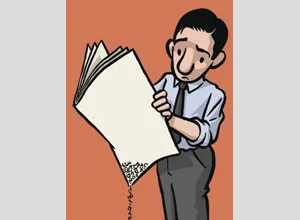
The New Yorker Takes On The Dying Newspaper Industry

digg Share this on Facebook Huffpost - The New Yorker Takes On The Dying Newspaper Industry stumble reddit del.ico.us RSS


First Posted: 12-15-08 07:46 AM   |   Updated: 01-15-09 05:12 AM

I Like ItI Don’t Like It
New Yorker Newspapers

New Yorker:

There's no mystery as to the source of all the trouble: advertising revenue has dried up. In the third quarter alone, it dropped eighteen per cent, or almost two billion dollars, from last year. For most of the past decade, newspaper companies had profit margins that were the envy of other industries. This year, they have been happy just to stay in the black. Many traditional advertisers, like big department stores, are struggling, and the bursting of the housing bubble has devastated real-estate advertising. Even online ads, which were supposed to rescue the business, have declined lately, and they are, in any case, nowhere near as lucrative as their print counterparts. Papers' attempts to deal with the new environment by cutting costs haven't helped: trimming staff and reducing coverage make newspapers less appealing to readers and advertisers. It may be no coincidence that papers that have avoided the steepest cutbacks, like the Wall Street Journal and USA Today, have done a better job of holding onto readers.

Newspaper readership has been slowly dropping for decades--as a percentage of the population, newspapers have about half as many subscribers as they did four decades ago--but the Internet helped turn that slow puncture into a blowout. Papers now seem to be the equivalent of the railroads at the start of the twentieth century--a once-great business eclipsed by a new technology. In a famous 1960 article called "Marketing Myopia," Theodore Levitt held up the railroads as a quintessential example of companies' inability to adapt to changing circumstances. Levitt argued that a focus on products rather than on customers led the companies to misunderstand their core business. Had the bosses realized that they were in the transportation business, rather than the railroad business, they could have moved into trucking and air transport, rather than letting other companies dominate. By extension, many argue that if newspapers had understood they were in the information business, rather than the print business, they would have adapted more quickly and more successfully to the Net.

Read the whole story: New Yorker

There's no mystery as to the source of all the trouble: advertising revenue has dried up. In the third quarter alone, it dropped eighteen per cent, or almost two billion dollars, from last year. For m...
Filed by Danny Shea  |  Report Corrections
 
Comments
3
Pending Comments
0
iPhone App Promo

Want to reply to a comment? Hint: Click "Reply" at the bottom of the comment; after being approved your comment will appear directly underneath the comment you replied to

View Comments:
- Henryk A. Kowalczyk - Huffpost Blogger I'm a Fan of Henryk A. Kowalczyk 16 fans permalink
photo

Saving dying newspapers could be in the old fashion hard work.

Mr. Surowiecki points correctly that the "a perfect storm" could be seen as the perfect test that the Chicago Tribune failed.

I put a few ideas in this texts,
http://www.huffingtonpost.com/henryk-a-kowalczyk/the-perfect-test-that-the_b_153554.html

    Favorite    Flag as abusive Posted 05:14 PM on 01/04/2009
photo

if they did the job they were given 200 plus years ago they might not be where they are today .

they have become complicit lazy inept consolidated meaning ( they have forgotten who they work for )

and in so doing we as a nation have given up and turned are backs sides to them turning not once to look back

    Favorite    Flag as abusive Posted 12:13 PM on 12/15/2008
- larry278 I'm a Fan of larry278 43 fans permalink

Yes, public newspapers could be like public radio & TV, complete with pledge weeks, aka begathons, to solicit money from the public so a public newspaper could be like public radio & TV & be 'free' of ads. You know, "Dr Herbert, gentle dentistry" , is underwriting this hour of WIMP, public radio, style ad free.

    Favorite    Flag as abusive Posted 10:51 AM on 12/15/2008
Comments are closed for this entry

 You must be logged in to comment. Log in  or connect with 

Connect