iPhone app iPad app Android phone app Android tablet app More

AFL-CIO Advances Employee Free Choice Battle With New Poll

First Posted: 02/07/09 05:12 AM ET Updated: 05/25/11 02:00 PM ET

Free

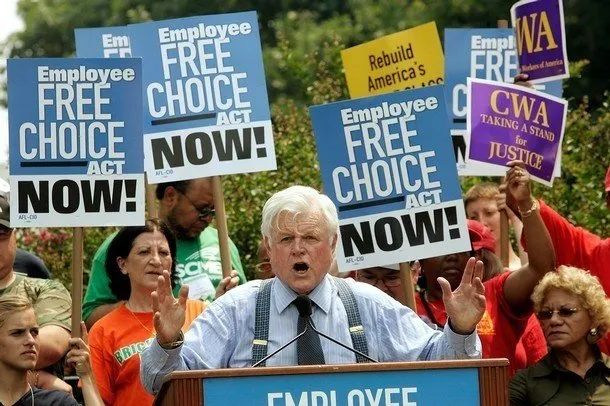
The AFL-CIO, one of the country's most powerful unions, has commissioned a new poll on the Employee Free Choice Act showing that their messaging on the legislation resonates with a broad and bipartisan swath of the population.

The survey, conducted by Hart Research Associates and provided to the Huffington Post by a union official, is meant in part to demonstrate that contention over the bill is mostly limited to the halls of power in Washington; among ordinary Americans, union officials say, EFCA enjoys strong support.

According to the study, 73 percent of adults said that they supported the Employee Free Choice Act when read the union's descriptions of the bill's three main provisions. Respondents, for instance, were asked if they favored EFCA provisions that allowed "employees to have a union once a majority of employees in a workplace sign authorization cards" or "strengthen[ed] penalties for companies that illegally intimidate or fire employees who try to form a union."

Meanwhile, nearly four in five (78 percent) said they favored legislation that generally would "make it easier for workers to bargain with their employers for better wages, benefits and working conditions."

Opponents of the bill undoubtedly have polls of their own to trumpet. The business-funded Coalition for a Democratic Workplace last year asked respondents questions such as, "Should federal laws be changed by Congress to make it much easier for unions to hold elections in non-union work places to organize more workers into unions or should the laws be left the way they are now?"

And yet, Democrats believe the anti-EFCA ad campaigns run during the 2008 election season by groups like the Chamber of Commerce were largely ineffective. Certainly, the AFL-CIO poll demonstrates that labor leaders have an opening on the issue if they can push the right message. Sixty-nine percent of Independents and 74 percent of moderates and Liberal republicans said they favored the legislation, as described in the AFL-CIO poll.

Passage of the Employee Free Choice Act could be one of the more dramatic legislative battles in the new Congress. Barack Obama pledged on the campaign trail, and reaffirmed during his presidential transition, that the legislation -- which would ease the process by which workers unionize -- would be a priority.

But opposition from Republicans in the Senate will be intense. The House of Representatives in 2007 passed the act easily. Senate Democrats, however, were unable to obtain the 60 votes needed for cloture. Majority Leader Harry Reid has added to his ranks since then, but a handful of Democrats have not agreed to back the bill, and very few Republicans are likely to cross the aisle to support it (Pennsylvania's Arlen Specter is seen as the most likely candidate). For that reason, the future of the Employee Free Choice Act remains very much up in the air.

Some other data points from the AFL-CIO's study:

-- Only 21 percent of respondents, when read the union's description of the Employee Free Choice Act, said that they opposed the legislation.

-- Of the three parts of the EFCA, the broadest support was for the majority sign-up provision, which allows workers to more easily and quickly form a union.

-- Sixty-nine percent of whites, 88 percent of African Americans, and 76 percent of Hispanics supported EFCA (as described in the survey).

-- The legislation is most popular in the Northeast (81 percent) and least popular in the South (67 percent)

FOLLOW HUFFPOST POLITICS


  • Comments
  • 46
  • Pending Comments
  • 0
  • View FAQ
Comments are closed for this entry
View All
Recency  | 
Popularity
Page: 1 2  Next ›  Last »  (2 total)
photo
HUFFPOST SUPER USER
DaCoach
06:29 AM on 01/09/2009
I fully support the bill with one exception. The right to privacy in voting is non negotiable. Make the voting a secret ballot and the bill passes Congress with ease. I don't understand the insistence that voting be public unless 1/3 request it. Imagine if our national elections were public.
HUFFPOST PUNDIT
JimR
11:01 AM on 01/09/2009
We need LESS secrecy in government, not more. What you are proposing is not only unconstitutional, it's downright scary.
photo
HUFFPOST SUPER USER
DaCoach
08:36 PM on 01/11/2009
I'd suggest you reread the constitution before you make claims that are absurd. You'll not find any rights broken when votes in a union representation case are done by secret ballot. It has nothing to do with constitutional guarantees.
03:39 AM on 01/09/2009
During WW2, Henry Kaiser offered his workers profit sharing in order improve production. No need of a union. At the end of the war, corporate industries put him out of business. How dare the workers want a slice of the pie.

Right to work states guarantee their own low wages and benefits.

Kinda like when farmer rubes and hicks in the South gave up their lives in order to protect the rich slave owners.
03:29 AM on 01/09/2009
First of all. The AFL-CIO is not a union. It's is a group of unions. Kind of like the UN is not a country.
HUFFPOST SUPER USER
laborgrunt
03:16 AM on 01/09/2009
I will tell you this more workers are intimated by employers and forced NOT to join unions then the unions intimating workers to join in.
All of you have fallen for the stereotypical view of unions. Thanks to people like those against this bill, America is behind other industrialist countries when it comes to workplace rights.
03:09 AM on 01/09/2009
I am going to do everything I can to help push this issue...it is a top priority in my opinion. If we want to not only strengthen but grow the middle class and offer ladders of opportunity to those in the lower income class who work just as hard as everyone else WE MUST DO EVERYTHING WE CAN TO GET THE EMPLOYEE FREE CHOICE ACT PASSED!!!
03:00 AM on 01/09/2009
This should be a top priority if we are gonna strengthen the middle class and allow workers to earn a LIVING WAGE and have much needed representation. There are no good reasons to be against this....just paranoid propaganda.
01:13 AM on 01/09/2009
Union people are so stupid. Passing the law will not help the unions. It will help kill them.
If it passes, all the jobs will go to the right to work states. Ohio and Michigan will have the populations of the Dakatos.
03:05 AM on 01/09/2009
redhot, "my friend" you have proven to be the "stupid" one.
09:34 PM on 01/08/2009
I'm sorry. I don't support Stalinism.
03:00 AM on 01/09/2009
That's great.... but you should support the EFCA!
03:06 AM on 01/09/2009
DAdvocate, that statement is rather ignorant................
05:59 PM on 01/08/2009
First no employer gets a union that doesn't earn one. Under the current system, if the employees offer a one hundred percent showing of signed union cards, it is the employer that can ignore that kind of showing and demand an election. If the employees want an election, they can petion for an election with as little as a 30%. And the abilty of the Union organization to intimidate prospective members in this age of audio/vidio devices everwhere is limited and doesn't work. Most if not all efforts of a union to target an employer, where the employees did not contact the union, are usually doomed for failure as well. No employer demands an election out of concern of intimidation of the employees. It is much easier for employer to buttonhole an employee. So if this passes companies brought it on themselves.
02:59 PM on 01/08/2009
Other than winning the "world's most mislabeled bill" I don't think the "End Voting Priviliges for Workers that Every Other American Has" Bill is going anywhere when an objective person actually explains what the Bill is to you.
08:06 PM on 01/09/2009
I suppose you supported Bush's "Clear Skies Initiative" which allowed increased air pollution. Bush wins ALL awards for naming bills the exact opposite of what they do.

If an objective person explains what the Bill does, people will either support it or oppose it based upon whether they think corporate intimidation or union intimidation is the bigger threat.

It's that simple.
02:01 PM on 01/08/2009
This bill is the = of PROP 8 and the fairness doctrine in its horrible misleading propaganda.....There is no choice here.....
photo
HUFFPOST SUPER USER
spartacus275
I'm still here
04:14 PM on 01/08/2009
You are dead wrong on this issue, the choice is very clear. Under the EFCA - employees would have the CHOICE of signing an authorization card which would indicate their desire for union representation. Employees also would have the CHOICE to easily refuse to do so as well. On the other hand the so-call CHOICE that workers have now is to be subjected to tremendous pressure from their employer during an NLRB run election process where many workers are often fired for expressing the slightest indication that they are leaning towards voting for union representation. The CHOICE is clear, a process free of employer intimidation or one where the employees are free to decide absent of any pressures. If you doubt my claim of employer intimidation check the daily docket at any NLRB region office in the country. There you will find numerous examples of charges file against employers for harassment of employees during the so-called free CHOICE elections that exist today.
This user has chosen to opt out of the Badges program
03:02 AM on 01/09/2009
I helped organize a teacher's union and can verify the truth of your comment. I now have a livable pension as a consequence. Workers need a union to represent them because of an obvious imbalance of power between a worker and most employers. " Power tends to corrupt and absolute power corrupts absolutely."
As the old song said, "You can't scare me. I'm sticking with the union."
Or if you hate unions your song should be "Work and pray. Live on hay. There will be pie in the sky when you die."
HUFFPOST PUNDIT
AnnfromCA
12:51 PM on 01/08/2009
The right to vote privately should not be discarded.
01:50 PM on 01/08/2009
If you remove the secret ballot, it would remove the freedom of the employee. The one reason many people support this is because it has free choice in it which can be mis-leading, other than that unoins can be a good thing.
05:43 PM on 01/08/2009
Zippy,

Describe to me exactly how the secret ballot system works when a worker wants to unionize.
05:14 PM on 01/08/2009
I see you fell for the Chamber of Commerce red herring argument. This isn't about secret voting or not, as the law provides that if 1/3 of the workers request a secret vote, then secret vote it is.

If I thought you cared, I'd explain why the secret ballot results in companies intimidating anyone trying to organize a union including firing.
12:39 PM on 01/08/2009
This seems like a flawed bill, and this article seems biased for not reporting the obvious risks to employees who are denied secret ballot elections.

There may be legitimate reasons to reduce hurdles to union representation in companies, but all employees should have a guarantee that their votes (to certify, to decertify) will be held in confidence to avoid retribution from either unions or employers.
07:54 PM on 01/09/2009
Fine, but the existing law and practice puts all the intimidation power on the side of the corporation.
12:21 PM on 01/08/2009
As long as a person can NOT be harmed in any way, who cares if it is secret or not?

This has to pass and I am betting it will.
01:41 PM on 01/08/2009
"As long as a person can NOT be harmed in any way"..

If it is a secret ballot, then you can't single out an employee for voting one way or another (by either side) for retaliation or intimidation.

If the ballot is not secret, you have a ready made list of people voting the "wrong" way (again for either side).

Which way is likely to produce MORE people "getting harmed"?
05:47 PM on 01/08/2009
If the process were that simple, e.g., a group can just say "let's have a secret vote tomorrow on whether to have a union", perhaps it wouldn't be a problem. But that is not what happens. It takes months, and during that time the company relentlessly works against voting for the union and fires anyone they perceive to be in favor of a union. The choice is not between secret voting vs. non-secret, the choice is between two very different processes for arriving at a decision.
HUFFPOST SUPER USER
OlskoolDem
03:07 PM on 01/08/2009
if it's a secret ballot that ballot box can be stuffed by the corp. it's better out in the open.
10:29 PM on 01/08/2009
I'm a UAW member and believe me management gets nowhere near those ballot boxes. It would be much easier for Union officials to stuff the ballot boxes. Although I'm a union member I'm still against EFAC.
photo
Aldyth
Advocating for those who cannot defend themselves.
11:37 AM on 01/08/2009
I can't support the bill as long as the right to a secret ballot is not guaranteed. It is fundamental to a democratic process.
12:39 PM on 01/08/2009
That is BS right-wing talking point. This bill WILL NOT eliminate the secret ballot. It's big business pushing that "secret ballot for democracy" meme. Do you really thing their primary concern is protecting workers right to privacy? Is that really what they will be spending millions to defend?
01:39 PM on 01/08/2009
Ok, so all it does is offer the OPTION to eliminate it. But if they had it before, and now they use the option to eliminate it, that will be portrayed as taking away someone's right to a private ballot.

I don't care what their motivation is- all I know is that if you think selling the idea of someone losing their right to a secret ballot is anything less than a hopeless effort you are delusional.

So, as long as that provision is in there (and despite numerous posts asking why so far NOBODY has offered a reason why the secret ballot SHOULD be eliminated) this bill will get spun and spun by big business and the right and have no chance of surviving. Seems like a really tone deaf and brain dead way to try and kill a bill that the polls listed above show that a majority of americans seem to otherwise agree with.
03:00 PM on 01/08/2009
You could not be more wrong. Eliminating the secret ballot is the key reason and purpose for the bill.