iPhone app iPad app Android phone app Android tablet app More

As Economy Crashed, Banks Made A Killing On Overdraft Fees

First Posted: 03/18/10 06:12 AM ET Updated: 05/25/11 03:15 PM ET

Bank

Talk about kicking people when they're down.

Banks and credit unions made an eye-popping $24 billion in overdraft fees in 2008, according to a report released Tuesday by the nonprofit Center for Responsible Lending.

That's a 35 percent increase from 2006.

The report estimates that about 51 million people were affected - meaning that one in six Americans were hit, on average, with $470 in overdraft fees last year.

The fees, which banks levy when approving check, debit card and ATM transactions despite a customer's lack of sufficient funds, have become a source of big business for financial institutions: nearly half of all banks and credit unions make more money from overdraft services than they make in profits, according to Moebs Services, an economic research firm. The firm estimates banks will make $27 billion off overdraft programs this year, and says this is the first time banks have raised their overdraft fees during a recession.

While billed as a convenience for customers who otherwise would see their purchases denied, the practice amounts to little more than a trap for consumers who don't know the precise dollar amount in their checking accounts, consumer advocates say. Banks typically enroll consumers in these programs automatically.

In addition, when it comes to tallying the fees, some banks post debits from the highest amount to the lowest, rather than chronologically, so a $4 purchase at 10 a.m. at Starbucks is posted to the account after a $68 dinner bill that created a negative balance, making each subject to a fee.

A number of lawsuits argue that the banks do this intentionally to increase overdraft fees, thereby boosting profits.

It's a phenomenon that regulators and legislators are trying to beat back after years of failed attempts. The Federal Reserve is mulling new rules, and Representative Carolyn Maloney (D-N.Y.) introduced a bill in March that calls for consumers to be alerted every time a debit card purchase would overdraw an account. Senator Chris Dodd (D-Conn.) is expected to introduce similar legislation.

Sensing the heat, some banks have begun to pull back. Bank of America, JPMorgan Chase and Wells Fargo announced changes to their overdraft programs. One such move: finally allowing customers to opt out of the service.

A recent survey of 679 adults by Consumers Union, the nonprofit publisher of Consumer Reports, found that two-thirds of bank customers said they preferred to expressly authorize overdraft transactions.

Here's a chart from Moebs showing how the fees have increased in the last two decades:
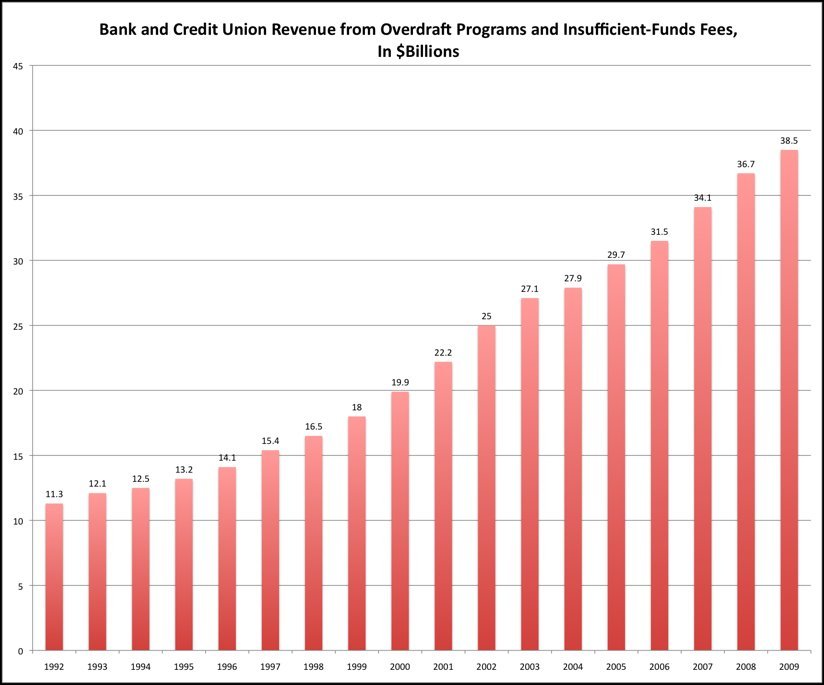

Source: Moebs Services
*2009 figure is an estimate

Here's a chart from Moebs showing how the fees make banks look even more predatory than payday lenders:
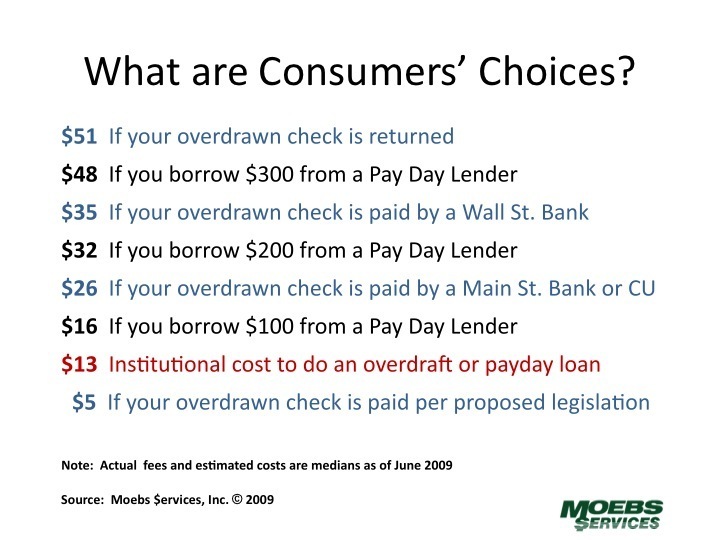

Source: Moebs Services

The bank lobby has been fighting proposed government oversight of overdraft programs for years. In 2007, the American Bankers Association testified before Congress, "specifically oppos[ing] proposals to require an opt-in for customers to have overdrafts paid or authorized, calculation of an APR for overdraft fees, and disclosure of a potential overdraft at the point of sale or ATM," according to the group's Web site. Those are the three things consumer advocates and certain members of Congress have been demanding for years.

In May 2008, federal banking agencies proposed rules governing overdraft charges, including prohibiting banks from charging overdraft fees unless consumers were provided an opportunity to opt out and failed to do so. The "ABA vigorously opposed this regulatory proposal," the group's Web site notes.

While the proposed rules were open to public comment, the Independent Community Bankers of America, another bank lobby, circulated a memo to its members urging them to send their comments to the federal agencies. Among the key points for the banks to consider when writing the agencies were "most customers welcome overdraft protection" and "requiring the opt-out notice in every statement cycle there is an overdraft is information overload for consumers and unnecessarily expensive and burdensome." The ICBA noted that disclosing fees should be enough and that an annual opportunity to opt out of overdraft protection was sufficient.

When it comes to overdraft fees, big banks charge the most. Banks with at least $50 billion in assets charge about $35 per overdraft, according to Michael Moebs, the founder of Moebs Services. Smaller banks charge about $28. But smaller banks will typically reverse the fee for customers in good standing, he adds.

"If people have a problem with their account and they're not abusive, if they're at a community bank [the bank] would refund you the money -- guaranteed," Moebs says. "That's why I tell people to have their accounts at community institutions."

Lilia Lopez-Rahman is one of millions of Americans who were hit with overdraft charges last year.

A retired pastor living in Hawaii, Lopez-Rahman, 70, thought she'd have no trouble last fall refinancing her mortgage for a lower monthly payment. But her lender saw a problem: Lopez-Rahman had a negative balance of hundreds of dollars on a Bank of America checking account she thought she'd closed in 2007.

After a series of phone calls, she discovered that the bank, after cutting her a closing check for the account balance, had apparently continued to charge $1.74 per month for accidental death insurance.

"When the account turned negative, the overdraft protection then deposited $100 [into] my account," said Lopez-Rahman, 70, "They kept on charging this overdraft protection." Fees to cover the unwanted insurance piled up in the account she thought was closed. Then debt collectors started harassing her for $386 they said she owed the bank. With her credit score ruined, refinancing the mortgage was no longer a possibility.

In its report, the Center for Responsible Lending calls for a number of changes, including improved disclosure of the true cost of overdraft programs, fee limits and getting banks and credit unions to provide customers with a warning every time they are in danger of overdrawing on their accounts.

Read the report HERE:

Overdraft Explosion -

Additional reporting by Arthur Delaney.

HuffPost readers: Have you been hit with outrageous overdraft fees? Let us know your story. Email arthur@huffingtonpost.com.

Get HuffPost Business On Facebook and Twitter!

FOLLOW HUFFPOST BUSINESS

Talk about kicking people when they're down. Banks and credit unions made an eye-popping $24 billion in overdraft fees in 2008, according to a report released Tuesday by the nonprofit Center for R...
 
 
  • Comments
  • 315
  • Pending Comments
  • 0
  • View FAQ
Comments are closed for this entry
View All
Favorites
Bloggers
Recency  | 
Popularity
Page: 1 2 3 4 5  Next ›  Last »  (11 total)
08:19 PM on 01/30/2010
My bank, Susquehanna Bank in Boonsboro, Md. is in the process of settling with me over my suing them for my overdraft fees back. They are giving me all of them back that I asked for over the last 2 years but the lawyer says that I must close my checking account immediately because the poor little bank can't afford my bad balancing problems. They just built an addition on the front made of brick and trapezoid huge windows. They didn't hire anyone new, just wanted bigger offices. THey make one girl at the window handle 2 busy drivethru lanes on Thursday and Friday afternoons while the managers just sit in the office and don't offer to help the poor girl and get the customer through quickly. They push transactions thru quickly sometimes but yet not at other times and my paycheck takes forever to deposit. I do not feel guilty at all asking for them back because I never bounced checks when I used them . I have only had this problem since the invention of the check card. I am going back to checks starting right now. I thought this may help someone else. Just file a small claims suit in District court and make them pay you back. They are ripping the pubic off and its all pure greed. We need to put them back in their place to protect our money not to steal it from us.
02:57 PM on 10/19/2009
i have a credit card i had to use to survive and pay for rent and medical insurances, when a payment is made i dont make much progress, then a finance charge is charged over 100 then if their fee puts me over the limit they charge me an overage fee of 39.00 for their first fee, i have no problem bank of america
naming you and also the monthly bank fee went up 3.00 to 8.95 and my savings fee went up 2.00
the economy is down but their fees go up!!!!!! i complained many times and someone said something like
well we offer more serviced so we raised our fees

like health insurance
it should be for the sick
those who need it
not those who are perfeclty healthy dont need it
go to a doctor once a year
gosh
they can get insurance
those who dont need it
get it for great prices
those who are sick
are penalized severly
gosh

money may indeed be the root of all evil
and is sure the root of banks and health insurances

someone needs to stick to stick it to them
08:00 PM on 10/07/2009
Criminal banks extort money by withholding banking services like timely balances avaialble to account holders and delay check clearing.

That any news publication would print or court would accept the banks' claim that they are helping already impoverished people by paying their grocery tab and charging usurious fees at the rate of 100s of % points, is ludicrous and a sign of a society without heart, soul or a right to exist.
photo
HUFFPOST SUPER USER
Tim303
02:53 PM on 10/07/2009
In the land of "weak" Europeans they'd never get away with it. HA.
HUFFPOST SUPER USER
Jimboy17
12:24 PM on 10/07/2009
Aside from regulating the gouging the banks routinely give their customers, we all need to learn to live within our means. Myself included (hello overdraft fees!).
11:25 AM on 10/11/2009
Easier said than done. Unemployment is between 10% and 20%. Jobs are still being outsourced overseas. Those fortunate to still have jobs are expected to work 50-60 hours per week and be paid only for 40 hours, even forced to work 80 hours per week, if the employer knows you have no other options. Sudden unemployment lowers monthly income to half of what had been earned. The landlord cannot lower your rent just because you are receiving unemployment checks. Unless you've been budgeting as if you were already unemployed while you were working, your living from paycheck to paycheck has been above your means without you knowing it.
12:15 PM on 10/07/2009
good articles; http://iamned1.blogspot.com
12:15 PM on 10/07/2009
Everything but the little people have become too big to fail.

Everyday we pay the consequences of Reaganomics and neoconservative economics

80's: Arthur Laffer, MIlton Freidman, Greenspan, Alexander M. Haig, Jr, Donald T. Regan, James A. Baker 3rd,
Later: Robert Rubin, Bernanke, Paulson
10:51 PM on 10/06/2009
JP Morgan Chase Bank took out a full page ad in the NYTimes announcing that they would not only allow bank customers to "opt out" of automatic debit card overdrafts, but they also would "forgive' fees for small transgressions. I think the ad said something like not charging huge fees for "small mistakes" like a large coffee at Starbucks. I made a small mistake and was charged a fee for it. The purchase on my debit card was for around $6. They allowed the purchase and charged a $35 overdraft fee. I called Chase and cited the ad that came out the very day the overdraft fee posted to my account. They said that the new policy (the one in the full page ad) did not take effect until 2010. So, it is inaccurate to say that they have changed policies. They took out an advertisement saying they were changing policies, but everything is as it was. I shouldn't have let my account get so low, but in times of economic troubles, people spend their buffers. The point is, while I don't deny my responsibility, the full page ad Chase took out in the Times claiming a new policy was misleading. They need to take responsibility too.
photo
kk78
Someday Texas will be blue again
09:10 AM on 10/07/2009
Isnt that false advertising?
12:43 PM on 10/07/2009
That detail was in the mouse print at bottom of ad.
photo
HUFFPOST SUPER USER
MSMSucksCom
Sadly, my bio fits in this space.
09:29 PM on 10/06/2009
IMHO the simple solution to all this is to allow us to opt out of this supposed customer convenience.

Anything else is not a solution, such as disclosures or warnings. Fact is, the banks design the system so people think they have money that they actually don't. They then make purchases and the bounced "check" fees start rolling in.

Thins about what crooks these banks are. They used to say that $35 charges were necessary to cover the cost of handling bounced checks.

With computers that eliminated that argument since everything is done by the machines, so it's probably pennies to handle an overdraft.

So now they come out with the customer convenience argument. But when the customer calls the bank to say they don't want that convenience, the Banks say "No, you can't opt out."

Throw em all in prison (the bankers).
09:26 PM on 10/06/2009
Bank of AM charged me $72. yesterday for accidentally depositing a check that was intended for a different bank's drive thru. Instead of sending it back in the tube when the account number/name didn't match, they accepted it and charged a fee for "administrative costs." A $72. non refundable fee!
photo
HUFFPOST SUPER USER
pflickner
Democratic Candidate for AZ State House LD15
09:20 PM on 10/06/2009
My daughter got charged $50 by Desert Schools when she went over $2.33 -- she'd miscalculated. They refused to give her a bye, so I've pulled my money out and moved it into my ING account and had her open one. I've only been charged a small amount of interest on the amount I went over -- about $4 the last time -- when I've gone over what's in the Electric Orange.
photo
HUFFPOST SUPER USER
DandyDon2k
08:45 PM on 10/06/2009
I get text messages to my phone whenever a deposit posts, an overdraft fee is incurred, or balance falls below $50. I have made deposits before 2 pm (the cut off time for that day), and the next day make a charge to my debit card. Very early the next morning, my phone goes off with overdraft fees, only to have the deposit post 15 seconds AFTER they overdraft me!! This is robbery, and HAS to be stopped!
photo
HUFFPOST SUPER USER
Josh Seipp
10:11 AM on 10/07/2009
Yeah this has started happeing to us more and more.
photo
HUFFPOST SUPER USER
treetracker
12:24 PM on 10/07/2009
I deposited a IRS refund check that I could have gone to the teller (per the teller) and cashed in full and then deposited the cash. Since I deposited it, they applied their 1 day rule - but they're supposed to allow you access to $100. That $100 would have cleared my check. But their amount and the amount listed in my on line banking account were different amounts. So they charged the overdraft fee.

The last time it happened, they bounced 6 or 7 checks and told me there was a three day waiting period on checks to clear - whereas the teller told me there was a 1 day period. The would only reverse half of them.

I'm moving my account to a credit union next month. I've had it with these banks. They are crooks of the highest order.
08:37 PM on 10/06/2009
Yes! My bank ~ Bank of America ~ charges *$38* per overdraft item. What's ironic about this is that, although in the old days a human person in the bank had to physically handle an overdrawn check, nowadays it's all simply done by computer, so there is no rational justification for these outrageous fees! Having been unemployed for 17 months, I do occasionally make this mistake as I try to keep bills paid and sometimes misjudge when an automatic payment will come through, so I know all too well about this tactic. It sucks audibly.
photo
dennisc68
Fine Art Finger Painter
08:23 PM on 10/06/2009
I agree with keeping your checkbook register up to date, yet with online banking SO MANY do not and we've come to expect that our banking records are current and up to the minute. That's not bad except so many of the banks have outrageously inadequate systems - much due to mergers.

But do as I did and if you don't want these fees.. simply call your bank and OPT OUT of their Overdraft "Convenience" Program. This just means that if you are making an electronic purchase.. at the time of purchase if the funds aren't in your account, they will simply deny the purchase.

I personally am OK with a "Oh crap" moment standing at a check out if I happen to have made a mistake or if the bank made a mistake. I'd personally rather know where I am at or what the bank is up to BEFORE they take money from my account.

The way we send these greedy companies a message is that you get on the phone right now or send an email to everyone you know and tell them to call their bank and OPT OUT of this program.
They will soon get the message to change their ways or they'll lose this gold mind of a business model.
photo
HUFFPOST SUPER USER
MSMSucksCom
Sadly, my bio fits in this space.
09:24 PM on 10/06/2009
You don't get the point mister. BANKS DON'T ALL CUSTOMERS TO OPT OUT OF THIS. In other words, if someone calls the bank and says "I don't want the convenience. Do NOT approve the charge. I'd rather be embarrasses trying to buy a $2 coffee at Starbucks rather than have you (bank) approve the purchase and charge me a $40 overdraft fee."

If you do that with most major banks they will NOT let you opt out. I tried doing that with Wells Fargo, they said they would not do that. My friend tried that too, after the got hit with about $700 in profits, excuse me, overdraft fees. They would not allow her to opt out.

That's the crime, that banks won't let us opt out of supposed overdraft protection. The con job is that they tell legislators that this is a convenience to customers and to prevent their embarrassment of having a charge disapproved.

Of course that begs the question, if this is a customer convenience issue, then why doesn't the customer get to say thanks, but no thanks to this supposed great service.

It's because they don't want to give up this huge cash cow profit center.
08:14 PM on 10/07/2009
Oecause it affects only those living paycheck to paycheck. A $2,000 limit in your account would make overdrafts moot. So your senators and congressman aren't affected by this; the struggling salaried, poor and disabled are.

Its a class issue: screw the poor and get rich. The more poor the better for TPTB. That's why an immigration invasion of more than 20,000,000 poor people has been encouraged.
photo
HUFFPOST SUPER USER
oxygen
love is like oxygen
08:01 PM on 10/06/2009
I paid (after overdraft charges) around 170 bucks for 5 cups of coffee at dunkin donuts
09:00 PM on 10/06/2009
Why would you tell the world that?
photo
HUFFPOST COMMUNITY MODERATOR
PWM
Eisenhower Republican. Liberalism = Liberty
08:47 AM on 10/07/2009
Why not.
This user has chosen to opt out of the Badges program
photo
08:30 AM on 10/07/2009
Have your tank checked.