Editor's Note: This is the second of three articles by the Investigative Fund on the credit rating companies. Read the first article here.
When the nation's top credit rating companies came under attack in Washington in recent years, Charles E. Schumer often emerged as their strongest ally.
As recently as 2006, the senior senator from New York questioned whether new oversight legislation was necessary given that the companies, "located in the great city of New York," were already "making good-faith efforts to improve the transparency of their ratings." At a Senate hearing that spring, he encouraged the chairman of the Securities and Exchange Commission not to ignore the raters' central argument against government interference - that their ratings of bonds are just opinions, protected by the First Amendment.
But a year later, as the nation reeled from an economic meltdown, the Democratic senator changed his mind. He lashed out at the companies for awarding top grades to bonds comprised of high-risk mortgages. When the bonds defaulted, investors lost billions.
"My particular bugaboo here are the credit agencies," Schumer told a press conference in December 2007. "The investors who bought this can't be expected to know all the nooks and crannies."
Schumer's turnabout is at once a symbol of the credit rating industry's past success on Capitol Hill and its more precarious future. Some of the same politicians who used to go to bat for the companies are supporting bills in the House and Senate that would mandate stricter oversight.
Yet passage of either bill is far from assured, and in the meantime the three big raters -- Standard & Poor's, Moody's and Fitch -- are spending record amounts to lobby lawmakers and regulators.
For years, the credit raters have stated that they are open to stronger supervision from Congress and the SEC. But behind the scenes they repeatedly have quashed or watered down potential government rules by arguing that, much like a newspaper editorial, ratings are protected by the constitutional right to free speech, according to a Huffington Post Investigative Fund review of congressional testimony, SEC documents and lobbying reports.
The companies say they gather facts to form educated opinions about the safety of bonds. Ratings are not, the companies say, guarantees that the bonds will or will not default.
So far the courts have agreed with the credit raters, but some specialists in constitutional and securities law find fault with the argument that a bond rater is akin to a journalist.
"To the extent that they are successful in claiming protections under the First Amendment, this could have rather dangerous consequences and seriously undermine the sense of transparency in the U.S. capital markets," said Michael Siebecker, a University of Florida law professor and former arbitrator for the National Association of Securities Dealers.
Pushing Back the SEC
Investors rely on credit rating companies to be their eyes and ears in the bond markets.
The companies have been around for a century, growing increasingly important to the U.S. and global financial systems. When corporations, banks or local governments want to borrow money from investors, they issue debt in the form of bonds. The rating companies determine the likelihood of default by assigning bonds a letter grade -- ranging from the safest triple-A to the "junk" bond status of C or lower.
Until the 1970s, the raters charged investors for their work. Then they shifted, assigning fees to the corporations that issue the bonds. Critics have claimed that the switch caused an inherent conflict of interest, giving the rating companies the incentive to please the bond issuers rather than the investors.
The idea that the companies needed more accountability gained traction at the SEC in the mid-1990s. But nearly every time the SEC has proposed credit rating regulation over the last 15 years, the companies have filed comments with the commission invoking the First Amendment defense, records show. In response, the SEC has often either abandoned or modified its attempts.
In 1997, when the SEC aimed to define the job of a credit rating agency, the general counsel for Moody's filed a comment objecting that among other things new regulation would "Erode the First Amendment rights of all publishers of credit opinion." The SEC eventually abandoned the plan.
"You might come up with something that makes everybody happy, and we won't have to legislate."
-- Sen. Charles E. Schumer (D-N.Y.), 2007 Press Conference
In 2000, the SEC was pondering a crackdown on insider trading. If financial players selectively disclosed information to an interested party, the SEC wanted them to share the information publicly.
Moody's spoke up and asked for an exemption for the credit raters. "The rating agency's role is analogous to that of a newspaper or magazine publisher, not to the role of a legal or financial advisor," the company's vice president said in a comment filed with the SEC.
The SEC approved the rule--and the exemption for rating companies.
'On a Pedestal'
In the wake of the Enron scandal, the raters finally braced for a change. The companies had left high grades on Enron's bonds just four days before it filed for bankruptcy in 2001.
At an SEC hearing in 2002, the commission's chief economist challenged the rating companies to voluntarily drop their free-speech claims. Leo C. O'Neill, then president of S&P, declined. "I don't think that we should be asked to waive our rights under the First Amendment," he said.
No new rules arose from the hearings.
In 2003, the SEC did float the idea of having its staff inspect the companies' rating procedures. O'Neill again rebuffed the SEC, this time in a comment filed with the commission. The plan "would likely run afoul of fundamental First Amendment principles," his comment said.
The SEC's plan never materialized.
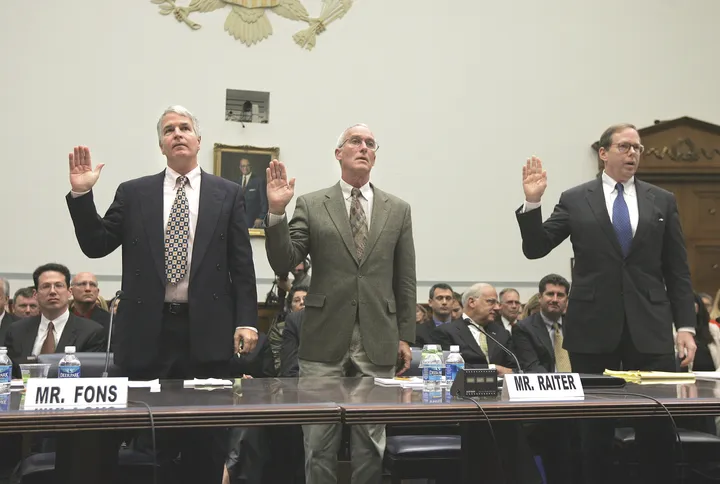
Failing to impose rules on the credit raters, the SEC instead turned to a voluntary oversight plan. Jerome Fons, a Moody's managing director, recalled in a recent interview that he was on vacation in March 2004 when the SEC called to pitch the idea.
Fons jumped at the plan, he said, and his bosses were receptive. "We thought it was great," Fons said. The voluntary plan balanced the First Amendment protections with concerns that the companies were unregulated, Fons said.
Eventually, though, the credit raters learned that as part of the plan the SEC's enforcement officers wanted access to some of their records. "That's when the lawyers said, 'No, that's not going to happen,'" said Fons, who now consults on credit issues.
In an interview, Richard Y. Roberts, who was an SEC commissioner from 1990 to 1995, said the SEC "put the rating agencies on a pedestal."
Roberts said he first warned the commission 15 years ago about the danger of lax oversight. "They did not use the authority they had, even though it wasn't much," he said.
An SEC spokesman declined to discuss decisions made under past SEC chairmen or the commission's current regulatory proposals.
'That Would Be Pleasant'
On the wall of his Langhorne, Pa., law office, former congressman Michael Fitzpatrick hangs a framed copy of the bill that he had hoped would rein in the rating companies. It reminds him of both a legislative victory and a lost opportunity.
In 2005, as a freshman Republican on Capitol Hill, Fitzpatrick was alarmed that the rating companies were players in virtually every recent financial mishap yet had little oversight from the SEC.
"We believed that the rating agencies had consistently failed to perform their basic mission, which is to provide timely and accurate ratings," he said. Meanwhile, the companies were enjoying record profits in 2005. Moody's saw net income of $560 million and Standard & Poor's reported $1 billion, including earnings from its S&P stock index.
So Fitzpatrick proposed a bill to allow the SEC to "take action against" the companies if they issued ratings that violated their own internal procedures. He met resistance. At a 2005 hearing, Rep. Paul E. Kanjorski (D-Pa.,) warned that Congress must be "very sensitive to the First Amendment issue posed in these debates."
The legislation nonetheless passed the House in 2006, the first time either chamber of Congress had approved new oversight of the raters. (Kanjorski was one of the 165 Democrats who voted against Fitzpatrick's bill. Kanjorski is now chairman of the House subcommittee on capital markets and the author of the pending credit rating oversight legislation.)
When the Senate took up Fitzpatrick's measure, the rating companies brandished the free-speech defense. Standard & Poor's submitted a memo to Congress that said the bill had "fatal constitutional defects."
"Courts have repeatedly held that rating agencies are entitled to similar constitutional protections as, say, The Wall Street Journal or BusinessWeek," Vickie Tillman, then executive vice president of Standard & Poor's, told a Senate committee in March 2006. "This is so because the activities of rating agencies are fundamentally journalistic."
At another Senate hearing in April 2006, Schumer, the New York Democrat, questioned then-SEC Chairman Christopher Cox about showing "sensitivity" to the companies' First Amendment rights. Without those rights, Schumer said, investors might "threaten to sue" the rating companies or "bamboozle them, push them around."
Schumer encouraged Cox to revive the voluntary oversight plan. "You might come up with something that makes everybody happy, and we won't have to legislate," Schumer told Cox.
"That would be pleasant all around," Cox responded.
Schumer agreed: "Yes, it would," adding that the companies still "need to be strictly regulated."
Weakening the Bill
Despite Schumer's efforts, Fitzpatrick's bill advanced. But it carried an amendment -- which records show was introduced by Sen. Mitch McConnell (R-Ky.) -- forbidding the SEC from regulating "the substance of credit ratings or the procedures and methodologies."
That echoed language in the Standard & Poor's memo previously submitted to Congress, which had warned that SEC regulation of rating "procedures and methodologies" would "affect the substance of those ratings."
The Senate's amendment also parroted Schumer's words at a hearing the year before: "The regulation of these entities should not mean dictating the content of their businesses." The bill passed and was signed by President Bush in September 2006.
Fitzpatrick, who lost his seat in the 2006 midterm election, blames Schumer for weakening the law. "Mr. Schumer from New York became involved with doing their bidding," he said. "A bill was passed that was much less reforming than what I shepherded in."
In 2007, following the dictates of the new legislation, the SEC adopted rules requiring the companies to publicly disclose their rating methodologies, performance of their ratings and potential conflicts of interest. The SEC also aimed to prohibit credit raters from the "coercive or abusive" practice of slashing a company's bond rating when the company refuses to buy additional ratings.
May 2007 letter from Sens. Schumer, Menendez, Sununu and Enzi to the SEC.
Schumer again intervened.
He and three other senators -- Michael Enzi, a Wyoming Republican; John Sununu, a New Hampshire Republican; and Robert Menendez, Democrat of New Jersey -- wrote Cox a letter in May 2007 to "express our concern" over the plan. The senators reminded Cox that the 2006 law required the SEC to enforce "narrowly tailored" regulations.
Four months later, it was clear the housing bubble was bursting, and the raters were vilified for misjudging mortgage-backed bonds. Schumer did an about-face. He announced at a September 2007 Senate hearing: "I will tell all of the representatives of [rating] companies that I have worked with and defended in the past -- they're good New York companies -- to say nothing went wrong, that ain't going to fly."
He also has urged the SEC to sanction Moody's if the commission verified allegations that the firm issued inflated ratings and covered up the error.
Asked to comment on the senator's change in position about the rating companies, Schumer's spokesman, Brian Fallon, said in an e-mail that the rating companies "treated their ratings as negotiable to please their clients, and ended up as one of the main culprits behind the economic crisis. As a result, Senator Schumer has been one of the lead proponents in Congress for drastically overhauling this industry's business model in order to root out inherent conflicts of interest once and for all."
Turning to Lobbyists
In the wake of the financial crisis, the credit raters say they have tightened internal controls and made it harder for products such as mortgage-backed bonds to receive rosy ratings.
All three big raters also have filed comments with the SEC encouraging some additional regulation. In September, the SEC approved rules that require the companies to make public all of their ratings, beginning with those issued in 2007.
Floyd Abrams, the renowned First Amendment lawyer who has defended Standard & Poor's for more than 20 years, said that the SEC already has "significant oversight powers." He said that another check on the companies is the market itself, because if the ratings aren't credible the companies won't be able to sell them.
Still, Abrams said, "I think that, in light of the events of recent years, more regulation by the commission is in the interest not only of the public but of the rating agencies."
Moody's and Fitch declined to comment for this article.
Some aspects of Kanjorski's bill, now making its way through the House, concern the credit raters. They object, in particular, to a provision that would allow investors to sue the companies if it later turned out that they had failed to follow their own internal rules in assigning a rating.
Even stronger provisions emerged in the Senate on Tuesday, when Democrat Christopher Dodd of Connecticut unveiled his financial reform plan. Dodd's plan would make it easier for investors to sue the credit rating companies if they could show the raters "knowingly or recklessly" failed to fully investigate a bond.
Facing the new pressure from Congress, the credit raters have stepped up their lobbying. In the first nine months of 2009, records show, the companies collectively spent almost $2.7 million, already $180,000 more than they spent in all of 2008 and the most they have ever spent in a year. Of the big three raters, Standard & Poor's has spent the most so far this year on lobbying --about $1.5 million--though that amount includes some lobbying for its parent company, McGraw Hill. Standard & Poor's lobbyists also have cast the widest net--taking their case to the White House, SEC, FDIC, Federal Reserve and Treasury Department, records show.
Congress must be "very sensitive to the First Amendment issue posed in these debates."
-- Rep. Paul E. Kanjorski (D-Pa.), 2005 House Hearing
Recently joining the company's campaign is the influential Podesta Group and its owner, Tony Podesta. His brother, John Podesta, was co-chairman of President Obama's transition committee. The Podesta group also has Israel Klein, Schumer's former communications director, lobbying for the rating company.
An S&P spokesman noted that the rating industry's lobbying expenses are paltry relative to that of banks and other financial players.
Moody's has spent $820,000 this year on lobbyists that include former Sen. Lauch Faircloth (R-N.C,) and former Rep. Vic Fazio (D-Calif.) The company also has hired a new lawyer--constitutional heavyweight and Harvard professor Laurence Tribe. Tribe was a law-school mentor to then-student Barack Obama and later became an adviser to Obama's presidential campaign.
Tribe recently wrote a white paper for Moody's about the rating companies and the First Amendment, which the company offered to share with Kanjorski. Moody's declined to release the white paper to the Investigative Fund.
Maria Zilberman and Rachel Leven contributed research to this report.