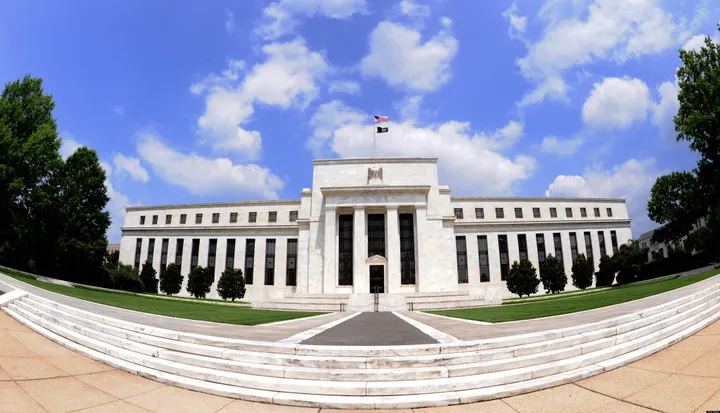
Audit The Fed Effort Under Threat In House

Posted: 11-17-09 07:52 PM

What's Your Reaction?
Fed

A bipartisan effort to force transparency on the Federal Reserve is suddenly in jeopardy after a House Financial Services Committee member introduced an amendment that would let the multi-trillion dollar organization continue throwing tax dollars around in secret.

Rep. Mel Watt, a Democrat from North Carolina, has introduced an amendment intended as an alternative to the measure to audit the Federal Reserve introduced by Reps. Ron Paul (R-Texas) and Alan Grayson's (D-Fla.) . But instead of increasing transparency, as the amendment claims to do, Watt's measure would instead make the institution more opaque.

The measure could come for a vote anytime this week. Read the amendment here.

Watt pitched his amendment in a letter to colleagues circulated Tuesday. "While my amendment will certainly fall short of demands by those intent on destroying the independence (if not the existence) of the Fed, the critics of my amendment will have to concede...that my amendment will provide transparency of the Fed's financial operations that will be completely unprecedented," he wrote.

In fact, the critics are conceding no such thing. "The Watt Amendment, as written today, actually places new restrictions on the little authority that exists, such as it is, for independent auditing of the Fed," Grayson said. "It keeps in place all existing restrictions and adds four more. So I don't see why anybody would reasonably think that it creates unprecedented authority to audit the Fed."

The devil, as always, is in the details. While Watt's amendment talks a big game about opening up the Fed to a complete audit, all of the new powers granted must be carried out "each case in accordance with subsections (b) and (e)."

Those subsections of the current law delineate the many restrictions that an auditor confronts when seeking to audit the Fed. Watt's measure not only leaves those in place but requires all audits to abide by them.

And in addition to the current restrictions in place, it creates new ones. An auditor could not look at loans or liquidity arrangements the Fed enters into, the terms of those arrangements, or the effect of those loans and other liquidity deals on "reserves, the balance sheet or financial condition of a Federal reserve bank or the Federal Reserve System."

Story continues below

The Fed has expanded its balance sheet drastically over the last year, entering into exotic swap arrangements and otherwise pumping trillions of dollars into the economy. How it has done so and who has been on the receiving end would remain secret under Watt's bill.

By contrast, the Paul-Grayson amendment is patterned after Paul's bill H.R. 1207, which has broad bipartisan support. It has more than 310 cosponsors in a chamber with 435 members.

Paul's measure would repeal the provisions that Watt's leaves in place. If every member who cosponsored Paul's bill votes for it in committee this week, it would have the votes to pass. Watt's amendment is an effort to peel off votes.

Paul spokesman Jesse Benton said that Watt's proposal falls far short of the transparency that the multi-trillion dollar organization needs.

"The new exemptions are described as limited but they are extremely broad," Grayson said. They're so broad, in fact, that there would be very little left for an auditor to look into. What could an auditor check up on?

"Count the pencils on the desks," Grayson speculated. "Perhaps check on proper Metro card usage."

Watt wasn't immediately available, but his letter to colleagues is here:

Dear Financial Services Committee Colleague:


This week during the Financial Services Committee markup of the Financial Stability Improvement Act of 2009, I plan to introduce an amendment to provide historic transparency to the operations of the Federal Reserve. While my amendment will certainly fall short of demands by those intent on destroying the independence (if not the existence) of the Fed, the critics of my amendment will have to concede (1) that I have worked diligently with them to find all possible common ground and (2) that my amendment will provide transparency of the Fed's financial operations that will be completely unprecedented.

My amendment acknowledges that taxpayers have a right to know how their money is being spent. To that end, my amendment will expand the audit powers of the Government Accountability Office ("GAO") over the Federal Reserve to all financial activities of the Fed.

I. Complete GAO Audit Authority of the Numbers.

Under my amendment, the GAO will have complete authority to review and audit, including by onsite examination:

(1) Federal Reserve programs, activities and operations: A full audit of the functions, programs, activities and operations of the Federal Reserve Board and Federal reserve banks relating to prudential supervision, provision of currency, check clearing and collection services, payment systems operations and provision of wire transfer services;

(2) Federal Reserve financial statements: A full audit, of the kind performed by outside auditors, of the Federal Reserve's financial statements, including all the Fed's assets and liabilities no matter how they are acquired or incurred; and

(3) "Emergency" 13(3) lending facilities: An audit of the emergency actions taken by the Fed under Section 13(3) of the Federal Reserve Act ("13(3) powers") to extend credit to a single partnership or corporation, or broad liquidity facilities for distressed markets, including:

* The effectiveness of the Fed's internal control structure to ensure limited risk exposure to the Fed with respect to each liquidity facility and the prevention of waste, fraud and abuse in the use of that facility;

* Whether the collateral policies and procedures appropriately address risk to the Fed;

* Whether credit extended and fees charged by the Fed are collected in accordance with the terms and conditions established by the Fed;

* The manner in which the Federal Reserve system accounts for the facility on its balance sheet and the adequacy of the procedures for financial reporting.

For example, my amendment would allow the GAO to audit the financial aspects of multi-billion dollar credit facilities extended to Bear Stearns and AIG during last year's financial crisis, as well as the broader market credit facilities such as the Term Asset-backed Loan Facility (TALF). In addition, the specific names of borrowers of 13(3) credit facilities would be disclosed after 1 year.

In sum, the GAO will have new powers under my amendment to audit every aspect of the Fed's nearly $2 trillion balance sheet, providing unprecedented transparency to the American people.

II. No Interference with Monetary Policy.

The critics of my amendment will say that it does not allow the GAO to audit or second guess Fed monetary policy decisions. They are correct. My amendment strikes a sensible balance between providing increased transparency to the public, while preserving the long-standing independence of the Federal Reserve regarding the making of monetary policy. Every industrialized nation observes strict independence of their central banks to set monetary policy and shields them from undue political interference. Such independence from political interference is important for several reasons:

* An independent central bank can limit inflation and promote economic growth. If there is even the perception that politics is interfering with monetary policy decisions, fears of inflation could rise and erode market confidence in the ability of the central bank to make sound economic decisions, which could cause higher prices and increased job losses;

* Bond rating agencies view the independence of central banks as an important factor in determining sovereign credit ratings. An erosion of Federal Reserve independence could harm the credit rating of Treasury bills, increasing our cost of borrowing and hurting the economy in the form of higher prices to all American consumers;

* Foreign central banks would fear engaging in transactions with a politically compromised Federal Reserve, which could destabilize the U.S. and international economies.

Recently, over 400 economists, academics and former government officials signed the attached petition supporting the independence of the Federal Reserve regarding monetary policy. The petition included three winners of the Nobel Prize in economics and five former presidents of the American Economics Association. The notion that we should allow the GAO or any other government agency to audit or second guess Fed monetary policy is nonsensical and would be terrible public policy.

Conclusion

My amendment strikes the appropriate balance of increasing Federal Reserve transparency while preventing political interference with monetary policy. Only a transparent central bank, free from political interference, can effectively carry out its congressionally-required dual mandate of stable prices and fostering job growth. I hope you will support the amendment to provide an historic advance of transparency at the Federal Reserve while preserving its independence to be able to fulfill the dual missions for which it was formed.


/S/

MELVIN L. WATT

A bipartisan effort to force transparency on the Federal Reserve is suddenly in jeopardy after a House Financial Services Committee member introduced an amendment that would let the multi-trillion dol...
Report Corrections
 
Comments
526
Pending Comments
0
View FAQ
Comments are closed for this entry
Page: 1 2 3 4 5 6 7  Next ›  Last »   (13 pages total)
Show: 
hrpmap   02:08 PM on 11/19/2009
It is right there in the " Owens Glass Bill" (the federal reserve act) "The right to alter amend or repeal this act is hereby expressly reserved." So let's do an audit and see if that should be the next step. Under the present secrecy and therefore unaccountability we will never know. How does one discover a wrongdoing if there is no way to ferrit it out?
photo
NelsonBig   02:56 PM on 11/18/2009
CALL YOUR REPRESENTATIVE TO VOTE THIS DOWN!!
photo
HUFFPOST SUPER USER
Carolab   07:49 PM on 11/18/2009
ABSOLUTELY!
photo
spassbeim   02:50 PM on 11/18/2009
The knee-jerk ad hominem invective one is subjected to for not regurgitating HP's preconceived narrative is really amazing.
photo
siasina   03:50 PM on 11/18/2009
The Fed's argument (and your argument) has been proven illegitimate. Everyone wants to see the Fed get fully audited, and you failed to present an argument why it should not be.

Do you really think the Fed is not under political pressure right now? Let's see what would happen if they raised interest rate to 15% or even higher (and I would argue it should be higher, although it might be too late now).
photo
siasina   03:56 PM on 11/18/2009
Also secrecy and independence are completely two different things. Audit is the solution, not the problem.
Jupitersky   04:05 PM on 11/18/2009
You believe the Fed is independent and therefore shouldn't be audited. The rest of us believe the Fed is not independent and we'd like to know the who, what when where and why. that's the purpose for the audit.

You can't sit there after the past 12 months and suggest that taxpayers don't have a right to know where half a trillion dollars went. That's nonsensical based on your argument of independence.
photo
spassbeim   04:34 PM on 11/18/2009
It has not been "proven" illegitimate--you just disagree.

I have repeatedly presented the argument, in fact. Here it is again, in case you missed it:

The independence of the Federal Reserve System is a key component of the monetary system of the United States. Politicians have repeatedly proven themselves poor custodians of monetary systems, especially when there is a fiat currency, which the US has had since Nixon ended the gold standard in 1971. Since there is no backing to the currency, or "peg", government control of the money supply can be disastrously waged for political gain, as happened with government control of the German Central Bank in the 1920s, for instance, or the Hungarian National Bank in the late 1940s. A non-fiat currency may be better run by a central bank that is more closely monitored by the government, but when money can be freely printed with no underpinning, avoidance of governmental (especially parliamentary) interference is vital.

In a similar vein, the specific lending activities of the Fed should be left up to the Board of Governors and the Chair. Should the Fed be forced to inform the Congress of its activities in detail, the Congress would risk creating financial panic within the system, as happened in 1931 when the Congress required the disclosure of the names of banks who had received Federal assistance in the Great Depression.

If you want to debate these points, I'd love to. If you want to call me names, well...
HUFFPOST SUPER USER
thrashertm   08:52 PM on 11/18/2009
The dollar has lost 95% of its value since the Federal Reserve became the steward of its value in 1913. Not exactly a good track record of responsible custodianship. You haven't a leg to stand on. Stop shilling for the Fed.
hrpmap   01:52 PM on 11/19/2009
Name calling is the tactic of unintellegent minds, while freely and strongly expressing diverse opinions is healthy. I am one of nine siblings, five of which own and manage a business. We are of course devided fairly equally between Dems and Reps, however we all agree that the fed is not operating in the best interests of our country. We all beleive that we have a right to know how our resources are being used. Is it to serve the nation, or to serve the interests of those who have put us in this current economic condition? .Something is wrong, but what? An audit of the fed is needed to expose any coruption. If there is none then we will know and surely and put to rest the suspician and move foreward. If there is we can hold those who are guilty responsible and put them where they belong. Why not audit the fed and move foreward either way?
fscuttle   02:46 PM on 11/18/2009
I think most of those co-sponsers will not actually vote for an audit of the Fed. My attitude on the subject is.........I will believe it when i see it.
Schvenzlerman   02:41 PM on 11/18/2009
The Fed system is the federal government's premiere tool for financing w.ar. K.ill the bank and we can return to peace, freedom and prosperity. Let it live and we will be locked into institutional mur.der in our names, slavehood to system-induced debt, and a downward-spiraling standard of living until the financial architecture finally suffers complete breakdown.

K.ill the bank.
photo
HUFFPOST SUPER USER
Carolab   07:50 PM on 11/18/2009
Well said. Yes, the Fed was designed to finance war and enrich the elites.
Matrsnot   02:32 PM on 11/18/2009
I would love to see them audited. Last time it was attempted, we lost a President though. Nov 22, 1963
photo
rf-hawaii   01:18 PM on 11/18/2009
MoveOn needs to target the Fed.
photo
EndRacismNow   01:23 PM on 11/18/2009
They won't. They're owned by Hedge Fund Hyena George Soros. He's in the bankers club and his interests are the Fed's interests.
photo
hardrain77   01:55 PM on 11/18/2009
Yeah, ultimately all Moveon is is a front for getting mainline Democrats elected. They don't even pretend to be anti-war or anti-Fed.
photo
HUFFPOST SUPER USER
Carolab   07:54 PM on 11/18/2009
His remarks in his interview in 2007 with Judy Woodruff are fairly clear on how well he thinks the Fed performed "its job".
paintitblack   12:46 PM on 11/18/2009
Contact Mel Watt and let him know about his decapitation of HR1207 and that the people won't stand for this!

Here is the contact form: http://www.house.gov/formwatt/IMA/issue_subscribe.htm
Zip code: 28201-8209
Address: Use the address to his office building (address has to be in his district or they won't read it)
1230 W. Morehead St.
Suite 306
Charlotte, NC
28208-5214

Here is his number: Tel. (202) 225-1510
Here is his site: http://watt.house.gov/
Opensecret: http://www.opensecrets.org/politicians/summary.php?cid=N00002328&cycle=2008

copy and pasted from another poster- PLEASE COPY and PASTE
photo
siasina   12:32 PM on 11/18/2009
Ben Bernanke, why are we still listening to this guy? Just the mere fact that we know its history and their report card, they should be abolished.

http://www.youtube.com/watch?v=HQ79Pt2GNJo

Congress gave its powers away, and it has the power to get it back. Sorry, too bad.
MakeAWish   12:24 PM on 11/18/2009
CONGRESS DO YOUR JOB AND AUDIT THE FEDERAL RESERVE. IT IS YOUR DUTY TO OVERSEE AND PROTECT THE PEOPLES MONIES COLLECTED FROM TAXPAYING CITIZENS!
photo
Manq   12:27 PM on 11/18/2009
Not according to Mel Watt is isn't. NC district 12 please vote this focker out!!!!!!!
photo
JackRusselTerrier   12:20 PM on 11/18/2009
Corporation person-hood should NOT = People's rights

No regulation = No change

Too big too fail = Too big too exist

No enforcement of existing regulation = Continual abuse_ on Wall Street and from the banks.

No auditing of the FED = Perpetual abuse_ from the BANKING CABALS which ARE the FED.

No campaign finance reform = Continual corrupt government on both sides of the aisle.

$ to the Government from lobbyist = Corruption in government = No change in corruption on Wall ST. etc.

Democrats and Republicans = Good cop and bad cop

Good cop and bad cop = Divide and conquer

Divide and Conquer = The plutocrats win = The people loose

Derivatives = Investment without vested interest

Hedge funds = Betting on failure = Wanting failure

Money for failure does NOT = Capitalism

Socialism for the rich does NOT = Capitalism

Capitalism for the poor and Socialism for the rich does NOT = Fairness for all Americans

Universal health care *politicians get it, but the public doesn't = Unfair system in America
photo
siasina   12:18 PM on 11/18/2009
Spassbeim:

The Fed is pretending that it is merely trying to insulate itself from political pressure, and that politician's re-election concerns should not interfere with sound "monetary policy".

Congress is elected by the people, and the people can throw the bums out if they don't listen to the people's demands. So even though most congress members are political hacks, they are subject to at least some accountability.

The Fed, on the other hand, is subject to no accountability. The Fed is refusing to provide Congress any information on where the trillions of dollars it has handed out have gone. The Fed is also refusing to disclose what toxic assets it has taken from the banks and put om its own books.

What the Fed is really arguing is that it should not have to answer to the American people.

Because if the American people knew what the Fed was really doing, they would demand that it be terminated immediately.

THE FED ITSELF ADMITS IT'S A PRIVATE INSTITUTION: http://www.bloomberg.com/apps/news?pid=20601203&sid=avjlPu.bRVmk

According to many PhD economists (such as Marc Faber), the Fed caused this economic crisis, as well as the Great Depression.

The Fed has also replaced assets with some real value with toxic derivatives on its balance sheet, in order to act as a giant garbage disposal for the big-stakes gamblers at the giant banks.
photo
JackRusselTerrier   12:23 PM on 11/18/2009
Keep up the good work.
Fanned.
photo
siasina   12:26 PM on 11/18/2009
Again this is Alan Greenspan admitting that the Fed is Private, above the law and not accountable to anyone:

http://www.youtube.com/watch?v=pVmxQsvj6lo
photo
spassbeim   12:28 PM on 11/18/2009
Fed is independent, unaudited, above the law. Agree, agree, agree.

Wouldn't have it any other way.
photo
spassbeim   12:26 PM on 11/18/2009
Milton Friedman ("The Great Contraction") was the first to argue convincingly that the Fed caused the Great Depression. However, he also showed how the Fed could have alternatively prevented the Great Depression--it simply made the wrong moves at the wrong times.

The Fed is indeed "owned" by its member banks, but this is not ownership in any normal sense. Rather, the banks are literally required to own part of the Fed in order to borrow from it--i.e. to be the gateways through which liquidity passes into the economy. This flow is regulated by the discount and federal funds rates--this is a classic illustration of how the banks' "ownership" of the Fed is not normal private ownership. The rates are not determined by the banks but by the Board of Governors, which is led by the Fed Chair, appointed by the President of the U.S.

The Fed should not be audited. I still contend that I don't want Newt Gingrich, Tom DeLay, Nancy Pelosi or any of those folks in any way controlling the money supply. It is too delicate for them to deal with. PhD economists handle the money supply better than self-interested politicians who are up on the block every two years. Look at the pre-Fed era, with its enormous, frequent depressions in comparison to the Fed era, with its periodic but in-all-but-two-cases mild recessions if you don't believe me.
photo
hardrain77   02:09 PM on 11/18/2009
Actually arguments can be made that the pre-Fed booms and busts were a lot smaller and not as harmful as the post Fed ones we've had to live through. Sure there were areas hit bad, but it was more locally and therefore never affected almost every facet of the economy like it does now.

We all know by now their manipulations and motivations in the crashes of '29 and '08, but before the implementation of the Fed, we never had a centralized bank, but $ was backed by gold much, much more stronger than now, so it never fluctuated that badly in value and therefore the booms and busts were relatively milder, but having something where the entire country's banking establishment is brought to its knees like now is only a result of the Fed central banking and manipulations.
photo
spassbeim   12:30 PM on 11/18/2009
siasina they deleted a lengthy comment in which I reiterate that I totally agree with your characterization of the issue in every way--we're not arguing any facts whatsoever. I just think it has to be that way, unfortunately. Congress would botch things so badly if it held the reins we'd be 1920s Argentina in no time.
photo
Manq   12:32 PM on 11/18/2009
Stop smoke-screening your opposition to HR1207. We all know where you stand.

Using fear as a tactic to defeat a completely reasonable bill. Never had THAT happen before!
photo
spassbeim   12:34 PM on 11/18/2009
You bet your a** I'm against it! No smoke screen needed. The only issue at stake is the central one: Fed independence from political pressure.
photo
siasina   12:35 PM on 11/18/2009
As if thing's are so good right now right? Let's get real, The fed, the lender of last resort is to blame for all the messes and cycles since its existence.
photo
siasina   12:39 PM on 11/18/2009
American economist Milton Friedman argued: "The power to determine the quantity of money... is too important, too pervasive, to be exercised by a few people, however public-spirited, if there is any feasible alternative. There is no need for such arbitrary power... Any system which gives so much power and so much discretion to a few men, [so] that mistakes - excusable or not - can have such far reaching effects, is a bad system. It is a bad system to believers in freedom just because it gives a few men such power without any effective check by the body politic - this is the key political argument against an independent central bank."

Why are you against transparency?
photo
spassbeim   12:43 PM on 11/18/2009
I'm not against transparency, I'm against the politicization of the money supply. In this case I think the danger of too much of the latter is greater than the danger of too little of the former.

I don't care what Friedman said.

BTW the Iraq War prevented the death of several dogs. Why do opponents of the war hate dogs?
photo
spassbeim   12:46 PM on 11/18/2009
If you read the Great Contraction by Friedman and Schwartz, you'll find that decisions by Congress to disclose the names of banks that received aid from the Fed and from the Treasury lending programs in 1930-31 caused runs on those institutions, hastening their collapse and worsening the depression. If the Fed is forced to disclose to which institutions it lends and how much, for instance, it could compromise the stability of the nation's financial system.
MakeAWish   12:14 PM on 11/18/2009
It's time for our congress to take back control from this quazi government that is dictating policy and undermining our democracy.

The Congress should mandate an audit. The Federal Reserve has become a rogue institution that needs to be brought under control or dismantled entirely. It is hurting our country not helping it.

The taxpayers demand that congress be accountable for our money. How can they do this when the Fed is shrouded in secrecy?
photo
siasina   12:05 PM on 11/18/2009
This is for those who say the Fed is already fully audited. Here is the US Code regarding the Federal Reserve:

Chapter 7, subchapter II, point (b)

(b) Under regulations of the Comptroller General, the Comptroller General shall audit an agency, but may carry out an onsite examination of an open insured bank or bank holding company only if the appropriate agency has consented in writing. Audits of the Federal Reserve Board and Federal reserve banks may not include—
(1) transactions for or with a foreign central bank, government of a foreign country, or nonprivate international financing organization;
(2) deliberations, decisions, or actions on monetary policy matters, including discount window operations, reserves of member banks, securities credit, interest on deposits, and open market operations;
(3) transactions made under the direction of the Federal Open Market Committee; or
(4) a part of a discussion or communication among or between members of the Board of Governors and officers and employees of the Federal Reserve System related to clauses (1)–(3) of this subsection."
photo
siasina   12:08 PM on 11/18/2009
Now read that carefully. Essentially, nothing of importance can be audited from the Fed. It is all done in secrecy.

The power to coin money was given to the Congress by the Constitution, Article 1 section 8. The congress gave that power away to the federal reserve in 1913.

There is no reason the Congress can't and should not take that power away. The Fed should just accept it. People think the Fed was a entity that was here from the beginning.
photo
spassbeim   12:16 PM on 11/18/2009
The Fed is not audited and should not be, at least not by the Congress. It would open the money supply up to dangerous politicization.
photo
siasina   12:18 PM on 11/18/2009
Read my comment on top!
photo
Manq   12:30 PM on 11/18/2009
Yes, heaven forbid monetary policy be considered by folks who actually might not be re-elected next term, whereas the existing Fed structure is required to make no statement explaining its purpose or movements.

HR1207 is a standard CBO audit. That's it. it promises nothing else.

What does the fed have to hide? A lot I believe. Remarkable evidence exists that they are making money by de-leveraging the US Dollar against foreign currencies.
photo
spassbeim   12:32 PM on 11/18/2009
its independence is at stake. It's the most important concept in government regulation of the economy in this country.
viperhawk2k4   01:13 PM on 11/18/2009
Try reading the Constitution , A quit the Politicization B>S>!
photo
siasina   11:53 AM on 11/18/2009
311 people co-sponsored the original Paul-Grayson HR1207 bill, and it only takes one guy to gut it all out.

Mel Watt, you son of a........Let's make this guy famous.
photo
Manq   12:25 PM on 11/18/2009
I already commented on his opencongress.org page.

Let's all reveal this man for the devil that he has proven himself to be.

http://www.opencongress.org/people/comments/400424_Melvin_Watt

Twitter Edition