More

FDA Asks Hospitals To Report Safety Glitches In Digital Health Systems

Fda

Huffington Post Investigative Fund   First Posted: 05/11/10 06:12 AM ET Updated: 05/25/11 04:50 PM ET

Concern over safety risks posed by health information technology has led the Food and Drug Administration to step up scrutiny of the products, including digital medical records systems on which the government plans to spend billions of dollars in coming years.

The FDA last month asked a network of 350 hospitals it set up across the country to report data on potential hazards from a range of computer-assisted medical devices, according to an agency document obtained by the Huffington Post Investigative Fund.

The FDA action comes as federal officials forge ahead with plans to use as much as $27 billion in economic stimulus money to replace paper patient records with digital ones. The Obama administration wants to create a digital health file for every American by 2014, saying the conversion will save money and improve the quality of health care.

Reports that hospitals send to the FDA are to be posted on an agency Web site. The FDA maintains it has the authority to regulate the technology, but has not taken steps to do so, leaving the industry largely to police itself. Reporting of problems is voluntary and most manufacturers have not done so.

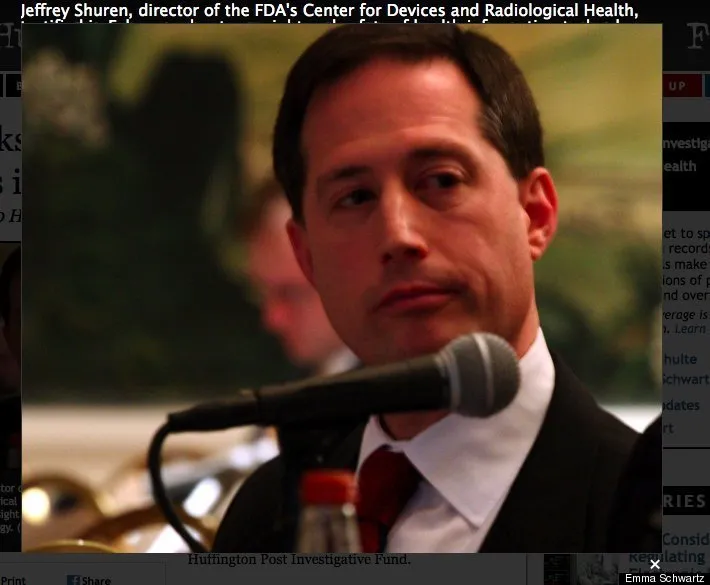
During a hearing in Washington on Feb. 25, FDA official Jeffrey Shuren noted that "several serious safety concerns have come to light." He said the agency had logged reports of six deaths in the past two years, which "may represent the tip of the iceberg."

In the letter sent to hospitals last month, Marilyn Flack, of the FDA's Center for Devices and Radiological Health, said use of digital medical equipment "continues to grow and affect patient care and safety." The FDA "is exploring problems....that may affect patient safety," she wrote.

The agency plans to collect reports using its Medical Product Surveillance Network, called MedSun. It is asking hospitals to note a wide range of problems involving electronic health records and other computerized systems for hospital laboratories, pharmacies and anesthesia and radiology devices, including hand-held ones.

In an interview, Flack said that the agency "has been talking about these issues for over a year," but the letter was the first time the hospitals had been sent an alert. "Sometimes we need to remind them about certain things they should be looking for," she said.

Flack's letter made special mention of potential glitches in systems that help doctors prescribe medications. She also cited an example of a software package used in a hospital emergency room in which lab tests "ordered for one patient returned the results for another."

In another case, a hospital in the MedSun network reported an operating room software product that often "locked up" during surgery, without alerting anyone that "data entry had ceased."

According to the FDA letter: "At the end of the surgical procedure, surgical procedure notes were incomplete--compromising the accuracy of the data as nurses had to manually re-enter from memory many of the surgical notes."

In a third case cited by Flack, a radiology workstation became "extremely slow, delaying procedures and causing X-ray techs to subject patients to repeat X-rays." The cause was determined to be a software glitch that happened when too many characters were entered in.

Graham Yuill, director of clinical engineering at the East Alabama Medical Center, which participates in the MedSun program, said he believed it was the first time the FDA had specifically asked about problems with health information technology.

"In the past I probably would not have gotten involved with that or reported that," he said.

Arthur Bartosch, director of Biomedical Engineering Services at Westchester Medical Center in New York, agreed. He said he planned to circulate the FDA's alert to the hospital's chief medical information officer and they would "probably" create a task force to figure out how to document any problems.

Given all the federal money flowing into health information technology, Bartosch said, he wasn't surprised to see the FDA taking an interest. "I think you're looking at the early checks and balances of what is going to be there in health care," he said.

In the past, the FDA has relied mainly on another data system to track medical software system failures. But that system only receives sporadic reports from a few technology companies and users on a voluntary basis.

That other system in the past two years has captured 260 reports of malfunctions with the potential for patient harm, including 44 reported injuries and the six deaths the FDA cited at the recent safety hearing. Adding the MedSun system could substantially boost the number of reports.

"The more data we get - I view that as a valuable thing," said Paul Egerman, co-chair of a government panel looking at the safety of health information technology.

"The fundamental problem we have here is we're dealing with an industry that really isn't used to a transparent reporting of problems," he said.

Egerman, whose advisory panel expects to make its findings public in April, said government officials have a long way to go in fully understanding the potential hazards of adopting the new technology.

"Are there much more serious problems that we would know about if we had the data?," he said. "These are all reasonable questions to ask."

FDA's Letter to Hospitals on Health Information Technology

FOLLOW HUFFPOST TECH

Concern over safety risks posed by health information technology has led the Food and Drug Administration to step up scrutiny of the products, including digital medical records systems on which the go...
 
 
  • Comments
  • 27
  • Pending Comments
  • 0
  • View FAQ
Comments are closed for this entry
View All
Recency  | 
Popularity
Page: 1 2  Next ›  Last »  (2 total)
This user has chosen to opt out of the Badges program
photo
08:39 AM on 03/22/2010
The electronic capture and storage of medical information about you and me – the medical record – is complex enough. But what is going on here is the capture and storage of the medical process. The number of software providers for this data collection is very large. It is difficult enough to write clean, foolproof code for one application, coordinating that code among different providers in a dynamic environment maybe impossible.

If software runs amuck in an automobile engine from one manufacturer, what will happen with software provided by hundreds of vendors for a medical center?
photo
HUFFPOST SUPER USER
DavidWyld
Professor of Management
10:42 PM on 03/21/2010
OOPS! Well, for those with a "Unabomber-like fear of technology," this will be gold. However, the reality is that our medical records today are scattered hard copies residing in various manila folders around the country, bot linked together in any way. Now, we do need EMRs, but we also need the best possible data security and encryption to make the system work.

David http://wyld-business.blogspot.com/
photo
HUFFPOST SUPER USER
PlayTOE
Morals evolved due to cooperative group living
10:22 PM on 03/21/2010
digital medical records systems could be problematic.
Other countries use them with no serious issues and would never return to paper. They make the medical file available, search-able and understandable. They eliminate double work and catch missing work.

But we could have the odd glitch, especially if the system is set up using 30 year old technology and by people who don't know what they are doing, or who are planning to have it fail.

Strangely, no one seems to worry that bank records are digital and somehow the banks have found a way to make an electronic system work, even on an international level ... so why would American medicine not be able to access technology that is proven to work in other countries?
This user has chosen to opt out of the Badges program
photo
08:09 PM on 03/21/2010
after the screw ups with paper records for me, I will gladly take the risks with digital ones. The paper errors nearly killed. being allergic to motrin resulted in a mild heart attack because my records did not arrive in time for them to review them.
photo
HUFFPOST SUPER USER
Tom95134
04:29 PM on 03/21/2010
Those who are developing software for medical systems should be forced to watch the movie "Hospital" with George C. Scott monthly. People need to have a very high level of confidence that when they go into a hospital or for medical treatment that they will come out of the experience no worse off than they were when they went in.
photo
HUFFPOST SUPER USER
SallieParker
09:34 PM on 03/21/2010
Good flick. Paddy Chayefsky script, just antecedent to 'Network' (and sort of a dry run). Was it with Diana Rigg and Barnard Hughes? Anyway, I do not trust paper records, human error, or digitalization. Once I was dunned repeatedly for a prostate operation. Prostate!!! Apparently some bad keying had mixed up my file with a man twice my age! That was a while ago, but does anyone really thing 'digitalization' will fundamentally change things? No, it's a scam, a make-work project for some Obama cronies. Jobs for the Boys.
12:32 PM on 03/13/2010
The FDA understands that a patient medical record is but a protocol, or data collection system. What the FDA fails to understand, is the simplicity of having individual patient protocols monitored electronically. Were the FDA to require all computers to be treated as a medical device, with manufacturing controls on them, much of the quality control issues would be dealt with cost effectively, and to the patient's benefit, not the vendor's. Too bad we don't have competent and responsible FDA officials willing to deal with this topic.
07:52 PM on 03/13/2010
Naive comment from someone who seems invested in the vendors.

The free pass that has enabled the vendors of computerized records and ordering systems to have unfettered sales rights, unlike other medical device makers, is finally being called in.

The FDA needs to be even more aggressive to halt the camouflaged experiment serving none other than the EMR vendors and their executives.
08:42 PM on 03/13/2010
Worthy comment. Suppose, instead, I am an advocate for Open Source clinical data collection systems. One software platform that replaces pen and paper. No entity owns it. Big Pharma hates that, and has spent literally tens of millions to keep such an approach out of the public eye.
09:41 AM on 03/13/2010
The FDA is not up to the challange, it is not capable of even regulating radiological devices. Do you know how many people work at the radiological devices branch? You can count them with your fingers and still have some left. The FDA is a reactive, reactionary corrupt entity. Enough said.
This user has chosen to opt out of the Badges program
photo
08:45 AM on 03/22/2010
It may not be an organization, public or private, that is not up to the challenge, but human beings ourselves. There may be too many variables for our rational minds to handle.
photo
HUFFPOST SUPER USER
rougebaisers
06:03 AM on 03/12/2010
They cannot even protect the Pentagon, or major corporations. How, if ever, do they expect to protect all of our medical records from the identity theft goldmine they create?
photo
HUFFPOST COMMUNITY MODERATOR
SmartladyDem
Woman for OBAMA!
01:27 AM on 03/12/2010
Privacy is everything! If they can't ensure that, they have nothing.
This user has chosen to opt out of the Badges program
photo
loki
Better to die fighting, than live on knees
12:08 AM on 03/12/2010
with the track record of the FDA for actually doing the job they are suppose to do and keep the population safe, I would say that they will totally screw this up too, and not until thousands die will they actually wake up and decide to do the right thing. Otherwise, they will do just like they do with the drug companies and food processors and keep taking the payoffs to look the other way.
07:47 PM on 03/13/2010
Loki does not get it: " and not until thousands die will they actually wake up and decide to do the right thing"

The point is that thousands will die, and many have already died, from the flawed electronic ordering gear that accompanies non-approved EMRs. Are they being sold in violation of the Federal Food Drug and Cosmetic Act?
photo
HUFFPOST SUPER USER
johnny g locker
11:03 PM on 03/11/2010
Just great.

Give hackers and disgruntled employees access to our most private records.

Pure genius.

And those that trust the government to safeguard these records are delusional.
11:08 PM on 03/11/2010
Agreed- the clowns can't keep social security numbers or credit card data save, but we should trust them with our complete heatlh record. The really neat part is that potential employers or anyone else with an interest & access will now be able to readily review your complete life medical history electronically
09:54 PM on 03/11/2010
The dangers are widespread. Patient care is continually being compromised when EMRs and electronic ordering systems are running the show.

Kudos to the authors and kudos to Mr. Egerman who confirms that there just may be cover-up by the HIT vendors and its trade groups:

"'The fundamental problem we have here is we're dealing with an industry that really isn't used to a transparent reporting of problems,' he said."

Sure is a problem.
08:32 PM on 03/11/2010
not possible to secure....any system can be hacked.
This user has chosen to opt out of the Badges program
photo
08:49 AM on 03/22/2010
And any store window can be broken, any bank robbed. This is not about having someone see our specific medical records, it's about software capturing every detail of procedures correctly, processing that info, storing it, and distributing it correctly among all necessary medical stakeholder, of which the patient is only one.

Systems don't have to be hacked to fail, they just need to be created by humans.
06:20 PM on 03/11/2010
This is confusing -- the first paragraph says digital information technology but the second one says computer-assisted medical devices. Two different things.
07:04 PM on 03/11/2010
Understandable. DIT is a very broad term. *Health* information technology is the actual term used. I would think that the coauthors are taking advantage of that breadth as they write: "...health information technology has led the Food and Drug Administration to step up scrutiny of the products, **including** digital medical records ...". HIT does not limit itself to medical history databases nor CAMDs.
photo
OzoneTom
Living on the border
06:06 PM on 03/11/2010
Hard is not the same as impossible, you just have to be willing to pay for it. We have the technology to make these transactions secure even across the internet -- the weak link is typically the human. Good design reduces chances for a human to screw things up.

As a long-time developer I know that there is no such thing as a large piece of software that will be 100% perfect in all imaginable (and unimaginable) scenarios, but I know that we can produce much better software than is discussed in the horror stories in this article. It didn't sound like these were particularly complex processes and problems should have been uncovered and corrected early in any realistic development/testing cycle.

These sound like problems that come up in projects that are poorly run with inadequate and or inexperienced teams. Often a sweetheart deal or a "race to the bottom" causing standard essential aspects like quality assurance testing to get short-shrift. I've seen many clients trading their experienced staffs for companies who are cheap and promise to throw inexperienced offshore bodies at everything and the cost savings will make the decision-makers look good.

I know that we can do this sort of thing right because we have before -- many on systems that are even more complex. Hopefully the experiences reported will lead to improved and standardized systems because some day we are all going to end up in a hospital.
photo
HUFFPOST SUPER USER
CaptainSunshine
08:12 PM on 03/11/2010
It doesn't seem like the FDA is concerned with content as much as they're concerned about the capability of devices coming in contact with patients.

For example, dialysis machines are certified by the FDA. Many of the newer capabilities being added to equipment have not been tested in a clinical environment. It sounds like the FDA wants to make sure that devices are safe.