
Click on the next page and scroll down for audio of the interview
The U.S. should bust up its megabanks and impose strict laws curbing the size and complexity of financial institutions, a top Federal Reserve official told the Huffington Post.
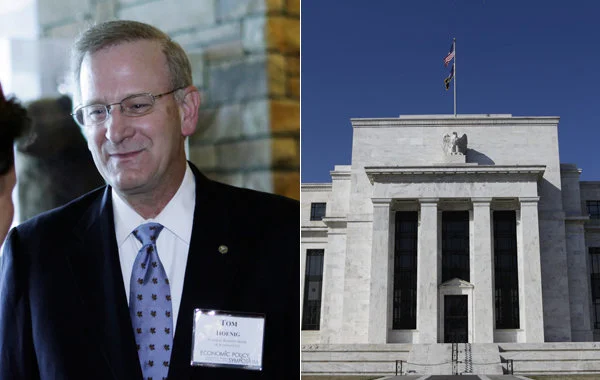
In a 45-minute interview this week, Federal Reserve Bank of Kansas City President Thomas M. Hoenig, who's emerged as one of the few influential voices calling for a fundamental redesign of a broken U.S. financial system:
- Lambasted the tilted playing field that benefits Wall Street banks over Main Street banks;
Hoenig's criticisms echo those made by reformers pushing to remake a financial system that melted down in 2008 after years of excessive risk-taking and loose regulation finally took its toll, causing the worst economic collapse since the Great Depression and costing the nation more than 8 million jobs.
But Hoenig isn't just any reformer -- he's the longest-serving Fed policy maker; a voting member of the Fed's main policy-making body, the Federal Open Market Committee; and his credentials as a deficit- and inflation hawk are unparalleled.
In February, Simon Johnson, former chief economist of the International Monetary Fund, professor at the MIT Sloan School of Management and contributing editor to the Huffington Post, wrote a post on his blog titled "Tom Hoenig for Treasury," putting him forward as one of just a few viable candidates to succeed current Treasury Secretary Timothy Geithner should he step down.
And unlike top officials in the Obama administration, Congress and his colleagues at the Federal Reserve, Hoenig is calling for perhaps the most significant changes in the U.S. financial system: breaking up the big banks and imploring Congress to establish tough rules so that bank regulators will never again be put in a position to bail out troubled firms.
Breaking Up Megabanks
For example, one of the effects of Too Big To Fail, Hoenig said, "has been that the concentration of financial resources in this country has nearly doubled over the last 15 to 20 years. That's what we have to end."
The banks owned by the four largest financial firms in the U.S. -- Bank of America, JPMorgan Chase, Citigroup and Wells Fargo -- collectively account for about 45 percent of all assets in the U.S. banking system, according to a HuffPost analysis of Federal Deposit Insurance Corporation data.
The top 12 banks in the U.S. control half the country's deposits. By comparison, it took 25 banks to accomplish this feat in 2003 and 42 banks in 1998, according to a Jan. 4 research note by Jason M. Goldberg of Barclays Capital.
Those four megabanks collectively hold about $7.4 trillion in assets, according to the most recent regulatory filings with the Federal Reserve. That's equal to about 52 percent of the nation's estimated total output last year.
"The fact that they needed to be supported by TARP tells me that they're too big," Hoenig said. "I think that that's a very clear signal that they're too big. The fact that they had to be bailed out under those circumstances suggests they are too big, and that needs to end."
In response, he says policymakers should simply break up the megabanks and split them off into their component parts.
"I think they should be broken up," Hoenig said. "I think there's no reason why as we've done in other instances of [sic] finding the right mechanism to break them into their components.
"Underwriting [securities], hedge fund activities, trading for their own accounts -- that should be in a separate institution," Hoenig said, referencing the proposals that have become popularly known as the Volcker Rules, named after their original proponent, former Fed chairman Paul Volcker. "And in doing so, I think you'll make the financial system itself more stable. I think you will make it more competitive, and I think you will have long-run benefits over our current system, [which] mixes it and therefore leads to bailouts when crises occur."
By first breaking up the firms, the market will then decide what's an appropriate maximum size, Hoenig said.
"...We've provided this support and allowed Too Big To Fail and that subsidy, so that they've become larger than I think they otherwise would," Hoenig said. "I think by breaking them up, the market itself would begin to help tell you what the right size was over time."
In a March 24 speech in Washington, Hoenig said that the TBTF subsidy "provides a direct cost advantage to these firms."
"Without the fear of loss to creditors, these large firms can use higher leverage, which allows them to fund more assets with lower cost debt instead of more expensive equity," he said.
That allows them to get even bigger, leaving their smaller competitors behind who need to worry about raising equity before they can fund more loans.
"If the top 20 firms held the same equity capital levels as other smaller banking institutions, they would require $210 billion in new equity or reduced assets of over $3 trillion, or some combination of both," he said.
Bringing Back Glass-Steagall
The U.S. should revive parts of Glass-Steagall, the Depression-era law that long prohibited banks from underwriting securities and engaging in other Wall Street-like activities, to break up megabanks, Hoenig told HuffPost. The law was repealed during the Clinton administration. The Obama administration has shown no desire to bring it back.
"At the moment I would be inclined to break them up along those lines of activities, and then let the market define what the right size is, and it will be, I suspect, smaller, much smaller, given our recent experience," he said.
"When Glass-Steagall was set aside and Gramm-Leach-Bliley [the law that repealed it] was introduced, I gave a speech which raised the concern that we would encounter mega-institutions," Hoenig said. "People would say... 'They're not too big to fail', but when the crisis came they would be too big to fail, and that's what we've gotten.
'So I am partially in favor of re-establishing elements of Glass-Steagall that separates the very important commercial banking that is so critical to our economy and our payment system from what I call high-risk activities in investment banks and hedge funds.
"I have nothing, nothing at all against high-risk activities in hedge funds and so forth, but they should not be part of our commercial banking payment system."
On Whether The U.S. Needs Megabanks
Asked if he believes in a popular notion shared by top policymakers, legislators, and those on Wall Street -- that the U.S. needs megabanks to compete globally, Hoenig said:
"That is a fantasy -- I don't know how else to describe it. Our strengths will be from having a strong industrial economy. We will have financial institutions that are large enough to give us influence in the markets but not so large that they're too big to fail.
"The outcome of that is that strong banks [and] strong economies bring capital to themselves, and they are by themselves competitive.
"The United States became a financial center not because we had large institutions but because we had a strong industrial economy with a good working financial system across the United States -- not just highly-concentrated in one market area," he said in an apparent reference to Wall Street.
JPMorgan Chase Chairman and Chief Executive Officer Jamie Dimon defended megabanks in his annual letter to shareholders this week, arguing for the economic benefits of outsized financial institutions.
On The Fed Guaranteeing Wall Street's Profits
Popularly known as the lone dissenter on the Fed's policy-making panel who twice this year has voted against the Fed's decision to keep the main interest rate "exceptionally low" for "an extended period," Hoenig said part of the problem with near-zero rates is that it guarantees Wall Street profits.
"When you guarantee a zero rate, you guarantee a spread to Wall Street or to others, and you encourage speculation, and that's what you want to avoid," he said. "If we've learned anything from the last episode, we want to avoid encouraging speculative activity and zero rates, I'm afraid, have the effect of encouraging it."
On Wall Street, "industry profits could exceed an unprecedented $55 billion in 2009, nearly three times greater than the previous all-time record," according to a Feb. 23 report by New York State Comptroller Thomas P. DiNapoli.
The national unemployment rate, meanwhile, is nearly 10 percent. Hoenig calls that "unfair."
Low interest rates enable banks to make a killing because they borrow at near zero yet lend or invest at much higher rates. They also can trade in securities. For banks facing debilitating losses on consumer lending products like credit cards, auto loans and home mortgages -- something that happens in every recession -- low interest rates are an easy way to make money and protect against losses.
But while Hoenig acknowledges that low rates were necessary in the immediate aftermath of the crisis, he said they should now be steadily raised.
The federal funds rate -- the rate that banks charge each other on overnight loans -- was 0.13 percent at the end of February, according to Federal Reserve data. It should be raised to the 2-2.5 percent range "over the next several quarters" depending on economic conditions, Hoenig told HuffPost.
"I don't think we have any business guaranteeing Wall Street spreads," Hoenig said. "We need to recognize that and address it by removing these guaranteed extremely low rates. I think it's extremely important that we do that, and not create the conditions for speculative activity and a new crisis down the road."
"I don't think we have any business guaranteeing Wall Street when we're unable to guarantee Main Street," he added.
Dodd's Bill And Too Big To Fail
Senate Banking Committee Chairman Christopher Dodd (D-Conn.) recently pushed through his committee the chamber's main bill to reform the financial system. Hoenig said it's a "good start," yet he worries that it perpetuates Too Big To Fail and solidifies the balance of power currently tilted in favor of Wall Street versus Main Street.
The bill takes away the Fed's supervisory authority over small banks and instead gives the central bank authority over all institutions with more than $50 billion in assets. That shift would just increase the size of megabanks, Hoenig worries.
"I worry that the Dodd bill, as it's now proposed, will reinforce the consolidation by removing the Federal Reserve from its supervisory role for community banks across the country. The effect of that is to make the central bank of the United States... the central bank of Wall Street, and that's a very serious error.
"I think it's absolutely critical we have this balance between Wall Street and Main Street. We're a great nation... because we have checks and balances and I think it's very critical we have all sorts of banks and that the Federal Reserve and these regional banks have a role to play as a counterbalance, if you will, to Wall Street. I feel very strongly about that."
The biggest firm under the Kansas City Fed's direct supervision is BOK Financial Corporation. With $23.5 billion in assets, the firm is the 43rd-largest bank holding company in the nation, according to Federal Reserve data.
As for Dodd's treatment of Too Big To Fail, Hoenig said the bill puts too much power in the hands of regulators.
"What I worry about [is] if you have a large institution, and it got into very serious trouble and you only have a weekend to take care of it, the procedures under the Dodd bill would make that very difficult," Hoenig said.
"Let's say you were coming into Monday morning and you didn't have the ability to get to the judges in time to get this thing approved, and you had to get to another day. What you would tend to do is lend to that institution -- if it were not a commercial bank, you would even use the [Fed's] so-called 13-3 authority... and you would lend to it," he said in a reference to the legal authority that the Fed claimed gave it the power to lend taxpayer money to AIG. "So you would still have it as an operating bank, you would not have taken control of it, not put it in receivership yet, and yet you would be bailing it out. That's what we have to avoid.
"There's still this desire to leave discretion in the hands of the Secretary of the Treasury, and while I understand that desire -- because you never know what the circumstance is going to be -- the problem is in those circumstances you always take the path of least resistance because of the nature of the crisis.
"You don't want to be the person responsible for the meltdown, so you take the exception and you move it through.
"But if you had a good firm rule of law, and the markets knew... there were no exceptions... you would be in the long run much better off. It does affect behavior," he said.
At the end of 2008, the government -- and U.S. taxpayers -- stood behind about three-fifths of all financial firm liabilities, according to economists at the Federal Reserve Bank of Richmond. The explicit and implicit federal guarantees protect lenders from losses due to a borrower's default.
Until that's fixed, megabanks will continue to benefit from the federal safety net.
"And community banks, of course, because they're not too big to fail, are much more sensitive to maintaining their capital levels, and that's the value of the market: Because they know that there's no one [who is] going to stand behind them. That's how markets work. That's how capitalism works well, because it allows for success and it allows for failure.
"When you don't allow for failure, you create inefficiencies, distortions, and bad outcomes."
Clear Rules Needed To Rein In Wall Street
Regarding the amount of leverage in the financial system -- the ratio of liabilities to equity -- which skyrocketed during the go-go years, leading to an eventual crisis, Hoenig said Congress "should require that we come up with simple leverage ratio that can be... understood and enforced.
"The simplest is: What is your total assets and what is your equity capital, and what's that ratio, and what's the maximum we should allow it to be? Should it be 12 or 14 or in some instances 15? We can have that debate either through the legislative process or though the regulatory process with comments and then come to a rule that is binding and cannot be exempted under any circumstance.
"I think that would do a lot to become counter-cyclical. In other words, when the boom time comes, people and banks tend to say: 'Let's lend more against our capital base, and things are good, we always get paid back.' And it becomes pro-cyclical. [But] when you have a clear rule that says if you want to lend more once you're at this maximum, you have to raise proportionally more capital, then it comes counter-cyclical and much healthier for the economy.
"The max should be -- and this is based on my experience, I haven't done the studies, so I have to put that caveat in there -- if a bank has a 12-to-1 leverage ratio, total assets to equity, that's a fairly good operating level if you look across the country. So I would be inclined to put 15-to-1 as the max, so that in a growth environment you could get to 15, but not beyond that. That becomes a constraint, and I think it would work over time. You would get some blame during the boom that you're inhibiting growth, but that means you'd have to bring capital to the table and that would be strong.
"So I would start with 15. Let the debate go on -- if that's not the right number -- but that's where I would start."
Told that he may upset Wall Street with such a strict ceiling, Hoenig replied: "That's a good sign it must be a pretty good number."
Prior to the crisis, investment banking firms leveraged up as high as 30 to 1. Using Hoenig's method, Goldman Sachs, the most profitable firm on Wall Street, currently has a leverage ratio of 12 to 1, according to its most recent annual filing with the Securities and Exchange Commission. Citigroup, which was bailed out with $45 billion in taxpayer money and had its losses guaranteed by the U.S. government on a $301 billion pool of assets, has a 11.98-to-1 ratio, according to regulatory filings.
Geithner, though, doesn't believe Congress should get involved. In a Jan. 11 letter to Rep. Keith Ellison (D-Minn.), the Treasury Secretary wrote: "We do not believe that codifying a specific numerical leverage requirement in statute would be appropriate."
Hoenig, told that Volcker said that Congress should act because regulators waffle, said in response: "I would feel more comfortable with Mr. Volcker's approach because then you have it under the rule of law, which is my preference in almost all cases." Hoenig also wants strict limits on totals loans relative to assets and capital levels.
Dodd's bill, though, doesn't call for any such specificity; instead it passes the responsibility on to regulators. Federal Reserve Chairman Ben Bernanke said in a January speech that regulators were to blame for the housing bubble and subsequent financial crisis.
Wall Street needs clear rules. "Guidelines are not as effective because they are guidelines. They are much more difficult to enforce," Hoenig said.
"The problem with guidelines and having it vary over time is that it is an opportunity to engage in debate, rather than, 'Here is the rule, let's have it, you must comply with it.' It becomes much stronger and much more counter-cyclical," he said.
"You can't ask an examiner to enforce something that is a guideline because they don't have the ability to do that. They don't have the authority to do that. All they can do is recommend and criticize, but when you give them a rule to enforce, then they will."
Instead, "we need to give them clear sets of rules that can be understood and enforced," he added.
Part of the problem with the current regulatory regime is how banks account for their assets and capital. Rather than an easily-understood approach, the U.S. and other industrial countries base their rules on the Basel Accords, an international agreement that sets standards for banks.
For example, under Basel banks can lower the amount of capital they're required to keep to guard against losses by using derivatives and other exotic financial instruments. But when those financial instruments blow up, like many did during the crisis, banks become woefully short of capital. And when losses start to pile up, there's nothing to protect the banks against failure. That's part of the reason why taxpayers bailed out banks and other financial firms.
"I'm not in favor of the Basel rules," Hoenig said. "I've never been in favor of them. They're too complicated, and therefore they can be circumvented easily, and therefore I think we need simple, understandable, enforceable rules."
"I think we need to simplify it, not complicate it," he said.
A Canadian Model For The U.S.?
One popular idea in Washington these days is that the U.S. should emulate the Canadian banking system, where a handful of firms dominate the financial industry but in return are subject to much stricter regulation and supervision. Canada escaped the worst of the financial crisis.
Hoenig said that's a horrible idea.
"Under no circumstances should [the U.S.] emulate Canada," he said. I don't think it is as competitive, I don't think it allows for the kind of innovation we need, and I don't think it serves the local markets as well as community banks serve the local markets across this country.
"The United States is the strongest, most successful economy in the world because of its innovation, because of its banking system, and I think we need to remember that. And as much as I admire Canada, I don't think they have been as successful as the United States, and I don't think that's the model.
"I think we have a good model, and what we ought to do is work to maintain that model. And that means: hold these largest institutions to firm leverage standards, [a] firm loan-to-value [ratio], make sure commercial banking is commercial banking.
"Then we can compete, and then we can serve all of our constituents -- large and small -- and the outcomes are much more beneficial. That I feel very strongly about."
LISTEN to the full, unedited interview here: