
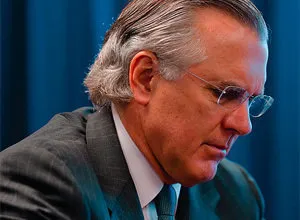
Referring to the danger posed by megabanks as one that's able to spread "debilitating viruses throughout the financial world," a second top Federal Reserve official called for policymakers to bust up the nation's financial behemoths before they cause another worldwide financial crisis.
Richard W. Fisher, president and chief executive of the Federal Reserve Bank of Dallas, told a gathering of economists and financial experts Wednesday that "a truly effective restructuring of our regulatory system will have to neutralize what I consider to be the greatest threat to our financial system's stability... 'too big to fail'."
"In the past two decades, the biggest banks have grown significantly bigger," Fisher said in New York during a lunchtime speech that elicited rounds of applause. "The average size of U.S. banks relative to gross domestic product has risen threefold. The share of industry assets for the 10 largest banks climbed from almost 25 percent in 1990 to almost 60 percent in 2009.
"Existing rules and oversight are not up to the acute regulatory challenge imposed by the biggest banks," he said. So U.S. policymakers, along with their international counterparts, should come up with a system that will break them down into a manageable, less-risky size.
Fisher's comments echoed those from last month in which he also called for giant financial firms to be broken up. Along with Federal Reserve Bank of Kansas City President Thomas M. Hoenig, the two regional Fed presidents are arguably the most qualified and influential voices calling for a new blueprint for the nation's financial system -- a level playing field between Wall Street and Main Street, embodied in ending mega-institutions' dominance over the U.S. economy. Both are deficit- and inflation hawks and both represent the nation's heartland -- Kansas City and Dallas.
Their calls amplify what had been voices on the fringes calling for a fundamental redesign of the nation's financial system. It's not so easy for the White House, the Treasury Department, the Board of Governors at the Federal Reserve or influential members of Congress to dismiss calls to break up megabanks when two regional Fed presidents are calling for just that. Fisher and Hoenig, whose jobs put them above the partisan bickering in Washington, want to reform what's been laid bare as a broken and inefficient financial system.
"First, these large institutions are sprawling and complex -- so vast that their own management teams may not fully understand their own risk exposures, providing fertile ground for unintended 'incompetence' to take root and grow. It would be futile to expect that their regulators and creditors could untangle all the threads, especially under rapidly changing market conditions," Fisher said as he began his defense of his position.
"Second, big banks may believe they can act recklessly without fear of paying the ultimate penalty. They and many of their creditors assume the Fed and other government agencies will cushion the fall and assume some of the damages, even if their troubles stem from negligence or trickery. They have only to look to recent experience to take some comfort in that assumption," he said.
Then, Fisher went after the heart of the Obama administration's and Wall Street's central argument -- that the U.S. needs megabanks to compete on a global stage.
"Some argue that bigness is not bad, per se. Many ask how the U.S. can keep its competitive edge on the global stage if we cede LFI [large financial institutions] territory to other nations -- an argument I consider hollow given the experience of the Japanese and others who came to regret seeking the distinction of having the world's biggest financial institutions. I know this much: Big banks interact with the economy and financial markets in a multitude of ways, creating connections that transcend the limits of industry and geography.
"Because of their deep and wide connections to other banks and financial institutions, a few really big banks can send tidal waves of trouble through the financial system if they falter, leading to a downward spiral of bad loans and contracting credit that destroys many jobs and many businesses, creating enormous social costs. This collateral damage is all the more regrettable because it is avoidable."
Hoenig similarly discarded arguments favoring megabanks, referring to the ideas supporting them as "a fantasy -- I don't know how else to describe it."
"These costs are rarely delineated by analysts," Fisher said. "To get one sense of their dimension, I commend to you a thought-provoking paper recently written by Andrew Haldane, executive director for financial stability at the Bank of England.
"Haldane pulls no punches," Fisher said in a clear endorsement of Haldane's arguments. "He considers systemic risk to be 'a noxious by-product' or a 'pollutant' of an overconcentrated banking industry that 'risks endangering innocent bystanders within the wider economy.' He points out that the government's fiscal transfers made in rescuing or bailing out too-big-to-fail (TBTF) institutions -- whether they are repaid at a profit or not -- are insufficient metrics for tallying both the cost of the damage caused by their mismanagement and their subsequent rescues.
"Like me, he puts things in the perspective of the entire cardiovascular system and the body of the economy. He concludes: "...these direct fiscal costs are almost certainly an underestimate of the damage to the wider economy which has resulted from the crisis."
In fact, Haldane argues that "evidence from past crises suggests that crisis-induced output losses are permanent, or at least persistent, in their impact on the level of output." The "world economic output lost relative to what would have obtained in the absence of the recent crisis might be $60 trillion or more," Fisher said, referencing Haldane. "That's $60 trillion with a "T" -- more than four years' worth of American economic output."
While Haldane "may significantly overstate the real social costs of TBTF... the message is clear: The existence of institutions considered TBTF exacerbated a crisis that has cost the world a substantial amount of potential output and a whole lot of employment," Fisher said.
He went on to cite Haldane's study of the funding advantage enjoyed by TBTF institutions -- "which has widened during the crisis" -- and quoted a figure calculated by Dean Baker, co-director of the Center for Economic and Policy Research in Washington, who said that advantage amounts to a $34-billion-a-year taxpayer-provided subsidy for the 18 largest U.S. banks.
Haldane's study "simply adds grist to the mill of my conviction," Fisher said. "[B]ased on my experience at the Fed... the marginal costs of TBTF financial institutions easily dwarf their purported social and macroeconomic benefits. The risk posed by coddling TBTF banks is simply too great."
Based on Fisher's desire to break up the nation's biggest banks, the present financial reform proposals before Congress just don't go far enough.
"To be sure, having a clearly articulated "resolution regime" would represent a step forward, though I fear it might provide false comfort: Creditors may view favorably a special-resolution treatment for large firms, continuing the government-sponsored advantage bestowed upon them," he said. "Given the danger these institutions pose to spreading debilitating viruses throughout the financial world, my preference is for a more prophylactic approach: an international accord to break up these institutions into ones of more manageable size -- more manageable for both the executives of these institutions and their regulatory supervisors."
And if not possible to do this on an international level, then the U.S. should act unilaterally and go it alone, Fisher said.
"It would obviously take some work to determine where to draw the line," he said. "Haldane's paper suggests that 'economies of scale appear to operate among banks with assets less, perhaps much less, than $100 billion,' above which 'there is evidence... of diseconomies of scale'."
"[T]here are limits to size and to scope beyond which global authorities should muster the courage to draw a very bright, red line. I align myself closer to former Fed chairman Paul Volcker in this argument and would say that if we have to do this unilaterally, we should. I know that will hardly endear me to an audience in New York, but that's how I see it," Fisher said.
"Winston Churchill said that 'in finance, everything that is agreeable is unsound and everything that is sound is disagreeable.' I think the disagreeable but sound thing to do regarding institutions that are TBTF is to dismantle them over time into institutions that can be prudently managed and regulated across borders," Fisher said. "And this should be done before the next financial crisis, because we now know it surely cannot be done in the middle of a crisis."
READ the speech below: