iPhone app iPad app Android phone app Android tablet app More

Stop Robert Rubin Before He Kills Again

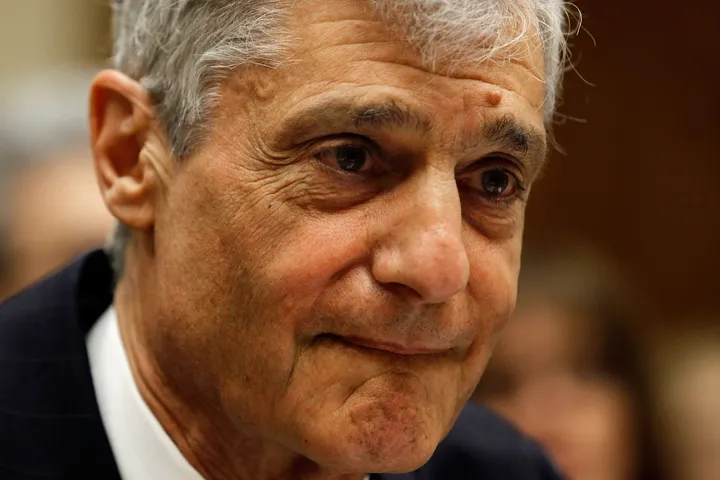
Robert Rubin

First Posted: 06/30/10 06:12 AM ET Updated: 05/25/11 05:20 PM ET

Robert Rubin is poisoning Washington again.

The former Treasury Secretary who presided over the nearly-fatal deregulation of the financial industry -- then made $126 million nearly killing Citigroup -- had been keeping an appropriately low profile in the nation's capital ever since everything he wrought went pear-shaped.

But now he's back, and once again trying to influence public policy.

On Friday he made his third major (and apology-free) Washington appearance in two weeks, delivering opening remarks at a conference that his pet think tank, the Hamilton Project, co-sponsored with the liberal Center for American Progress.

But the last thing Washington needs right now is another infusion of Rubinomics -- by which I mean the combination of deregulatory zeal, deficit obsession, free tradeism and general coziness with fat-cat Wall Street bankers that Rubin epitomizes.

It's long been troubling that so many of Obama's top economic advisers are former Rubin proteges, but the return and rehabilitation of the man himself is particularly unwelcome right now. Mild signs of recovery aside, we remain very much in the midst of an unemployment crisis that is devastating American families and that requires active, urgent government intervention -- not hand-wringing about the federal budget deficit. Financial regulation, to be effective, needs to limit what Rubin and his friends want to be able to do.

The Rubin effect could be felt at Friday's event, which was ostensibly about "The Future of American Jobs," but which -- with a few notable exceptions -- lacked a sense of urgency about the current unemployment crisis, focusing instead on long-terms "structural problems."

Asked by feisty moderator Chrystia Freeland of Reuters to explain why, if our capital markets are the best in the world, job creation is so weak, panelist and Berkeley economics professor Alan Auerbach instead launched into a disquisition on tax policy and the need to reduce corporate income taxes.

The centerpiece of Friday's event, a new report by MIT economist David Autor, did a commendable job of relating the polarization of job opportunities and contraction of the middle class to the feeble state of the America's public education system, but it glossed over the key role played by rapacious financial titans.

Panelist Ron Blackwell, chief economist for the AFL-CIO, was almost alone in giving more than lip service to the current jobs crisis. Blackwell said he had never seen a labor market "in worse condition than exists at present." He pointed out that the U.S. is an outlier country -- "No other country is experiencing anything like this," he said. He decried the way "globalization and financialization" has "changed the balance of power between workers and employers." And generally speaking, he made no bones about the government's essential role in both creating and fixing America's unique economic problems.

What's needed, he said, is nothing less than a "sustained public-investment led recovery that rebuilds the capacity of the American economy."

His cause was not taken up by his fellow speakers, however -- including Larry Summers, President Obama's chief economic adviser, and one of the event's two headliners (along with New York Mayor Michael Bloomberg.)

Summers began his remarks with an acknowledgment of the terrible trauma being caused by high unemployment. Then he pivoted.

"This is a profoundly important problem for our society, but it's the task of economists to analyze it in a more bloodless way."

And bloodless he was. For the next several years, he said, "What I think is safe to say is that even on optimistic assumptions, there is going to be substantial unused capacity in this economy," measured by, among other things, the unemployment rate.

Asked when that high unemployment would abate, he explained that it would depend upon "the pace of the economic recovery in terms of GDP" [Gross Domestic Product] and whether the formula that economists have historically used to predict job growth based on GDP would continue to be skewed by unusually high productivity. "Make your judgment about the GDP forecast over the next several years. Take your guess about whether the formula is going to snap back, or continue to be off, and you can form a view about the unemployment rate," he suggested.

"Maybe things will restore to normal," he said -- in which case job growth would actually outpace GDP. "That would be my guess, though not one I would hold confidently."

Summers did endorse some new government measures to spur job growth. "I don't see how anyone can look at the wholesale destruction of construction jobs [and] the state of our infrastructure in many spheres and not think that something ought to be done to increase the extent of our national effort around public investment," he said.

But asked if the country needs another stimulus, he replied: "I don't think framing the question in terms of a 'stimulus' is very helpful." He said he favored continuing unemployment insurance, new funding for local governments and investments in energy efficiency -- three major progressive goals.

But beyond that, he said: "Is this the moment for some major new experiment in Keynesian pump-priming? Absolutely no."

Rubin's public rehabilitation tour started last week, with a Hamilton Project event devoted to the principal that "it is vital that we begin to confront the challenges that pose a greater risk to our long-run prosperity than the Great Recession."

Vice President Joe Biden was the keynoter at that event, but, in a turnabout, used the occasion to challenge the Wall-Street friendly Democrats Rubin had assembled to join President Obama in making sure that this economic recovery, unlike the last one, actually benefits the middle class.

Rubin's second major appearance was on Wednesday, at a gala "Fiscal Summit" organized by fellow deficit hawk (and fellow Wall Street mogul) Peter Peterson. (The two men even joked onstage about their relative net worths.) That was a lovefest -- and a deeply disturbing one at that.

Although Biden didn't play along, Rubin has some highly placed enablers in his rehabilitation. The deficit summit's keynoter, former President Bill Clinton, had warm words for Rubin. "He's taken a few licks lately, like all of us have," Clinton said. But "I think he's the finest Treasury Secretary since Alexander Hamilton, and I still believe that."

At Friday's event, I asked Center for American Progress head John Podesta, who is close to the Obama White House, if he was concerned about enabling Rubin. He responded: "I think he has a track record, much of which is successful, some of which is not successful."

At last week's event, I asked Rubin about his role in deregulating derivatives -- one of the critical steps in the series of events that led to the country's financial meltdown. He replied that he had always favored regulating them. I wrote that even were this the case, his claim to fame remains that he killed the one serious attempt to regulate them.

Jumping to his defense Friday afternoon in Newsweek was Jacob Weisberg, the Washington Post Co. executive who co-authored Rubin's 2003 autobiography (talk about intimate relationships between journalists and their sources). Weisberg insists that Rubin supported regulation, but was just powerless to do so given the opposition from Wall Street and other members of the Clinton administration. Similarly, Weisberg argues, despite multiple reports to the contrary, that Rubin wasn't involved in the decisions that led to Citigroup needing a massive federal bailout to survive.

Is anything disqualifying from public life these days? Given the chance to weigh in, the voters evidently think so -- consider the parable of soon-to-be-former Sen. Chris Dodd.

In Washington public policy circles, however, the answer is apparently not -- certainly not if you're rich and well connected.

But as Rubin's literally disastrous track record so clearly suggests, Washington would be better off shorting Rubinomics than investing in it.

*************************

Dan Froomkin is senior Washington correspondent for the Huffington Post. You can send him an e-mail, bookmark his page; subscribe to RSS feed, follow him on Twitter, friend him on Facebook, and/or become a fan and get e-mail alerts when he writes.

FOLLOW HUFFPOST POLITICS
Subscribe to the HuffPost Hill newsletter!
Robert Rubin is poisoning Washington again. The former Treasury Secretary who presided over the nearly-fatal deregulation of the financial industry -- then made $126 million nearly killing Citigroup...
 
 
  • Comments
  • 897
  • Pending Comments
  • 0
  • View FAQ
Comments are closed for this entry
View All
Favorites
Highlights
Bloggers
Recency  | 
Popularity
Page: 1 2 3 4 5  Next ›  Last »  (21 total)
11:28 AM on 05/06/2010
What does it take to make people who are as disgusting as Robert Rubin just slink away in shame, go "pursue private interests," and leave the rest of us to clean up the mess they created in their arrogance and greed? Given Rubin's performance and accomplishments, a modicum of humility seems indicated - I'd say a leading role in tanking the global economy would make many people a bit more reticent to share their "wisdom and expertise" - but of course that hasn't slowed Larry Summers down one iota. They are not "Masters of the Universe." They never were. I believe there's a label for this kind of gradiose delusion, but I'm bored with the subject already.... Go AWAY Bobby - we're sick of you.
photo
Levonsky
a fan of enlightened self interest
01:20 PM on 05/03/2010
Dan Froomkin is one of the best political journalists around today.

Thanks, Dan.
07:36 AM on 05/03/2010
Letting Rubin and Greenspan fade into obscurity would be the best punishment of for these narcissistic, incompetent thugs and tumors of humanity.. Rubin makes my skin crawl every time I see his face.. he's such a greedy little lousy smuck... his ego is out-of-control… and he’s really, really destructive… same with Alan the simpleton… get on your rocking chair, Alan, and reflect on your life’s work, which was a complete failure…
photo
ibsteve2u
Someone who cares - to his unending regret
06:55 AM on 05/03/2010
Rubin = neoliberal; neoliberal = Republican who is smart enough to throw the American people a bone now and again so as to keep them mollified until it is too late.

Clinton was/is a neoliberal.
HUFFPOST SUPER USER
LiberalDem
12:53 PM on 05/24/2010
Clinton is still a neoliberal.
03:17 AM on 05/03/2010
When someone who made ove 100 million by ruining lives of the people he SWORE TO SERVE does not go to jail for treason lwas have no meaning whatsoever.
photo
HUFFPOST SUPER USER
billw8017
History looks like this
07:26 PM on 05/02/2010
When Enron ravished California, Bush and Cheney told us this was but the working of "market forces." This kind of attitude would have led to a collapse no matter the "system" in power.

Mines were relieved from having to honor safety rules, food inspection was reduced, wealthy people were encouraged to cheat on their taxes and to send their earnings to the Bahamas. In simple fact, the "elite" who were the "base" of the previous administration made out like pirates.

At the same time, wages and middle class income would seem to have drifted lower as a share of the nation's wealth. This undermined manufacturing and encouraged luxury imports.

We had not "free enterprise" capitalism but "crony capitalism" which seldom works well. When the government chose to execute the laws and prosecute some of the more egregious offenders, as with Elliot Spitzer in New York, it could do so. I don't like Rubinomics or having his disciples in Washington, but a case can be made for private enterprise within the law and fiscal responsibility in the federal budget. Neither of these things have been practiced by the former administration.

Before we talk about revolution, we might try to remember exactly how we truly got into this mess.
photo
HUFFPOST SUPER USER
William1950
everything I say could be wrong.
05:43 PM on 05/02/2010
there is no way of stoping rubin.. or his cronies, short of total - what's the word here? it won't happen at the ballot box.
03:26 PM on 05/03/2010
I think the word you are looking for is self-reliance.
02:18 AM on 05/04/2010
If we lived in caves maybe.
photo
HUFFPOST SUPER USER
texgal7
Under starry skies....
04:15 PM on 05/02/2010
"The American people need to know exactly who was responsible"............. it was us, the American people. We were too busy with our own lives, and understanding economics seemed to complicated to worry about, as long as we were mostly doing okay. Government is just us, or a reflection of us. My story now is that any economic policy that is too complicated for me to grasp is suspect. (I have 2 postgraduate degrees and a minor in economics.) I don't buy the idea that we need to keep huge banking conglomerates because it's good for business and good for the world. I think the people who are making millions in bonuses do think it's good for business and for themselves, and I don't think they are necessarily bad people. I think they are like selfish children who will take anything they can get without giving anything because those are the rules their parents have allowed to become established in the household. This is our country. We are supposed to be the parents. We are not supposed to abdicate that responsibility to "banking experts" who tell us it's too complicated for us to grasp, so we need to let them run it.
photo
HUFFPOST SUPER USER
William1950
everything I say could be wrong.
05:45 PM on 05/02/2010
perhaps it is the collective "our" fault... but i don't think so other than in terms of believing that our leaders, public and private, were motivated by public good.. we find out that they are interested only in gain.
photo
HUFFPOST SUPER USER
billw8017
History looks like this
07:41 PM on 05/02/2010
I mostly agree. People were gulled into taking loans they couldn't repay because the housing bubble seemed to indicate they might be able to sell what they borrowed to buy in a kind of Ponzi scheme. Even more, however, a slick sales person can sell almost everything. People feel some sympathy even when they understand how self serving the salesperson may be, or may buy just so the salesperson will go away. I, for one, find I can resist almost anything except temptation.

Adam Smith wrote of the agents of the East India Company, saying most were well intentioned, but when they took their earnings and returned to England, they really didn't care if the whole subcontinent were to sink beneath the ocean. This was the problem of those who initiated the unsound loans. If they had only done a public service, their profits should have been deserved.
photo
HUFFPOST SUPER USER
texgal7
Under starry skies....
09:40 PM on 05/02/2010
IMHO, some of our so-called leaders are smart, some are dumb, some are greedy, some are noble, but we are eventually going to have to realize they are no better than us - they ARE us. That's why we have the constitutional ability to vote them out of office every few years.
photo
Levonsky
a fan of enlightened self interest
01:24 PM on 05/03/2010
We were sold a bad product. That product was neo-conservatism with all the financial, political. and social policies that went with it.

Yes, it is our fault for not recognizing a Pinto when it was presented to us and rejecting it.
02:51 PM on 05/02/2010
Rubin and his rubinites need to leave policy making to those who actually have good ideas. They all need to leave the capital right now before any more damage is done. The very fact that anyone still listens to advice and implements their ideas is very disturbing.
12:31 PM on 05/02/2010
If the housing bubble had been just that, the economy wouldn't have crashed, only the housing market. The subprimes may have cost even $100 billion at most. Had the crash been limited to those "greedy homeowners" who wanted a house and something for nothing, we would not be in this mess. Yes, ordinary people are to blame for the housing crash, along with the mortgagee's and the banks that funded the mortgages. But this would never account for the mess we are in. What happened was that investment gurus came up with exotic ways to turn $1 worth of debt, backed by .75 cents of assets into $1,000 worth of debt backed by that same .75 cents. I'm so tired of hearing about the equal blame that is spread around. No homeowners are not equally to blame for the world economic crash, nor the failure of Wall Street to manage risk and to gamble on our futures.
cuchulain
Occupy the Tao
04:44 PM on 05/02/2010
Good post. You're exactly right. Homeowners were only taking chances with their own credit. If they lost the bet, their own credit would be destroyed and they'd lose their house. A tragedy for them, but it didn't cause others to share the pain.

Wall Street and the financial sector, OTOH, placed bets they couldn't cover, securitized them, bought insurance on the securities, bet on that, and bet against other bets, thus risking the entire world economy. They couldn't cover their bets, so they had to get the government to backstop them, which cost all of us. They leveraged themselves to obscene levels and are completely responsible for creating a systemic crisis.

Again, individual homeowners only put themselves at risk in pursuit of the American Dream. OTOH, Wall Street and the financial sector put everyone at risk, because they weren't satisfied that they had enough wealth. Their billions weren't enough, so they basically mortgaged our future to gain billions now.

It's ludicrous to blame poor homeowners for this debacle.
10:56 AM on 05/03/2010
agreed agreed agreed a greed a greed a greed
paid bonuses in real money based on profits made of paper
09:52 AM on 05/02/2010
While the shellacing of the Goldman, Sachs operatives serves a useful purpose, only when criminal investigations of the enablers of financial deregulation will be started by the justice department, will there be hope for a change. The names of these enablers still alive today, are well known: Bush I, Clinton, Rubin, Gramm, Greenspan, Bernake, Summers and a long bipartisan list of Congressional parasites paid by Wallstreet. Let justice be served.
08:58 AM on 05/02/2010
Another bad move against average American citizens to put a guy in the mix that had a hand in previous problems. The "Old Boy's Club" lives on and forget everyone else. Until Washington understands that the same ole, same ole, has failed us in so many ways and changes radically to the side of the middle class, we will have no change. Imagine if the middle class was suddenly given the tools to grow and prosper again. Everyone would benefit. Too bad the mega rich don't want that to happen and they have the power. Someday they'll see that without a strong middle class, they can hoard all the money they want, eventually they will have no one to serve them or buy their stuff or give them tax money for bailouts, subsidies etc.
photo
HUFFPOST SUPER USER
Livid
08:56 AM on 05/02/2010
I agree that Rubin needs to be banished from the kingdom. So do Summers, Greenspan and Levitt. All of them were part of the presidential working group that pushed Clinton to sign deregulation and repeal of Glass-Steagall.

However, individuals come and go. What really is at issue here is right wing political philosophy and the entrenched class, religious and racial warfare that is underway in the U.S.

The essence of this philosophy is that society, more particularly whitey, is better off without laws.

Really !?!

Human beings are innately horrendous creatures. We kill each other as no other species on earth does. Laws separate us from animals, and laws draw bright lines between what is functional for society and what is not.

It has always been that way, and it always will be.

For the time being, our country has been hijacked by the lunatic fringe. Rubin, Summers, Greenspan, and Levitt are simply examples of economic thinking that was lunatic at the time, and that has proven to be more so in hind sight.

Part of the solution is to get these morons off the stage and pay no more attention to them. And, of course, to call them out for what they really are, dangerous.
This user has chosen to opt out of the Badges program
02:25 AM on 05/02/2010
Someone take this SOB behind the barn and do the right thing.
01:58 AM on 05/02/2010
I remember the tech stock bubble. Everyone was making huge bucks (Wall Street fat cats, pension fund managers, and individual investors) riding an investor created wave - speculating on all the new tech miracles that were going to solve all the world's problems.

It seemed too good to be true, and like all such dreams - so it turned out. But during the ride up, more and more people looked at everyone around them making something for nothing and couldn't resist joining in.

Fast forward to the housing bubble. Again, many made lots of dough. Especially those who invested early. 60K houses shot up to180K in as little as 5-years time. Many cashed out of the booming markets and retired with nest eggs to less expensive areas to live. Many started investing and flipping houses for big bucks. Remember all the "no money down" schemes flooding the airwaves?

Amazing how people (from Wall Street down to Main Street) thought that the housing bubble would somehow be immune to the laws of economics.

The "experts" should have known better, but they were just abusing a wave created on the street. No one was forced to buy houses that were way over priced.

And congress forced Fannie/Freddie to loan half their 10-trillion to middle/low income customers - people who had no means to maintain payments after the slightest economic bump.

There is plenty of blame to go around here folks.