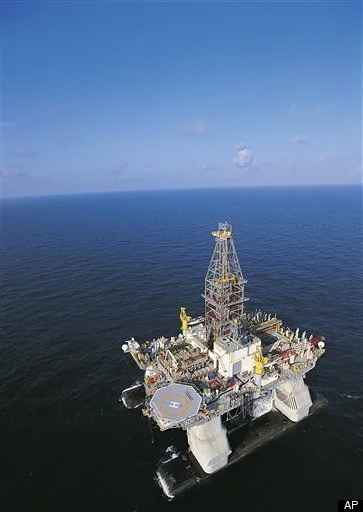
LOS ANGELES — The federal agency responsible for ensuring that an oil rig in the Gulf of Mexico was operating safely before it exploded last month fell well short of its own policy that inspections be done at least once per month, an Associated Press investigation shows.
Since January 2005, the federal Minerals Management Service conducted at least 16 fewer inspections aboard the Deepwater Horizon than it should have under the policy, a dramatic fall from the frequency of prior years, according to the agency's records.
Under a revised statement given to the AP on Sunday, MMS officials said the last infraction aboard the rig, which blew up April 20, killing 11 and spewing millions of gallons of oil into the Gulf of Mexico, occurred in August 2003, not March 2007 as originally stated.
The inspection gaps and poor recordkeeping are the latest in a series of questions raised about the agency's oversight of the offshore oil drilling industry. Members of Congress and President Barack Obama have criticized what they call the cozy relationship between regulators and oil companies and have vowed to reform MMS, which both regulates the industry and collects billions in royalties from it.
Among the dubious oversight practices, the MMS has reportedly allowed hundreds of drilling plans to move forward without required permits since Obama took office. On Friday, the New York Times revealed that one of those projects lacking a permit was the Deepwater Horizon rig:
The National Oceanic and Atmospheric Administration, or NOAA, is partly responsible for protecting endangered species and marine mammals. It has said on repeated occasions that drilling in the gulf affects these animals, but the minerals agency since January 2009 has approved at least three huge lease sales, 103 seismic blasting projects and 346 drilling plans. Agency records also show that permission for those projects and plans was granted without getting the permits required under federal law.
"M.M.S. has given up any pretense of regulating the offshore oil industry," said Kierán Suckling, director of the Center for Biological Diversity, an environmental advocacy group in Tucson, which filed notice of intent to sue the agency over its noncompliance with federal law concerning endangered species. "The agency seems to think its mission is to help the oil industry evade environmental laws."
Earlier AP investigations have shown that the doomed rig was allowed to operate without safety documentation required by MMS regulations for the exact disaster scenario that occurred; that the cutoff valve which failed has repeatedly broken down at other wells in the years since regulators weakened testing requirements; and that regulation is so lax that some key safety aspects on rigs are decided almost entirely by the companies doing the work.
The AP sought to find out how many times government safety inspectors visited the Deepwater Horizon, and what they found. In response, MMS officials offered a changing series of numbers.
At first, officials said 83 inspections had been performed since the rig arrived in the Gulf 104 months ago, in September 2001. While being questioned about the once-per-month claim, the officials subsequently revised the total up to 88 inspections. The number of more recent inspections also changed – from 26 to 48 in the 64 months since January 2005.
No explanation was given initially for the upward revisions. On Sunday, the officials said additional inspections were discovered after MMS gathered more information from a deeper examination of its databases.
AP granted MMS officials anonymity because without that condition, communications staff at the Interior Department, which oversees MMS, would not have let them talk.
Reacting to the latest disclosures, House Natural Resources Committee Chairman Nick J. Rahall, D-W.Va., said while he applauded Interior Secretary Ken Salazar's remedial actions, it seems "MMS has been asleep at the switch in terms of policing offshore rigs." He said the committee, slated to hold hearings May 26-27, will examine these issues "in the context of what our offshore leasing program will look like in the future."
Added Senate Republican leader Mitch McConnell, R-Ky., "While our priority now is to do everything possible to stop this spill and mitigate further damage, the administration's actions will be a major component of what we investigate."
Based on the last set of numbers provided, the Deepwater Horizon was inspected 40 times during its first 40 months in the Gulf – in line with agency policy.
Even using the more favorable numbers for the most recent 64 months, 25 percent of monthly inspections were not performed. The first set of data supplied to AP represented a 59 percent shortfall in the number of inspections.
Interior spokeswoman Kendra Barkoff would not comment on the inspection numbers. Instead, she offered a general statement: "We are looking at all the questions that are coming out of the Deepwater Horizon incident."
In response to a Freedom of Information Act request filed by AP, the agency has released copies of only three inspection reports, from Feb. 17, March 3 and April 1. According to the documents, inspectors spent two hours or less each time they visited the massive rig. Some information appeared to be "whited out," without explanation.
In an e-mail to AP, an Interior Department official emphasized with italics that the MMS inspects rigs "at least once a month" when drilling is under way. Monthly inspections are an agency policy, though not required by regulation, said David Dykes, chief of the agency's office of safety management for the Gulf region.
Last week, at a joint Coast Guard-MMS investigatory hearing in Kenner, La., Michael Saucier, MMS's regional supervisor for field operations in the Gulf, said about inspections aboard the oil rigs: "We perform them at a minimum once a month, but we can do more if need be."
The job falls to the 55 inspectors in the Gulf who are supposed to visit the 90 drilling rigs once per month and the approximately 3,500 oil production platforms once per year.
The Deepwater Horizon's inspection frequency numbers struck Kenneth Arnold, a veteran offshore drilling consultant and engineer.
"I'd certainly question it," he said. "I'd ask, 'Why aren't you doing it?'"
When the AP did ask, MMS and Interior would not answer directly. Instead providing a set of conditions when a rig would not typically be inspected – including during bad weather or when it is jumping among short-term jobs.
Transocean Ltd., which owned the Deepwater Horizon and leased it to BP PLC, would not provide a detailed accounting of the rig's activity history. According to RigData, a Texas firm that monitors offshore activity in the Gulf, the Deepwater Horizon was working approximately 2,896 days of the 3,131 days since it started its first well – about 93 percent of the time. That number represents the total number of days between when it broke the seafloor during a drilling operation to when it was released to another site.
A summary of the inspection history said the Deepwater Horizon received six "incidents of noncompliance" – the agency's term for citations.
The most serious occurred July 16, 2002, when the rig was shut down because required pressure tests had not been conducted on parts of the blowout preventer – the device that was supposed to stop oil from gushing out if drilling operations went wrong.
That citation was "major," said Arnold, who characterized the overall safety record related by MMS as strong.
A citation on Sept. 19, 2002, also involved the blowout preventer. The inspector issued a warning because "problems or irregularities observed during the testing of BOP system and actions taken to remedy such problems or irregularities are not recorded in the driller's report or referenced documents."
During his Senate testimony last week, Transocean CEO Steven Newman said the blowout preventer was modified in 2005.
According to MMS officials, the four other citations were:
_ Two on May 16, 2002, for not conducting well control drills as required and not performing "all operations in a safe and workmanlike manner."
_ One on Aug. 6, 2003, for discharging pollutants into the Gulf.
_ One on March 20, 2007, which prompted inspectors to shut down some machinery because of improper electrical grounding.
Late last week, several days after providing the detailed accounting, Interior officials told AP that in fact there had been only five citations, that one had been rescinded. The officials said they could not immediately say which of the six had been rescinded.
On Sunday, MMS officials said the 2007 citation was rescinded following an informal appeal, which they said can be granted by an inspector's boss. In this case, further review showed the equipment in question complied with regulations, the officials said.
The agency's problems with providing information extends to the data on display on its website. For example, the accounting of accident and incident reports is incomplete, making it very difficult to perform a thorough data analysis of the agency's performance and preventing a full accurate tracking of safety records of the rigs.
Data problems go back at least a decade. According to John Shultz, who as a graduate student in the late 1990s studied MMS' inspection program in depth for his dissertation, the agency's data infrastructure was severely limited.
"If you have the data you need, the analysis becomes fairly straightforward. Without the data, you're simply stuck with conjectures," said Shultz, who now works in the Department of Energy's nuclear program.
The strong inspection record led MMS last year to herald the Deepwater Horizon as an industry model for safety.
The Deepwater Horizon's record was so exemplary, according to MMS officials, that the rig was never on inspectors' informal "watch list" for problem rigs.
___
Associated Press Writers Michael Kunzelman in New Orleans and Garance Burke in Fresno, Calif., contributed to this report.