
iPhone app iPad app Android phone app Android tablet app More

Gulf Oil Spill: Slick-Coated Animals Struggle And Die As 'Wildlife Apocalypse' Becomes Reality

First Posted: 06/05/10 07:36 PM ET Updated: 05/25/11 05:40 PM ET

Gulf Oil Spill Wildlife Apocalypse

ON BARATARIA BAY, La. (AP) -- The wildlife apocalypse along the Gulf Coast that everyone has feared for weeks is fast becoming a terrible reality.

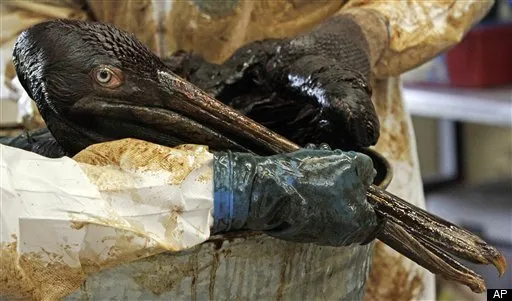
Pelicans struggle to free themselves from oil, thick as tar, that gathers in hip-deep pools, while others stretch out useless wings, feathers dripping with crude. Dead birds and dolphins wash ashore, coated in the sludge. Seashells that once glinted pearly white under the hot June sun are stained crimson.

Scenes like this played out along miles of shoreline Saturday, nearly seven weeks after a BP rig exploded and the wellhead a mile below the surface began belching millions of gallon of oil.

"These waters are my backyard, my life," said boat captain Dave Marino, a firefighter and fishing guide from Myrtle Grove. "I don't want to say heartbreaking, because that's been said. It's a nightmare. It looks like it's going to be wave after wave of it and nobody can stop it."

The oil has steadily spread east, washing up in greater quantities in recent days, even as a cap placed by BP over the blownout well began to collect some of the escaping crude. The cap, resembling an upside-down funnel, has captured about 252,000 gallons of oil, according to Coast Guard Adm. Thad Allen, the government's point man for the crisis.

If earlier estimates are correct, that means the cap is capturing from a quarter to as much as half the oil spewing from the blowout each day. But that is a small fraction of the 23 million to 47 million gallons government officials estimate have leaked into the Gulf since the April 20 explosion that killed 11 workers, making it the nation's largest oil spill ever.

Allen, who said the goal is to gradually raise the amount of the oil being captured, compared the process to stopping the flow of water from a garden hose with a finger: "You don't want to put your finger down too quickly, or let it off too quickly."

BP officials are trying to capture as much oil as possible without creating too much pressure or allowing the buildup of ice-like hydrates, which form when water and natural gas combine under high pressures and low temperatures.

President Barack Obama pledged Saturday in his weekly radio and Internet address to fight the spill with the people of the Gulf Coast. His words for oil giant BP PLC were stern: "We will make sure they pay every single dime owed to the people along the Gulf coast."

But his reassurances offer limited consolation to the people who live and work along the coasts of four states -- Louisiana, Mississippi, Alabama and Florida -- now confronting the oil spill firsthand.

In Gulf Shores, Ala., boardwalks leading to hotels were tattooed with oil from beachgoers' feet. A slick hundreds of yards long washed ashore at a state park, coating the white sand with a thick, red stew. Cleanup workers rushed to contain it in bags, but more washed in before they could remove the first wave of debris.

The oil is showing up right at the beginning of the lucrative tourist season, and beachgoers taking to the region's beaches haven't been able to escape it.

"This makes me sick," said Rebecca Thomasson of Knoxville, Tenn., her legs and feet smeared with brown streaks of crude. "We were over in Florida earlier and it was bad there, but it was nothing like this."

At Pensacola Beach, Erin Tamber, who moved to the area from New Orleans after surviving Hurricane Katrina in New Orleans, inspected a beach stained orange by the retreating tide.

"I feel like I've gone from owning a piece of paradise to owning a toxic waste dump," she said.

Back in Louisiana, along the beach at Queen Bess Island, oil pooled several feet deep, trapping birds against unused containment boom. The futility of their struggle was confirmed when Joe Sartore, a National Geographic photographer, sank thigh deep in oil on nearby East Grand Terre Island and had to be pulled from the tar.

"I would have died if I would have been out here alone," he said.

With no oil response workers on Queen Bess, Plaquemines Parish coastal zone management director P.J. Hahn decided he could wait no longer, pulling an exhausted brown pelican from the oil, the slime dripping from its wings.

"We're in the sixth week, you'd think there would be a flotilla of people out here," Hahn said. "As you can see, we're so far behind the curve in this thing."

After six weeks with one to four birds a day coming into Louisiana's rescue center for oiled birds at Fort Jackson, 53 arrived Thursday and another 13 Friday morning, with more on the way. Federal authorities say 792 dead birds, sea turtles, dolphins and other wildlife have been collected from the Gulf of Mexico and its coastline.

Yet scientists say the wildlife death toll remains relatively modest, well below the tens of thousand of birds, otters and other creatures killed after the Exxon Valdez ran aground in Alaska's Prince William Sound. The numbers have stayed comparatively low because the Deepwater Horizon rig was 50 miles off the coast and most of the oil has stayed in the open sea. The Valdez ran aground on a reef close to land, in a more enclosed setting.

Experts say the Gulf's marshes, beaches and coastal waters, which nurture a dazzling array of life, could be transformed into killing fields, though the die-off could take months or years and unfold largely out of sight. The damage could be even greater beneath the water's surface, where oil and dispersants could devastate zooplankton and tiny invertebrate communities at the base of the aquatic food chain.

"People naturally tend to focus on things that are most conspicuous, like oiled birds, but in my opinion the impacts on fisheries will be much more severe," said Rich Ambrose, director of the environmental science and engineering at program at UCLA.

The Gulf is also home to dolphins and species including the endangered sperm whale. A government report found that dolphins with prolonged exposure to oil in the 1990s experienced skin injuries and burns, reduced neurological functions and lower hemoglobin levels in their blood. It concluded, though, that the effects probably wouldn't be lethal because many creatures would avoid the oil. Yet dolphins in the Gulf have been spotted swimming through plumes of crude.

Gilly Llewellyn, oceans program leader with the World Wildlife Fund in Australia, said she observed the same behavior by dolphins following a 73-day spill last year in the Timor Sea.

"A heartbreaking sight," Llewellyn said. "And what we managed to see on the surface was undoubtedly just a fraction of what was happening."

The prospect left fishing guide Marino shaking his head, as he watched the oil washing into a marsh and over the body of a dead pelican. Species like shrimp and crab flourish here, finding protection in the grasses. Fish, birds and other creatures feed here.

"It's going to break that cycle of life," Marino said. "It's like pouring gas in your aquarium. What do you think that's going to do?"

___

Flesher reported from Traverse City, Mich. Contributing to this report were Associated Press writers Holbrook Mohr on Barataria Bay, La.; Melissa Nelson in Pensacola Beach, Fla.; and Jay Reeves in Gulf Shores, Ala.

FOLLOW HUFFPOST GREEN

ON BARATARIA BAY, La. (AP) -- The wildlife apocalypse along the Gulf Coast that everyone has feared for weeks is fast becoming a terrible reality. Pelicans struggle to free themselves from oil, thick...
Filed by Jeff Muskus  | 
 
 
  • Comments
  • 328
  • Pending Comments
  • 0
  • View FAQ
Comments are closed for this entry
View All
Favorites
Recency  | 
Popularity
Page: 1 2 3 4 5  Next ›  Last »  (8 total)
08:31 PM on 06/13/2010
BP spill the greatest enviromental disaster ever? Really? Every day the mountains of the Appalachians are blown up and the most biodiverse forest, second only to the Amazon, is being bulldozed into the valleys. All for what, 10% of the nations coal. The coal companies call it Mountain Top Removal. In reality its the total obliteration of the land and a culture. This has been happening for decades, but as long as people have cheaper electric bills, who cares about the people of Appalachia, right? I mean rich people love the beach, who cares about the poor people in the mountains, right? Nearly 2000 miles of streams have been buried or polluted by MTR valley fills and toxic run-off. 3,000,000 pounds of explosives are used on the mountains in WV alone every working day. 1 million acres of Appalachian forest and lands have been leveled, but less than 3% have been reclaimed for commercial or industrial use. Top coal producing counties in WV suffer from some of the worst poverty and unemployment. Residents who live in the coalfields live with increased flooding, blasting that damages homes, air filled with silica and toxic coal dust, plus poisoned water supplies. Is the oil spill bad? Yes. However, when compaired to Mountain Top Removal, I hardly see how it can be called the worst. The oceans will recover LONG before the mountains ever will, if they ever do.
HUFFPOST SUPER USER
KingKrub
03:25 PM on 07/01/2010
As long as profit is more important to us than the rest of this world, things like this will always happen.
05:53 AM on 06/12/2010
http://masglp.olemiss.edu/Water%20Log/WL17/gulf.htm
an interesting read.
02:41 AM on 06/08/2010
Just rename it "The Dead Sea" and be done with it.

Profit over people.

This whole thing makes me sick
This user has chosen to opt out of the Badges program
02:55 PM on 06/07/2010
Is this a great country, or what?
This user has chosen to opt out of the Badges program
02:53 PM on 06/07/2010
Here's what our own scientists won't say:

http://www.spiegel.de/international/world/0,1518,693359,00.html
This user has chosen to opt out of the Badges program
photo
Debbie338
What we manifest is before us
12:48 PM on 06/07/2010
Well, Mr. BP CEO: I'm sure these animals want THEIR lives back, too.
This user has chosen to opt out of the Badges program
02:55 PM on 06/07/2010
stick a fork in me---I am pretty well done with the only gift we commoners get from the elites being a sense of impotent rage
11:28 AM on 06/07/2010
Does Rush Limbaugh think these animals can heal themselves, just like the ocean can?
01:07 PM on 06/07/2010
If the oil takes the natural course of the Gulf currents and travels around the southern tip of Florida and up the eastern seaboard Rush will have a change of heart. The oil and vapors will literally be washing up in his back yard.
photo
HUFFPOST SUPER USER
FrankenPC
11:03 AM on 06/07/2010
"It's going to break that cycle of life," Marino said. "It's like pouring gas in your aquarium. What do you think that's going to do?"

I wonder why the Government doesn't get this concept. visible red ochre or not, the solvent portion of the oil has diffused into the water supply.

I ask you, what's scarier: The idea that the Government doesn't get this? Or the Government does get this and hopes we don't.
HUFFPOST SUPER USER
pingufan
NJ "Blue Dog" Prolife Dem
10:15 AM on 06/07/2010
We will likely see devastating effects from the destruction of the ecology for years to come. I wonder if this is the beginning of the end of America's greatness. With such large areas of destroyed marsh, and concurrent loss of livelihood from the Gulf, we are truly living an Apocalypse. Now.
11:30 AM on 06/07/2010
I am currently of the opinion that the line "This is the way that the world ends, not with a bang but a whimper" (from The Hollow Men by T. S. Eliot, 1925) will prove true. We're not going to nuke ourselves to death, we're just simply going to poison ourselves until there is no viable earth or water left.
photo
HUFFPOST SUPER USER
Puzzlr
thegrouphugdotorg
10:06 AM on 06/07/2010
This oil spill took over 30 days to reach a coast, so why is our response so lacking? Would it have taken 30 days to create more barrier islands? And why is the governor of LA begging for federal government help? Haven't they done anything since Katrina to prepare for a disaster? The mind boggles.
This user has chosen to opt out of the Badges program
photo
07:55 AM on 06/07/2010
I can't understand why Americans -- or anyone -- still buys gas at a BP station.
Who cares if the stations are franchises owned locally?
If BP can't sell gas through its franchises, its stock might go down. Lower stock price might slightly inconvenience a few board members and stockholders, but that's about all the revenge we'll ever get.
I think BP won't really be worried until the oil gets around to the East Coast where the high rollers all have beach-front mansions and where all the $100 million yachts are stored.
When the billionaires have to breath the same stench that working folks inhale daily, it becomes a social affront as well as an annoyance.
Imagine, having to breath the same air as taxpayers! Oh, the shame.
Only when this oil gets up to Annapolis, Hilton Head and Nantucket will something be done. Until then, the super-rich will of course be looking to buy derivatives pegged to a collapse in BP stock or BP stocks in anticipation of the oil giant's comeback next year.
Meanwhile, just don't buy anything connected with BP -- ever.
09:34 AM on 06/07/2010
I agree...I don't buy from McDonalds, Burger King and other fast food franchises because their products come from factory farms why should I buy oil from a company that doesn't give squat about damaging this country's environment.

I don't buy Japanese cars because they subsidize the killing of whales.
I don't eat in Red Lobster because they get all their seafood from Canada where seals are skinned alive every year.


so this notion that boycotting hurts the franchise or business...duh that's the point.
photo
HUFFPOST COMMUNITY MODERATOR
HLL
My little dog — a heartbeat at my feet ^..^
11:38 AM on 06/08/2010
Fanned dayala. I'm with you - I never buy fast food, ever. I'm a vegan vegetarian, but before I was, I never bought tuna because the nets kill dolphins, and I didn't want to kill tuna either.... look, the whole killing of animals is revolting to me, but each person has to make the decision for themselves as to what they're going to do about it.

Thank you for your compassion.
10:40 AM on 06/07/2010
Agreed. This is not BP's first incident, and each one has been handled poorly.

http://en.wikipedia.org/wiki/BP (go down to the section labeled "incidents)

I've been boycotting BP since 2006.
07:16 AM on 06/07/2010
Below 656 feet sunlight ceases to penetrate the ocean,below this point a recent marine life census by the louisana based oceangrapher Robert S.Carey said 'parts of the deep that we assumed were homogenous are actually quite complex'.Snow like matter cascades down to the depths even with sunken whale bones (amongst others) to feed the complex life(surface oil may well block this process).Oil and methane are also an energy source.1,000,000 species were estimated to be unidentified.Cities of brittlestars and anemone gardens existed.The deep was considered to be barren before these studies(now of course it may well be in large tracts).These myriad organisms on the lower end of the spectrum are known to exist in the hardest environments(in fact the seabeds under the entire Gulf stream appear highly fecund),they are the natural indicators of the degree of damage done down there.Marine scientists have described them as the cradle of lifes of the planet.When deceased these animals tend to disintegrate before getting to the surface.Environmental rejuvenation of land based disasters is a relatively new scientific field(involving vast amounts of time-lined information and analysis),my question is... does the planet have a single independant oceangrapher near the Gulf with the ability to begin assessing the impact on the affected environment because that will be where its rejunvenation will begin,if it s healthy down there their's hope...just maybe.And another thing stop the washing of oil tanks at sea BP!
photo
HUFFPOST SUPER USER
Ravyn
04:03 AM on 06/07/2010
Just heartrending and infuriating and frustrating. I could cry.
02:54 AM on 06/07/2010
BOYCOTT BP OIL....SPREAD THE WORD!!!BOYCOTT UNTIL THEY CAP THE WELL. BOYCOTT BP OIL!!!!!
02:32 AM on 06/07/2010
BP hit the jugular vein of the earth and it is bleeding oil. To hell with the politics of who did it and what for. The earth could be dying! We are the parasites and it is the host. If it dies, we die.