iPhone app iPad app Android phone app Android tablet app More

Do College Rankings Mean Anything? Bloggers Weigh In

First Posted: 08/17/10 11:45 AM ET Updated: 05/25/11 06:25 PM ET

College Rankings

Forbes does them. So does the Princeton Review. Washington Monthly is in on the game. And, of course, there's the granddaddy of them all: U.S. News and World Report.

It seems that every day a new set of college rankings appears on the radar. Is it too much of a questionably good thing?

Some of the country's higher education critics have started to greet the rankings with a yawn. Evidently, the only thing surprising about the rankings is just how underwhelming they are.

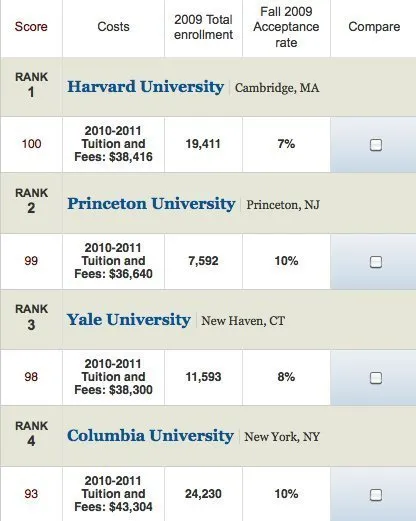
Last year, CBS MoneyWatch's Lynn O'Shaughnessy called U.S. News' rankings "a high-stakes beauty contest." This year, she pokes fun at the inevitability of an Ivy League school taking the U.S. News No. 1 spot:

The magazine would save itself a lot of trouble if it just flipped a coin every year to determine who was No. 1 since there are only two contenders. Or perhaps the magazine could find a three-headed coin so Yale would also get a chance in the college rankings sweepstakes.

NPR's David Gura considers the larger picture:

Sure, the top 20 schools in both categories are rearranged annually, depending on undergraduate academic reputation, graduation and freshman retention, faculty resources, student selectivity, financial resources, and the alumni giving rate, among other things, but what does it really mean if, say, Harvard University supplants another Ivy League school, or the California Institute of Technology falls to No. 7? When I looked at schools, I was more-impressed by qualitative differences than quantitative ones. The quad! The library! The food! The stories about that much-beloved professor!

What do YOU think? Do the rankings mean anything to you? Join the discussion in the comments section.

WATCH: U.S. News and World Report senior education writer Kim Clark breaks down the rankings on the Today show.

Visit msnbc.com for breaking news, world news, and news about the economy

FOLLOW HUFFPOST COLLEGE

Forbes does them. So does the Princeton Review. Washington Monthly is in on the game. And, of course, there's the granddaddy of them all: ...
Filed by Leah Finnegan  | 
 
 
  • Comments
  • 29
  • Pending Comments
  • 0
  • View FAQ
Comments are closed for this entry
View All
Recency  | 
Popularity
07:21 AM on 09/06/2010
Learn how to maximize profitability using simple financial tools and reports. Learn how to focus your resources to get the most return investment. Log on to http://www.twodaymba.org
IWantTofu
Evolution. Now a political position.
04:42 PM on 08/25/2010
My respect for the US News ranking went down significantly when I learned that when they evaluate a new criteria, if it changes the rankings too much (specifically the Ivies drop) they don't use the ranking. This maintains the Ivy bias you always find in their listing. (Cornell? give me a break.)
01:59 PM on 08/18/2010
The rankings are so crude that they are almost meaningless. I'd guess their margin of error is somewhere ca. 10%. That does mean that a school in the top 20 is likely a better bet that one ranked below 50; but anyone who thinks there is some objective criteria that would allow you to say that Harvard is better than Yale [or vice versa] doesn't know much about education [or big institutions.]

As several folks have said, the real question is the fit between a student and the program and resources available. No list can help much.
photo
HUFFPOST SUPER USER
Mondayboy
Rebel with a cause
11:35 AM on 08/18/2010
The rankings mean nothing if you attend an online university
This user has chosen to opt out of the Badges program
photo
11:41 AM on 08/18/2010
Unfortunately neither does getting a job. I've heard of lots of recruiters who immediately discard resumes if your "degree" is from University of Phoenix or Capella or one of the online-only schools. Not my opinion - just what I've heard from lots of people.
HUFFPOST SUPER USER
gangwayjan
12:20 AM on 08/18/2010
There are about 150 colleges in the US which can give any person an excellent education -- matching, of course the person with the college. [You wouldn't send a literature genius -- I know an argument is coming -- to MIT. ] There is no perfect school. I went to a big city school -- I'll match my colleauges and their post college resumes against any other school in the nation. But,if I had my druthers (and I did not -- Ma & Pa said , "college, great, how are you going to pay for it?") it would be the small, Liberal Arts School, the one where you know your professor and your professor knows you, whether on a City (overated) or isolated campus. Graduate school is a different animal: in Grad School you get the trade tools. Undergrad, you learn how to think. Hurrah for Kenyon, Earlham, Williams, Carlton, Amherst, Augustinian etc.
07:49 AM on 08/18/2010
Small liberal art schools are dumb.
This user has chosen to opt out of the Badges program
10:44 AM on 08/18/2010
Failed out, did you?
12:47 PM on 08/18/2010
Your incisive, insightful, and well-crafted argument has convinced me! Small liberal arts schools really are dumb!
This user has chosen to opt out of the Badges program
09:23 PM on 08/17/2010
These rankings mean that you get an "ooh ah" factor when you mention where you went to school. But they don't really mean much. Does anyone really believe that every program at Harvard is better (whatever that means) than every program at every state school? They matter even less when considering a graduate degree that requires you to specialize in a particular sub-field.
photo
HUFFPOST SUPER USER
Democommon Sense
10:47 PM on 08/17/2010
Well this doesn't take into account who you are there with. Being in an Ivy league gives you access which a state school will not have. So as other posts below point out there is a huge branding, then you add access, and possibly an edge in name recognition.

So getting an MBA with the future CEOs of major corporations is a huge asset. There will probably be more at an Ivy then the state school nearest home. So there is a lot to be said about the "ooh ah' factor. I mean surely gas mileage isn't the selling point of a Ferrari.
This user has chosen to opt out of the Badges program
09:45 AM on 08/18/2010
I agree that an MBA from an Ivy has more networking potential than an MBA from a state school. However, as I said, an MBA isn't one of those degrees (like the physical or social sciences) in which you specialize in a particular sub-field. You need to go where those specialists are. I'm sure there are specialized tracks like finance and such in MBA programs, but it's not the same thing.
photo
SF TKF
Cthulhu thinks you'd make a nice sandwich.
05:26 PM on 08/17/2010
Does it matter who's #1 and who's #4? Probably not. Does it matter who's in the top 10 and who's in the bottom 10? Hell, yes!
06:17 PM on 08/17/2010
Really? Why?
This user has chosen to opt out of the Badges program
photo
BeachBubbaTex
three cheers for anarchy, hiphip...
03:40 PM on 08/17/2010
I find these matter most to graduates and those interested in regional bragging. That said, I think it would be more interesting to see the schools that made significant progress over the past few years. This means that the top fifty won't change much, but there are a lot of nice up-and-coming schools that offer a great education.
HUFFPOST SUPER USER
cgeorgan
Proud American-Canadian Libertarian
03:15 PM on 08/17/2010
What's most important is the number of sentences required before a Harvard grad informs you of his status as a grad.

Currently the average is 2.5.
HUFFPOST SUPER USER
Benedictus70
08:49 PM on 08/17/2010
I dunno, most Ivy alum I know tend to not bring it up out of fear of being seen as exactly the sort of person you imply they are. I guess it's anecdotal, but I've definitely noticed it.
This user has chosen to opt out of the Badges program
photo
11:30 AM on 08/18/2010
I believe Ashley Judd refers to it as the "H-Bomb". That's a way that a Harvard student can brag about going to Harvard while at the same time appearing to seem humble.
05:16 PM on 08/18/2010
I agree with your post, Benedictus.
12:53 PM on 08/18/2010
I was accepted to Harvard -- twice! -- and both times chose to go elsewhere. I've never regretted it. I love to use the 'H-bomb' in that context.
01:06 PM on 08/17/2010
My school is ranked in the top 20 in the world by the Times Higher Education Supplement but in the top 50 in the world by Jiaotong Daxue's ARWU. That information did not factor into my decision. I decided to go to my alma mater based on the tuition price (~$1,800/year).

That aside, a degree is used for its branding. When you have one, you can claim to associate with the brand image that the rectors of the university have cultivated. This is to say that rarely is knowledge obtained during undergraduate studies necessary for the successful performance of a job; the majority of job skills are acquired by professional training and on-the-job learning. However, employers who know your "brand" of student and recognize the seal of approval granted by your university are more comfortable taking a chance and offering you employment.

This system is very resistant to change and fluctuates slowly at the undergraduate level. Universities rarely move-out of the top 20 in the US because the brand attracts a certain type of student and that certain type of student makes the brand.

At the graduate level, university brands are more fluid; a program at a specialized lower-ranked university may provide the graduate to more resources than a similar program at higher-ranked university. A good example is the Mayo Clinic, which is provides an arguably better medical training then most of the top 20 universities and, contrarily, isn't listed at all.
04:18 PM on 08/17/2010
Nice post. I attended an HBCU that is not nearly considered anywhere in the top 200 colleges. However, after the HBCU I graduated from or took classes at UCLA, Claremont, Cal St. Dominguez, and Oxford (UK). I can honestly say the only thing that these schools had over my HBCU was money for books in the library. Each one had terrible Professors that shouldn't be working at a dry cleaning store, and some that were truly gifted and knowledgeable. After five degrees and lots of work experience my HBCU taught me more about life and people than any of the higher ranked institutions. And your right, what it all boils down to is coffee table conversation when they see me with an Oxford Shirt, UCLA jersey or whatever. Truly strange and troublesome.
09:35 AM on 08/18/2010
Universities that pride themselves in their "academic excellence" have a hard time responding to the social history of academia in the United States that led to the necessity of HBCUs. I think that your comment underscores that point: the level of education available from an HBCU is indistinguishable from that offered by the label that would apply to the "historically white" (read: historically racist) universities that form the majority of the Top 20.

Which further emphasizes the idea:

Much like marketing often uses race as a context to place itself in the minds of the consumer, universities profit off of the superficial image of their "diversity" while maintaining tuition at levels that are "reasonable" only to affluent white people. Cognitive dissonance at its finest.
12:30 PM on 08/17/2010
College rankings not only affect students decisions on where to attend college, but they also affect a colleges decision on marketing campaigns, performance issues, and investments. Currently, with many of these skewed and biased rankings available, students and even colleges are basing their decisions off of the wrong reasons. This potentially creates various problems for students and colleges as the intended result of a decision does not occur.

We intend to change the focus from college rankings to detailed outcome analysis, please check out our research at:

http://www.collegeminer.com
This user has chosen to opt out of the Badges program
12:29 PM on 08/17/2010
Ranking methodologies vary; for example, Forbes weights the website "Ratemyprofessor.com" quite heavily, while USNWR does not.

The most objective ranking system I have seen is ARWU.ORG released by Jiaotong University, which uses scientific standards to deliver objective results (although some argue it is too anglo-centric).
12:58 PM on 08/18/2010
As far as I'm concerned, Forbes' reliance on "Ratemyprofessor.com" degrades their rankings to junk status. Ratemyprofessor attracts a tiny number of comments for professors at my institution, and most of them are obviously immature students who are holding a grudge. They dont' make any effort to be sure that the professors being rated even exist -- I've seen rankings for nonexistent professors, or others who have long since moved on. (Before you jump to conclusions -- I'm not even listed, despite teaching typically hundreds of students per year).
This user has chosen to opt out of the Badges program
04:54 PM on 08/19/2010
I could not agree with you more. Even USNWR's rankings are suspect, as they rely on peer-review surveys which introduce selection bias.
This user has chosen to opt out of the Badges program
11:15 AM on 08/17/2010
These newest rankings mean absolutely nothing. When I found two schools, one I attend, another I'm quite familiar with, and have no regard for it as a place of any learning, let alone higher learning, on the list, and the school I attend being considered only half as good as the school that is considered one of the worst places to actually go to school in New England, I was appalled and annoyed that they would rank it that way. But, clearly what actually matters is not what this ranking looks at.
12:51 PM on 08/18/2010
Huh?