More

Thomas Hoenig, Federal Reserve Governor, Is Fed Up

Thomas Hoenig

First Posted: 09/23/10 08:25 PM ET Updated: 05/25/11 06:50 PM ET

BusinessWeek:

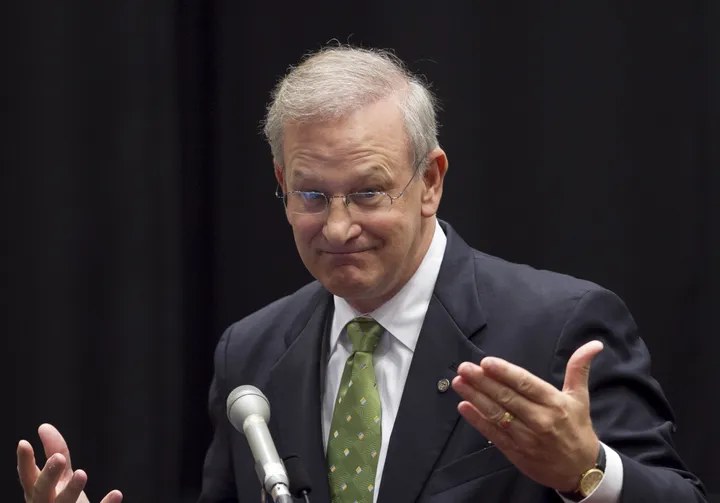
Thomas M. Hoenig, dressed in a gray suit, white shirt with French cuffs, and baby-blue tie, faces an edgy crowd of 150 people in a hotel meeting room in suburban Lenexa, Kan. A large "Kansas City Tea Party" banner covers a table at the door. Attendees wear anti-tax stickers on their lapels. This is not an after-dinner speech for which most central bankers would volunteer.

...

Hoenig smiles at his audience and begins: "This is a support-the-Fed rally, right?"

...

And, by the way, if it were up to him (though it's not, really) he would break up the biggest Wall Street banks.

Read the whole story: BusinessWeek

FOLLOW HUFFPOST BUSINESS
Subscribe to the HuffPost Money newsletter!
Thomas M. Hoenig, dressed in a gray suit, white shirt with French cuffs, and baby-blue tie, faces an edgy crowd of 150 people in a hotel meeting room in suburban Lenexa, Kan. A large "Kansas City Tea ...
Filed by Jeff Muskus  | 
 
 
  • Comments
  • 126
  • Pending Comments
  • 0
  • View FAQ
Comments are closed for this entry
View All
Favorites
Recency  | 
Popularity
Page: 1 2 3  Next ›  Last »  (3 total)
This user has chosen to opt out of the Badges program
photo
joeyfoto
“Écraser l'infamie!”
04:45 PM on 10/05/2010
Thomas Hoenig sounds like a decent man, who is ideally positioned to communicate with these under-educated, over-opinionated emotionally-attenuated tea-baggers.

There was not much about which to disagree in his statement, except for the timing of an uptick in interest rates. I would tend to disagree with his position, but then I don't have employees moving pallets of $100 bills with fork-lifts. This is a very big bet based on very mirky data. We'll see...
07:39 AM on 09/26/2010
My bank, which is one of the largest, freely admits taking more than $1700 out of my checking account over many months without my authorization on the pretense that I'd signed up for some ridiculous service I never did sign up for.
For most of my adult life I've been under the impression that skimming money from someone's private account is called embezzling. Seems to me I occasionally read about some non-corporate individual who embezzled money from a school or a business going to jail for quite a few years.
Only when I threatened to take the case to the state (certainly not the federal) attorney general, did the bank admit taking my money, apologize and return it to me. They said it was a 'mistake.' Oh.
I'd take the matter further but I know what happens to people who blow the whistle on a major bank; they go to jail. I don't want to spend a few years with angry muscular men for the crime of 'failure to disperse' or 'disorderly thinking' or 'consorting with suspected subversives' or any of the countless 'discretionary' charges any cop can pin on me merely for drawing breath. Nor would I expect mercy from our neo-con judiciary.
Still, something seems amiss when the bank can freely, routinely embezzle from its customers with the formidable de facto support of county, state and federal law.
Maybe it's just me.
05:16 PM on 09/25/2010
Hoenig catches slack for his policies on raising interest rates, but we currently have near 0% interest, inadequate lending to some sectors and a severe excess of gambling. The notional value of JP Morgans derivatives alone is larger then the GDP of the entire planet, still. So we have banks with concentrated market power making profits while doing no good for anyone in the economy but the investor class, asset bubbles in equities, and no loans. Because gambling is more profitable -- until of course it's disastrously not.

Since we changed what behavior we encourage with low interest when we allowed banks to gamble, in my view it would be best to raise interest rates for big-banks while introducing state-owned banks (see N. Dakota's bank) that receive low interest rates and are restricted to only taking deposits and lending to small businesses and consumers with some preestablished underwriting conditions.

Hoenig also goes against Bernake in advocating to break up big banks so they are not a systematic threat that we will always bail out and who has captured to many regulators and politicians to be effectively policed. He also believes in a reinstatement of Glass-Steagal so banks cannot gamble with FDIC insured funds from deposits, and are restricted to boring old (and of course safe and with an economic purpose) lending. He's one of the few heads of finance that appears to be working for the people and not Wall St.
03:49 PM on 09/24/2010
Wow link this guy to the tea party and everyone starts slamming. The reality is it is the administration that does not like him because he speaking the truth. Simon Johnson, MIT professor blogged "Tom Hoenig for Treasury"

He differs profoundly from the other Establishment deadbeats around him at the Fed Reserve is in calling for sweeping changes in the U.S. financial system: breaking up the big banks, imploring Congress to establish tough rules so that bank regulators will never again be put in a position to bail out troubled firms, jailing the crooks - None of this happened and financial reform was just one big concession to wall street

His stance means he stays firmly outside the tent where the Big Boys play with the President at ruining sorry running the US. "from the slog'

Anyone on these posts who assume Tom is a 'nut etc" because the tea party are gravitating toward him needs to think before they respond with a kneejerk reaction. WH and its economic team would love if you tea bag this guy....reality he is saying what many economist and some politicians wanted to happen....but the banks won
01:33 AM on 09/26/2010
I already liked Tom Hoenig for his previous statements. The fact that he spoke to the Tea Party and they liked some of what he said doesn't bother me at all. It just shows that there are some issues that grass roots people can agree on, whether right, left, or middle.
photo
Erdgeist
per omnia extrema
03:06 PM on 09/24/2010
"we will repeat the cycle of severe recession and unemployment in a few short years by keeping rates too low for too long." ~ Thomas Hoening

Most of the panics like the one in 1837 were the result of unbridiled speculation. What Hoening is saying is that with higher interest rates speculation is more difficult so the risk of a bubble[s] forming is much less (we've had two bubbles in the last decade). The economy, as a result, becomes more stable. This, of course, is bad news for the Wall Street grifters—not for Main Street America.

Whatever the Tea Party imagines Thomas Hoening to be, it is not for ending the Fed, not without a proven alternative, and that is pretty hard to find.
01:55 PM on 09/24/2010
So Tea Party folks are listening the the very bankers who took the Wall Street Bailout. What phonies they really are.
02:00 PM on 09/24/2010
Obviously you didn't read the article. Or you did and made your own reality after reading it.
photo
guveqzero
Inventor and Innovator
01:31 PM on 09/24/2010
Hoenig's problem is that he is still in denial. The recovery is not in process and the banks are not in sound condition. He also should be fixated on unemployment, that's 50% of his responsibility. I agree raising rates will push banks to start to lend money, but I think the lians will be going overseas and not invested here.
11:45 AM on 09/24/2010
I would like to point out to the Tea Partiers who agree with Honig that low interest rates, are agreeing with most progressives who realize that zero interest rates only benefit the big banks, who use them to make themselves bigger, and have no incentive for loaning it to other banks.

I hope somehow the Tea Party can get the message, that they agree with the progressives that Honig is right, low interest rates and loose credit created both these bubbles.
11:27 AM on 09/24/2010
The problem with economic ideology is just that ideology, not model is totally effective in all situations. As far as "Supply Side" goes which is based in neo-liberalism or just pure neo-liberalism which was the case in 1920s is that wealth shifts upward and the middle goes broke, followed by an economic reckoning. From 2001 to now we have been repeating the neo-liberalsim of the 1920's and the result is pretty much the same, I call that failure. I find it interesting how a President who called himself a conservative sold conservatives a economic ideology based in neo or classical liberalism. I guess that's why they started calling it neo-conservatism.
photo
Erdgeist
per omnia extrema
03:17 PM on 09/24/2010
Good points. In a way, a conservative cannot be, economically, neo-liberal (laissez-faire) and be consistent. What a neo-liberal want's is easy credit, no rules, and a bubble on the way up. Of course we know where this ends—it ends, if we are lucky, with a recession; if unlucky, a depression.
HUFFPOST SUPER USER
revko
04:07 PM on 09/24/2010
Neo-avarice
photo
halfpricefaustian
Voted for Obama. Waiting for Godot.
11:06 AM on 09/24/2010
Hoenig understands that starting to raise rates can actually spur lending. If people see that rates are going to start going back up, then a lot of people will get off the fence and buy that house they want rather than wait to see if rates or prices will drop some more. Keeping rates low and constantly recommitting to low rates to a large extent feeds a deflation mentality of wait and see.
11:24 AM on 09/24/2010
You make a good point.  The deal however can't get much sweeter. 

Some years ago when I lived in Dallas, TX, I was trying to sell a home in the middle of a Jimmy Carter recession.  The inventory of houses was astounding . However the threat that rates would go even higher was impetus to get the deal done.  It was being threatened we might see rates hit 20 percent.  At that time mortgage rates hit 16.  So even though the tech industries like TI were laying off like crazy, and stock market was tumbling, the housing managed and I sold an expensive home in about 2 mos which now looks like a fast sale.  I guess everything is relative. 
photo
guveqzero
Inventor and Innovator
01:18 PM on 09/24/2010
That's crazy thinking, those on the fence took advantage of the $10,000 incentive program months ago. The rate rise impact will be on banks and wealthy investors, to look for better investments other than bonds that pay 1% interest.
11:03 AM on 09/24/2010
Why do private banks get to have so much power in the regional Fed branches?  This is totally undemocratic.  Only elected officials should have power over our economy.
02:10 PM on 09/24/2010
The Federal reserve is a hybrid model. Part public and part private. Since I don't trust large powerful government control I believe that you definitely do not want government to have 100% control of the banks or money policy IMHO. Letting the government have absolute control over the economy is a recipe for disaster. Look what happened to the communist countries it didn't work. But I appreciate your opinion even though I disagree.
02:15 PM on 09/24/2010
You trust private banks more than the government?  Seriously?  I have an adjustable rate mortgage to sell you.

Are you aware that you have a voice in government through your vote?  Are you aware that you have absolutely NO voice in a private institution you don't own?

Did you know that the Constitution mandates that the currency be controlled exclusively by the government?  Letting unaccountable private dictatorships have any say in our monetary policy is not only stupid, but also unconstitutional.
11:00 AM on 09/24/2010
The problem isn't low interest rates its excesses in lending that have incurred in the past when rates were low. So far, since 2008 we don't have a problem with excesses in lending, but the opposite -- lack of lending. This guy should retire.
11:26 AM on 09/24/2010
You might want to check out the programs now in place to get unqualified buyers to once again purchase homes they can't afford.  My state is pushing a program with zero down again. 
02:13 PM on 09/24/2010
I guess that's why they say "history repeats itself." Why can't we change from a borrower nation to a nation of saving and living within our means? And I'm talking from the average person on the street all the way up to the government.
05:12 PM on 09/25/2010
No, we have inadequate lending to some sectors and a severe excess of gambling. The notional value of JP Morgans derivatives alone is larger then the GDP of the entire planet, still. So we have banks with concentrated market power making profits, asset bubbles in equities, but no loans. Because gambling is more profitable -- until of course it's disastrously not.

Being that a low interest rate now gives banks more money to gamble with instead of creating lending, there is some validity in Hoenig's stance. In my view it would be best to raise interest rates for large banks while introducing state-owned banks (see N. Dakota's bank) that receive low interest rates and are restricted to only taking deposits and lending to small businesses and consumers with some preestablished underwriting conditions.

Hoenig also goes against Bernake in advocating to break up big banks so they are not a systematic threat that we will always bail out and who has captured to many regulators and politicians to be effectively policed. He also believes in a reinstatement of Glass-Steagal so banks cannot gamble with FDIC insured funds from deposits, and are restricted to boring old (and of course safe and with an economic purpose) lending. He's one of the few heads of finance that appears to be working for the people and not Wall St.
photo
FoonTheElder
Always choosing between the lesser of two evils
10:43 AM on 09/24/2010
"In this environment, with 9.6 percent unemployment, Hoenig's position is just friggin' nuts," says Dirk Van Dijk, director of research at Zacks Investment Research in Chicago. "His idea for tightening monetary policy is roughly equivalent to a doctor giving anticoagulants to a patient suffering from severe internal bleeding."

That's exactly the case.  Hoenig is just another extreme right wing economist who has the same prescription that turned the stock market crash of 1929 into the Great Depression.  His policies sound just like Andrew Mellon, robber baron and Secretary of Treasury from 1921 to 1932.

Andrew Mellon was the tax cut king of his day, and was the creator of the policies that created and continued the Depression in the first place and causing the economy to contract by almost 50%, with no care of the effect of his policies on the average American.

"Mellon became unpopular with the onset of the Great Depression. He advised Herbert Hoover to "liquidate labor, liquidate stocks, liquidate farmers, liquidate real estate… it will purge the rottenness out of the system. High costs of living and high living will come down. People will work harder, live a more moral life. Values will be adjusted, and enterprising people will pick up from less competent people."

Additionally, he advocated the weeding out "weak" banks as a harsh but necessary prerequisite to the recovery of the banking system. This "weeding out" was accomplished through refusing to lend cash to banks (taking loans and other investments as collateral), and by refusing to put more cash in circulation. He advocated spending cuts to keep the Federal budget balanced, and opposed fiscal stimulus measures."
http://en.wikipedia.org/wiki/Andrew_Mellon
10:53 AM on 09/24/2010
""Another reason Hoenig wants to end super-low interest rates is that Wall Street banks and large corporations are currently able to borrow for almost nothing and either hoard cash, make acquisitions, or invest in long-term Treasuries for a guaranteed profit. Retirees and other bank depositors effectively subsidize this borrowing and earn almost nothing on their savings."
photo
FoonTheElder
Always choosing between the lesser of two evils
01:13 PM on 09/24/2010
Wall Street and large corporations did most of their borrowing prior to the recession when Greenspan artificially kept interest rates low.  Then they could borrow for a low rate and expect a much higher profits than the cost of money.

Today, most large corporations with any pre-existing debt is largely frozen out of the debt market.  That is why they keep cash on hand, because they can't rely on getting additional debt when they feel they need it.

What was the major difference between GM and Ford throughout the recession.  Ford had maxxed out its borrowings before the debt markets froze and GM did not.  When Ford had rough periods, they already had the money on hand.  GM couldn't borrow it from anyone once the recession hit and ended up bankrupt.  Now GM has a more manageable debt load and Ford is still full of debt. 

 
"Ford managed to avoid the bankruptcies that befell its U.S. rivals because it borrowed $23 billion in late 2006 before the recession. That left the automaker with a debt load that Chief Executive Officer Alan Mulally has said is now a competitive disadvantage. Ford paid down $4 billion on its obligations June 30, leaving it with about $27 billion in automotive debt."

http://www.bloomberg.com/news/2010-07-08/ford-names-sprint-nextel-s-james-hance-to-automaker-s-board-of-directors.html
photo
Erdgeist
per omnia extrema
03:27 PM on 09/24/2010
During the beginning of the Great Depression when the economy was in boom & bubble mode reaching the apex around 1928, the Federal Reserve failed to raise the rates they charged banks in order to slow down the economy. (The untimely death of the wise and fearless leader, Benjamin Strong, who was like today's Fed Chairman would have raised interest rates.) In other words, the actions of the Federal Reserve helped to pump up the bubble -- and burst it did. If Hoening had been the Fed chairman, he would have been like Benjamin Strong and raised interest rates thus avoiding a severe crash.
10:39 AM on 09/24/2010
D E M S, get out and vote!!!!!!!!!!!!!!!!!!!!!!!!!
photo
HUFFPOST SUPER USER
rr52
10:05 AM on 09/24/2010
Same old crap. If interest rates begin to rise we'll see the same as we did by time George Bush Sr. was in office after Reagan--14% mortgage interest rates! And no I don't have a link to prove that because I lived through those times while trying to buy a house. We were happy to lock into 10 3/4% in 87. It wasn't until Clinton that we were able to refinance at a lower rate and finally pay off our house.
photo
HUFFPOST SUPER USER
mark331blue
Left leaning independent
10:26 AM on 09/24/2010
You have an interesting memory. I, too, lived through those times, and I recall interest rates climbing to over 20% in the early eighties. Even more interesting: it was necessary to bring inflation under control, which it did. And that remains the only positive contribution the Republicans have made in over a generation. The rest has just been blather. But, it's been blather very effectively communicated to a public that sees no further than the end of their nose. The result: excellent progress for those who want to make us a third world country, a task most voters seem to find attractive these days. We get what we deserve...especially when less than half of registered voters even bother.
10:58 AM on 09/24/2010
"And that remains the only positive contribution the Republicans have made in over a generation"

That wasn't the Republicans that did that, it was Volcker -- he was head of the Fed during that period and broke the back of inflation with those high rates.
11:16 AM on 09/24/2010
I purchased a new VW Jetta in Sept of 1983, the lone cost me 9.6% not 20%, a mortgage would have been lower. Auto loans where in 12 to 14% range by 1986, this was my own experience I do know a guy who payed 18% for an auto loan in the mid 80's. During the Clinton presidency people where pretty thrilled to see mortgages drop to a low of 6.25% by 1995, when I bought my house. A consumer loan auto was 7 to 8%. During Reagan years people thought that double digit interest rates where the norm which weren't so bad because they could be written off, except Reagan killed that to during his lets offset taxes shell came, cut here and raise there.
photo
Erdgeist
per omnia extrema
03:33 PM on 09/24/2010
Buying homes can easily lead to bubbles if interest, over all, is too low. You can also keep the housing market in control with the old rule, you can't get a loan for a home when the price is over 3xs your yearly salary. This also helps to force builders to build smaller and more affordable homes (in the 1950s an average home was about 750 square feet).