
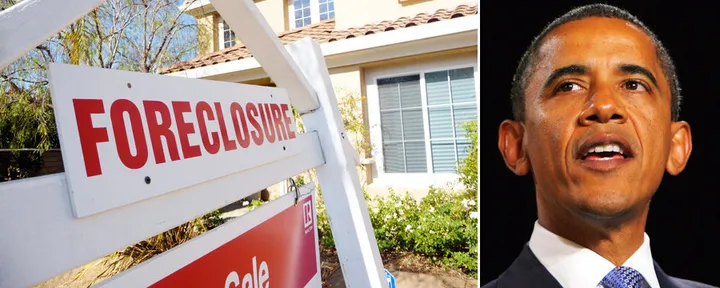
Mortgage companies enrolled in the Obama administration's signature foreclosure-prevention initiative may be receiving taxpayer funds despite not having a legal right to the home or to the mortgage, a top Treasury Department official revealed Wednesday.
But despite faulty or missing paperwork, the Obama administration allows mortgage companies to boot homeowners from the program, sticking the borrowers with massive bills that often leave them worse off.
During an oversight hearing, Phyllis Caldwell, Treasury's housing rescue chief, acknowledged during questioning that Treasury doesn't know whether mortgage companies and the owners of mortgages are receiving public money under "false pretenses." Treasury is investigating, she said.
The contradiction highlights what many critics of the past two administrations' policies have claimed for some time: they exert overwhelming force when it comes to saving financial institutions, but merely modest assistance when it comes to distressed homeowners.
More than $535 billion in taxpayer money went to firms and toxic assets as part of the Troubled Asset Relief Program and the bailout of Fannie Mae and Freddie Mac, according to the latest quarterly figures from two federal auditors. About $992 million has gone to homeowners, the same data show.
President Barack Obama's promise to "enable as many as three to four million homeowners to modify the terms of their mortgages to avoid foreclosure," which he detailed in a February 2009 speech, was "always modest compared to the incredible scale of the problem," Senator Ted Kaufman, a Delaware Democrat and chairman of the Congressional Oversight Panel, a bailout watchdog, said Wednesday during the hearing with Caldwell. "Certainly, it was modest compared to the boldness shown in rescuing AIG, Fannie Mae, Freddie Mac, Bank of America, Citigroup and the auto companies."
Caldwell's revelation about the possible wrongful disbursement of taxpayer money comes on the heels of multiple nationwide criminal and civil investigations emanating from mortgage companies' use of fraudulent paperwork to foreclose on homeowners.
The investigations and near-daily disclosures of improprieties has led to a growing crisis of confidence in the long-held assumption that lenders and other parties followed proper legal procedures when originating a loan and passing it through the chain of securitization. Over the past two weeks shares of Bank of America are down about 15 percent through Thursday; JPMorgan Chase is down seven percent.
"Evidence has mounted that there are substantive problems with the liens that support significant numbers of securitized mortgages," Damon Silvers, a member of the panel created to keep tabs on the bailout, who also works as director of policy and special counsel at the AFL-CIO, said Wednesday.
The paperwork determines true ownership. If those documents weren't properly passed along, then an investor who bought a piece of the mortgage or the company collecting those payments from homeowners, known as servicers, may not have the right to either the home or the mortgage.
The administration's Home Affordable Modification Program, known as HAMP, doles out taxpayer funds to servicers, investors, lenders and homeowners for successfully restructuring a struggling homeowner's mortgage and lowering their monthly payment so they can afford to stay in their home.
So taxpayer funds may be going to companies that have no right to it, admitted Caldwell, Treasury's chief homeownership preservation officer.
"How do we know that people who don't have good liens aren't getting public money essentially under the false pretense that they have a good lien?" Silvers asked Caldwell.
"Again, we don't," was her reply. "Our focus at this point has been on..."
Silvers quickly stopped her. "Hold it," he said. "That's the issue." He added that he hoped Treasury "would be diligent" in trying to answer "what's potentially at play -- are servicers and banks getting public money under false pretenses? We ought to try to figure out whether that's true or not," Silvers added.
Caldwell agreed.
Those companies continue to get the money, though. Meanwhile, borrowers are tossed from the program for the same reason -- faulty paperwork.
"I am concerned by what appears to be a discrepancy between the treatment of paperwork defects on the part of homeowners seeking help from HAMP, and the treatment of servicers who are obtaining HAMP funds on the basis that they have a valid lien on the homeowner's property," Silvers said in an interview. "However, I think that our hearing may have focused the HAMP team on what the issues are here, and I hope they do as they said they were going to do in terms of looking into the status of these liens," Silvers said.
Three megabanks -- Bank of America, JPMorgan Chase, and Wells Fargo -- service $5.4 trillion in home loans, or 50 percent of all outstanding residential mortgages, according to the latest quarterly data from MortgageStats.com and the Federal Reserve. BofA and JPMorgan, the nation's two largest banks, have halted foreclosure sales. On Wednesday Wells Fargo acknowledged errors in its paperwork, and said it's filing supplemental documents in 55,000 foreclosure proceedings.
The three lenders also stand to be the biggest recipients of bailout cash as part of HAMP. Of the $30 billion obligated to modifying loans, about $17 billion, or nearly three-fifths, is slated for BofA, JPMorgan and Wells Fargo, Treasury data as of Oct. 19 show.
"By fulfilling the goal of avoiding a financial collapse, there is no question that the dramatic steps taken by Treasury and other federal agencies through TARP and related programs were a success for Wall Street," the Special Inspector General for the Troubled Asset Relief Program wrote in his Oct. 26 report to Congress. "Those actions have helped garner a swift and striking turnaround, accompanied by a return to profitability and seemingly ever-increasing executive bonuses. For large Wall Street banks, credit is cheap and plentiful and the stock market has made a tremendous rebound."
For homeowners it's a different story.
The watchdog said that HAMP can sometimes cause the foreclosures it's supposed to prevent as applicants "end up unnecessarily depleting their dwindling savings in an ultimately futile effort to obtain the sustainable relief promised by the program guidelines."
"Main Street has largely suffered alone, however, in those areas in which TARP has fallen short of its other goals," SIGTARP wrote. "[T]he most specific of TARP's Main Street goals, 'preserving homeownership,' has so far fallen woefully short."
The criticism speaks to the larger attitude within the administration, something President Barack Obama explained Wednesday during a White House discussion with left-leaning bloggers.
"The biggest challenge," Obama explained, is to help those homeowners "who really deserve help... without wasting that money on folks who don't deserve help." The undeserving include "speculators," said Obama, a former community organizer.
His attitude towards homeowners is not shared among the two Republicans and three Democrats who make up the Congressional Oversight Panel.
While they all share the feeling that some foreclosures will undoubtedly happen, and that it's not incumbent upon taxpayers to prevent every foreclosure, the panelists uniformly expressed deep disappointment with the results of the administration's foreclosure-prevention initiative. Nearly 21 months after Obama promised that up to four million homeowners would be able to restructure their mortgages, just 640,300 homeowners remain in the program. Nearly 729,000 overburdened homeowners have been kicked out.
During Wednesday's hearing, the panelists relentlessly hammered away at the administration's approach in their questioning of Caldwell and Faith Schwartz, senior adviser to the Hope Now Alliance, a government-encouraged coalition of private industry lenders, servicers and investors that was formed out of the Housing Policy Council. The Council is part of the Financial Services Roundtable, the Washington trade group representing the nation's biggest financial institutions.
In fact, the two Republicans on the panel, J. Mark McWatters and Kenneth R. Troske, advocated an approach embraced by progressives and experts in bankruptcy and contract law: forcing banks to recognize their losses on depreciated assets (sour or underwater mortgages), and restructuring that debt to the current market value. Though they stopped just short of advocating for the judicial restructuring of mortgages, otherwise known as cramdown, they stressed that lenders need to recognize losses and allow borrowers the opportunity to stay in their homes. In other words, principal writedowns.
The only problem is that's the very approach most vigorously opposed by the banking industry. The Obama administration opposes it, too.
Basically, if the nation's biggest lenders had to write down the value of their mortgage assets to their current value, experts believe they'd be wiped out and another bailout would be necessary. The administration says it opposes widespread principal cuts in part because it would reward reckless borrowers. Some have pointed to other considerations.
"We are faced with a choice here," Silvers said during the hearing. "We can either have a rational resolution to the foreclosure crisis or we can preserve the capital structure of the banks. We can't do both."
McWatters, who once worked on Capitol Hill for Rep. Jeb Hensarling, a conservative Texas Republican, and Troske, who was picked for the panel by Senate Minority Leader Mitch McConnell, a Kentucky Republican, want banks to write down those mortgages.
"You know, I come at this problem as a corporate lawyer, M&A lawyer, tax lawyer," McWatters said. "And when I look at it, I'm sort of mystified, because if someone came in my office -- and [let's] take off our foreclosure-mitigation hat and just think about a work-out deal -- if someone comes in and says, 'Yes, I paid $250,000 for something. It's worth $150,000 today. There's a second lien on it of $50,000, and a first lien of $200,000. What do I do?'
"And the first thing I'd ask them is, 'It non-recourse debt?' And if it's non-recourse debt, I have an answer. Then if they say -- then I would ask them, if it's a recourse debt, and they say, 'Yes, it's recourse, but I'm broke.' Okay. Now we have the facts.
"In a commercial setting, what you would do is you would write the loan down to $150,000. You wouldn't fool around. You would just write it down to $150,000. Because guess what? That's what the property's worth. If you foreclose, nobody's going to pay a dime over $150,000, so you go to [the] economic reality of $150,000.
"Now, first- and second-lien holders are not chumps. They're going to say, 'Well, what if the market turns?'
"Okay, I'll give you an equity kicker. Okay? You give them an equity kicker."
An equity kicker is a mechanism that allows for the holder of the debt -- like the lender who owns the homeowner's mortgage -- to share in the appreciation of its value by giving the holder a stake in the collateral. For example, if the homeowner ends up selling the house at a premium, the lender would get a cut.
"In the second lien mortgage, what you should do is write them down to zero," McWatters continued. "You can't write them down to zero -- they're going to extort something out of you, right? They have a seat at the table. [So] you give them 10 cents on the dollar, you give them 20 cents on the dollar, but you make them happy. You give them an equity kicker. You write [the mortgage] down.
"Second thing you do is you refinance the loan to a market rate of interest -- not 7 percent, not one of these ridiculous adjustable-rate things which people can't pay. You take it down to a 3.75 or 4 percent risk-adjusted, 30-year fixed rate.
"Okay, what am I missing? Why doesn't that work in this environment?"
Schwartz, representing the financial services industry, was the first to respond.
"Well, you have investor contracts that won't let you write down mortgages. You have Fannie Mae, Freddie Mac and FHA [Federal Housing Administration], who won't allow for a write-down like that," she said.
"Well, those rules need to be changed, or someone needs to talk to them," McWatters retorted.
Left unsaid by Schwartz was that the nation's four biggest banks -- Bank of America, JPMorgan Chase, Citigroup and Wells Fargo -- together hold on their balance sheets nearly $434 billion in second lien mortgages, or nearly half of all outstanding seconds in the country, their most recent regulatory filings with the Fed show. Second liens are home equity loans, second mortgages and other debt that's junior to the primary mortgage. If a borrower were to declare bankruptcy, those second liens would be wiped out before the debt from the primary mortgage would be affected. Nationwide, there were $996 billion in outstanding second liens as of June 30, the latest Federal Reserve data show. About $742 billion of that is held by commercial banks.
After some back and forth, during which Schwartz didn't budge from her opposition to the widespread writing down of mortgage principal, McWatters had enough.
"Okay, so you're saying there are rules that would inhibit a common sense, market-oriented response. Oh, that's encouraging," he said.
But the bankruptcy expert among the witnesses, Katherine M. Porter, a law professor at Harvard Law School on leave from the University of Iowa, expressed support for McWatters's idea. She cautioned that financial firms may not be so supportive.
"I would tell them that's a personal problem," McWatters said. "They cut that deal back in 2004. I'm sorry they cut a bad deal. But guess what? If that deal had turned out to be a really good deal, do you think they would be calling [Treasury] Secretary [Timothy] Geithner and saying, 'Hey, we made a whole bunch of dough. We want to give you some more?' No, they would keep every dime of it. So they should live with the downside, too."
During a separate exchange, Kaufman and Caldwell discussed the second lien issue. Kaufman noted the "reluctance of some financial institutions to extinguish second liens because they're carrying them on the books at 90 percent of value."
"It seems to me the only reason that they're carrying the second liens is because they don't want to write them down because they're carrying them at 90 percent of value, and they're worth nowhere near 90 percent of value," he added.
"You know, that particular thing we hear a lot," Caldwell said. But, she noted, those second liens "continue to be current."
Experts outside the firms holding and selling second liens uniformly say there's no reason for a homeowner to keep paying their seconds if they're delinquent on or struggling with their primary mortgage.
The administration would never concede that point, though. Neither would the nation's biggest banks. A deal is a deal, after all.
"For those who are concerned that somehow there's something morally suspect about restructuring loans, I should note that every day on Wall Street the people of power and privilege in this society restructure their debt," Silvers said. "It is commonplace for everyone but the poor."
"As people have noted," Troske explained, "we are at a point where... house prices are worth less than they were. Banks need to write that off, and of course, people need to write that off as well."
*************************
Shahien Nasiripour is the business reporter for The Huffington Post. You can send him an e-mail; bookmark his page; subscribe to his RSS feed; follow him on Twitter; friend him on Facebook; become a fan; and/or get e-mail alerts when he reports the latest news. He can be reached at 646-274-2455.