iPhone app iPad app Android phone app Android tablet app More

How Did The Polls Do?

First Posted: 11/03/10 11:54 AM ET Updated: 05/25/11 07:10 PM ET

Poll

WASHINGTON -- How did the polls do this year? And who was the most accurate pollster? While crowning a polling "winner" can be a dubious proposition on the day after the election, some immediate lessons are apparent: On average, the final statewide pre-election polls once again provided a largely unbiased measurement of the outcomes of most races, Congressional District polling had a slight Democratic skew, national polls that sampled both landline and cell phones measured national Congressional vote preference more accurately than those that sampled only landline phones and the venerable Gallup Poll took one on the chin.

I have never been a fan of the usual rush to crown "the most accurate" pollster on the morning after each election. Votes are still being counted and the final, certified results will likely change enough to alter whatever rankings based on error scores calculated at this hour. Moreover, as ABC News polling director Gary Langer puts it, polling estimates are not "akin to laser surgery" and its a fallacy to assume that "pinpoint accuracy" is attainable in pre-election polls. At best, the estimate produced by any given poll will vary within a predictable range of random variation. If ten polls all capture a result within that "margin of error," they have all performed as they should. Some will do slightly better than others, but on average, any given poll may win what Langer calls "the horse race lottery" and get the result exactly right by chance alone.

But even at this early hour, we can begin to identify polls whose horse race estimates have fallen outside the margin of error. For example, as of 6:35 a.m. Eastern time, the Associated Press had reported results from roughly 96% of the precincts in Congressional races nationwide. My tally of the district-level AP vote count shows that over 78 million voters chose Republican candidates for Congress over Democrats by a margin of 7.4 percentage points (52.1% to 44.7%) with a small percentage (3.2%) casting ballots for independent and third-party candidates.

The uncounted precincts statistic at this hour likely understates the number of uncounted early votes in Democratic states like California and Washington, so the final margin could be as much as a point narrower. In 2006, the initial national count gave Democrats a six-point advantage, but it grew to a 7.2% margin once all votes were counted.

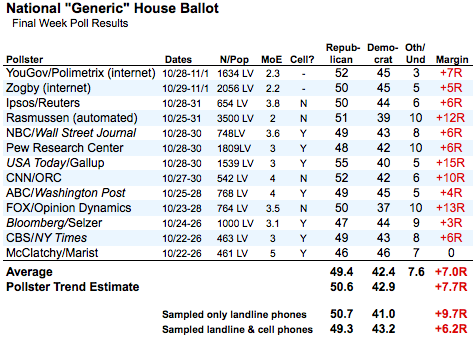
How did the final polls measuring the national "generic" vote preference compare to the ultimate Republican margin that will likely fall somewhere between six and seven percentage points? As the table below shows, the telephone surveys conducted by the Pew Research Center, Ipsos/Reuters, NBC/Wall Street Journal, CBS/New York Times and the two Internet-based surveys by YouGov/Polimetrix and Zogby Interactive all produced margins that are very close to the likely final result.
2010-11-03-Blumenthal-GenericResults1103.png

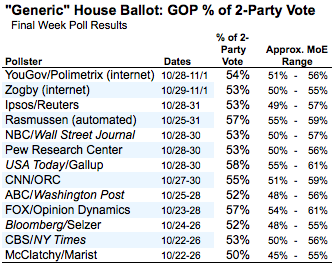
That said, if we factor out the undecided and calculate the Republican percentage of the two-party vote for each survey, most capture the likely final result (53%) within their respective margins of error (adjusted slightly to account for the missing undecided voters). The most prominent exception is the Gallup Poll. The Republican share of the two-party vote predicted by their survey (58%) will likely miss the actual result by five percentage points, falling just outside the expected range of variation (55% to 61%). Gallup's error on the margin will likely be its biggest since it started asking the generic vote question 60 years ago.
2010-11-03-Blumenthal-Generic2Party1103.png

While a focus on individual polls can get dicey, averaging results across surveys -- which effectively pools their sample sizes -- begins to yield important lessons: For example, the average predicted margin among the seven surveys that sampled both landline and cell phones (+6.2% Republican) comes much closer to the likely final result than the average margin among the four surveys that sampled only landline phones (+9.7% Republican)

At the state level, polls were remarkably free of bias, on average, so our "trend estimates" predicted winners accurately in almost all states. The most notable exception was Nevada, where Harry Reid defeated Sharon Angle by more than five percentage (50.2% to 44.6%) points after trailing on our aggregate of all public polls by nearly three (48.8% to 46.0% as of my final update yesterday).

When we drill down to the accuracy of individual polls, we see that most of the statewide polls conducted in the last two to three weeks of the campaign captured the final results within their theoretical margins of sampling error. Based on the vote counted so far, we have examined 232 poll in contests with at least 95% of precincts counted, excluding those from Alaska, Arizona, California and Washington (states where large portions of early vote remains uncounted), and nearly all captured the actual results within their theoretical margins of error. In fact, the overall error rate as of this morning (2%) appears to be well below what we would expect by chance alone (5% -- although these calculations should be considered preliminary).

Overall, the final polling results at the statewide level were also remarkably unbiased. Errors in predicting the Democratic percentage of the two-party vote have so far averaged to near zero in Senate contests (-0.1%) and just slightly more (+0.2) in contests for governor. The average of the absolute value of the errors of the Democratic percentage of the two party vote -- a measure of how much polls tend to vary from the average -- was just 2.3%.

In polling in individual Congressional Districts, however, we did see a more significant statistical bias. On average the 55 House polls that completed interviewing after October 15 produced a nearly two-point average error (+1.8) favoring the Democratic candidates and slightly more average variation (3.3) than the statewide polls. If we expand our focus to all polls fielded in October, that bias (+2.2) and absolute error (3.5) grow slightly greater. The skew toward the Democrats in District level polling -- a level of bias we did not see in 2006 or 2008 -- explains why our seat projections understated the Republican gains by 13 seats.

These are very cursory first impressions based on votes still being counted. Moreover, these statistics tell us only about the polls conducted in the last few weeks of the campaign. "The last poll" is only part of the story. Fully evaluating the performance of polls in 2010 requires that we look back at some of the conflicting narratives set by results that were more often divergent in September and early October than in the final weeks.

We will have more on how specific pollsters, types of polls and our state and district level trend estimates performed as we get a more complete picture of the results over the next few days.

Stay tuned.

Follow Mark Blumenthal and HuffPost Pollster on Twitter

FOLLOW HUFFPOST POLITICS
Subscribe to the HuffPost Hill newsletter!
WASHINGTON -- How did the polls do this year? And who was the most accurate pollster? While crowning a polling "winner" can be a dubious proposition on the day after the election, some immediate lesso...
 
 
  • Comments
  • 229
  • Pending Comments
  • 0
  • View FAQ
Comments are closed for this entry
View All
Favorites
Recency  | 
Popularity
Page: 1 2 3 4 5  Next ›  Last »  (6 total)
07:05 PM on 11/14/2010
http://richardcharnin.com/2010SenateMidtermsPostElection.htm

Yes, the party in power nearly always loses seats in the midterms. The unconventional wisdom is that the Democrats do significantly better than the recorded vote indicates in every election. There is no reason to suspect that 2010 was any different.

This analysis utilizes final likely and registered state and national pre-election polls along with preliminary and final exit polls. Likely voter (LV) polls are a sub-sample of registered voter (RV) polls. Since 2000, LV polls have closely matched the recorded vote while RV polls closely matched the unadjusted and preliminary exit polls.

It is standard operating procedure on the part of exit pollsters to force the final to match the recorded vote. The 2010 Final National Exit Poll indicated that 45% of the electorate were returning Obama voters and 45% were McCain voters. Of course, the pundits will claim that this was due to millions of unenthusiastic Democrats who did not return to vote in 2010.

The returning voter split understated Obama's recorded 52.9-45.6 margin by 7.3%. If the mix is adjusted to the actual 2008 vote shares, the Democratic 2010 share is within 1% of the GOP, matching the pre-election RV polls. But the recorded 2008 Democratic share understated the True Vote share by 4-5%. Therefore, the adjusted 53/45 mix includes the discount for unenthusiastic Democrats who did not return to vote in 2010.
photo
GG NV
Define the Future by Learning the Past
01:10 AM on 11/05/2010
The right wing based polls were always wrong during the Reid v. Angle race. Yes I knew when Rasmussen polls came out that Reid was loosing by a point only meant that Angle was loosing the race. Eventually Angle loosing by 5 points illustrates how bad these right wing based polls are. Even Huff Po was incorrect on the polling and prediction of Reid v. Angles race. I sort of knew the night before the election something was up with Reid. Yes, he won.
HUFFPOST SUPER USER
walkthewalk
Watch what people do, not what they say
09:56 PM on 11/03/2010
I am so sick of polling data. I can understand why candidates want to follow the poll numbers, but why should the voters know or care?

Having this information either gives voters a sense of overconfidence that may discourage them from voting, or a sense of impending defeat that may discourage them from voting. Basically, having poll information likely keeps people from feeling the need to vote.
This user has chosen to opt out of the Badges program
photo
09:21 PM on 11/03/2010
So Fox, Gallup and Rasmussen are way off.

What does this mean in regards to the President approval then? If they are 7 points off here can we assume the Presidents approval rating is way off too?
02:15 AM on 11/04/2010
You'd think serious pollsters would adjust metholodogy after deviant results. But the unknowable factor is whether the polls themselves affect outcomes. Here in Hawaii, polls showed two tight races that turned to be anything but. Might voters have been motivated by the prospect of a dire result to get to the polls? In any case, how typical of Americans to be obsessed by exciting ephemera rather than focusing on what really matters.
08:02 PM on 11/03/2010
This is how the Midterms will be Remembered 1,000 years from now: http://www.youtube.com/watch?v=wlffdZtWOKc
06:41 PM on 11/03/2010
Republicans running for the U.S. Senate in Nevada and Colorado performed significantly worse than the polling suggested. Naturally, if candidates of the party of peace and diversity had been the victims of such turnarounds, the innumerate howls about vote fraud would drown out a ten-megaton blast. But what actually happened in those races and others, such as the California Senate and Governor contests, where the Dems made the pollsters look very bad?
04:37 PM on 11/03/2010
Polls, especially exit polls do not much more than mislead with the intent to effect voter turnout for those they may agree or disagree with. From what I've seen pollsters tend to seek out people rather than randomly grab people for a true sampling...It all boils down to the bias' of the pollster sourcing the data, it has become a corrupted process....
photo
HUFFPOST SUPER USER
DarenTx
Morality is a decision not a religion
04:59 PM on 11/03/2010
I am a big fan of Nate Silver over at 538.com. He doesn't just take an average of polls but instead takes a variety of factors into account including a pollsters accuracy in past elections.

So, corrupt pollsters like you describe, quickly get eliminated from his predictions. In fact, he even publishes his ratings on the pollsters.
11:44 AM on 11/04/2010
I won't disagree with you but unfortunately, the mainstream media polls are the most corrupted and most advertised...
HUFFPOST SUPER USER
edgarcaycedoc
06:04 PM on 11/03/2010
" . . . it has become a corrupted process . . . " As has voting.
photo
HUFFPOST SUPER USER
freddychef
Tue,4 Nov '14 Dems take House! & Majority Senate!!
04:12 PM on 11/03/2010
The United States of America
As the government has been co-opted by RWNJ's, expect more and higher taxes, wars, government, intrusion into personal lives... you get the picture.


Consider escaping to Canada, where you will be welcomed.
Conbagger’s and RWNJ's will not be allowed.


http://www­.cic.gc.ca­/english/i­ndex.asp

Consider this. There is a 2 year process/wait list. You can apply now and then see what happens in the 2012 election. You can always turn down the offer if the Dems win. If the baggers win, your country will really be in a world of hurt.
Just think about it.
HUFFPOST COMMUNITY MODERATOR
SteadyOn
04:43 PM on 11/03/2010
You can always go work there and if offered citizenship, can keep dual citizenship. We already have an immigration attorney on board working on it.
photo
HUFFPOST SUPER USER
freddychef
Tue,4 Nov '14 Dems take House! & Majority Senate!!
04:48 PM on 11/03/2010
Welcome in advance friend.
photo
HUFFPOST SUPER USER
freddychef
Tue,4 Nov '14 Dems take House! & Majority Senate!!
05:30 PM on 11/03/2010
US citizens have a higher "Q" rating then all other applicants. That is without any of the following factors.
# 1 US citizen
# 1(a) US citizen with proposed business plan
# 2 skliied labour of any field, Canada is experiencing a skilled labour shortage.
# 3 qualified professional in any field, starting with the lowest qualification (BA)
#4 qualified professional in any field, starting with the highest qualification (masters degree)
05:01 PM on 11/03/2010
How can you imply that the right is just noted for war? Where do you think we would be now if we hadn't fought any wars? I believe that even you would be complaining if Bush sat back and did nothing after 9/11! And taxes--come on, it is the demos that want more taxes.Always complaining!

I say--move! Bye bye!
HUFFPOST SUPER USER
edgarcaycedoc
06:11 PM on 11/03/2010
"I believe that even you would be complaining if Bush sat back and did nothing after 9/11!" So when Timothy McVeigh destroyed the Murrah Building in OKC, maybe we should have just invaded--say--Rhode Island?? The problem with the war following 9/11, is that what happened was a "CRIME." We normally do not attack nations--including our own--just to punish CRIMINALS. Tell me, please, when we went to war against "Al Qaeda" who did we think was going to sign the surrender papers. There was no entity to attack. The Twin Towers had 19 criminals involved in their collapse. And when SHRUB "won" the presidency (by the appointment of the SCOTUS), I asked my brother-in-law (who was in Desert Storm) if he was ready to go back to Iraq. He asked me why. I told him that SHRUB was going to go back to war with Iraq as soon as he got the slightest excuse, because he wanted to avenge his daddy's embarassment at the hands of Hussein. Yes. The right is well "noted for war."
03:37 PM on 11/03/2010
Polls, schmolls, right or wrong, the voters yesterday were wrong and they will feel just how wrong when over the next 2 years, they realize that they have voted for the party of woe and no, void of ideas or a plan to help all Americans and this country move forward.
10:47 PM on 11/03/2010
Would that you were right.
But the Republican party is the party of the barely coherent, the racist, the selfish and the criminal. There is no one within the Republican party that is self critical of them. They are the heirs to the "Know-nothings" of the 19th century, not Abraham Lincoln. And because they hold together like bacteria, they will continue to win elections where it only takes 40% of 40% to win.
03:35 PM on 11/03/2010
Thought I'd share something from another HuffPo thread ....

Sundiszno 1 minute ago (3:24 PM)
125 Fans

Here's another doozy from Nate Silver on Rasmussen: "I haven’t checked this in detail yet, but it appears as though the worst poll of the political cycle will be the Rasmussen Reports survey of Hawaii, which had the incumbent Daniel Inoyue defeating Cam Cavasso by just 13 points. Mr. Inouye is ahead by 55 points right now. If Mr. Inouye’s margin holds, the 42-point error would be by far the worst general election poll in FiveThirtyEight’s database, which includes all polls since 1998; the previous record was 29 points."

The actual is 53.2% margin with 99% reporting.
photo
HUFFPOST COMMUNITY MODERATOR
zelduh
Democrats: the REAL American patriots.
04:44 PM on 11/03/2010
Here's a surprise: Rasmussen erred to the right in California as well!

http://latimesblogs.latimes.com/california-politics/2010/11/pollsters-california-hotly-contested-election-correctly.html
---
WHICH POLLSTERS CALLED CALIFORNIA'S TOP RACES CORRECTLY, AND WHICH MISSED THE MARK?

Pre-election polls divided into two noticeably different camps.

One group, which included the L.A. Times/USC poll and the Field Poll, projected hefty wins by Democratic candidates Jerry Brown and Barbara Boxer. The other, which included polls by the Rasmussen organization and Public Policy Polling, showed both Democrats likely to win, but by much smaller margins. Some showed the Senate race in particular getting closer.

In the end, Brown won by 12 points and Boxer by nine. The poll that came closest to nailing the results: The L.A. Times/USC survey, which had projected a 13-point margin for Brown and an eight-point margin for Boxer. Field, which had projected margins of 10 points for Brown and eight for Boxer, came in a close second.

The worst record? The Rasmussen surveys, which were conducted for Fox News and Rasmussen’s own survey website. Those polls projected a Boxer margin of three points and a Brown win by four.
---
Read the rest of the LA Times article for an interesting analysis as to why!”
02:55 PM on 11/03/2010
Reid said all along that polls were never right...I guess he was right. However, the theme up to the election was that the Dems would lose the House and lose seats in the Senate. For the most part the polls were correct on that front. Reid should be humbled for his close win, I know it was 5 points but don't tell me he wasn't sweating it. I saw somewhere that 115 teaparty backed candidates won. I wonder how many lost.
HUFFPOST SUPER USER
KRYSTY
02:50 PM on 11/03/2010
My goodnes! Many people talk like they have served as a US President before. Why are you people so judgmental about a situation that you have never experienced? I wouldn't want to be the President during two wars, awful economy, 24 hour cable noise, opposite party that wants to take you down, a whiny base and forgetful country. Being responsible for my kids and husband is a lot work. I can't imagine what the President is going through.
02:56 PM on 11/03/2010
He asked for the job and told us he could do the job. if you don't like the heat stay out of the kitchen.
photo
HUFFPOST SUPER USER
Agent Cooper
03:11 PM on 11/03/2010
What makes you a Real American Patriot, if you don't mind my asking?
02:43 PM on 11/03/2010
here's a little something to brighten your mood

http://nation.foxnews.com/glenn-beck/2010/11/03/beck-has-some-fun-pelosi-loss
photo
HUFFPOST COMMUNITY MODERATOR
zelduh
Democrats: the REAL American patriots.
04:47 PM on 11/03/2010
It did not brighten MY mood.
02:29 PM on 11/03/2010
paging stillow...Reid won...paging stillow...
02:22 PM on 11/03/2010
Okay, so Rasmussen, USAToday, Fox and Gallup have a 4-6% Republican bias and CNN isn't too much better.

That's excellent. What that means is that in any election, the propaganda machine - the echo chamber - can, for months before election day, trumpet the inevitable victory of the Republican Party with the result that probable Democratic voters won't consider voting to be worth the effort.

Good job, traitors, and the polling money is good too, right?
03:06 PM on 11/03/2010
Traitors? they were just doing there job. Kind of like MSNBC or HP or the unions or ...
photo
HUFFPOST COMMUNITY MODERATOR
zelduh
Democrats: the REAL American patriots.
04:48 PM on 11/03/2010
How'd ya got so many fans?