More

'Borrowing In Disguise': For Pension Funds, Lowering Expectations Could Cost Billions

First Posted: 11/04/10 02:23 PM ET Updated: 05/25/11 07:10 PM ET

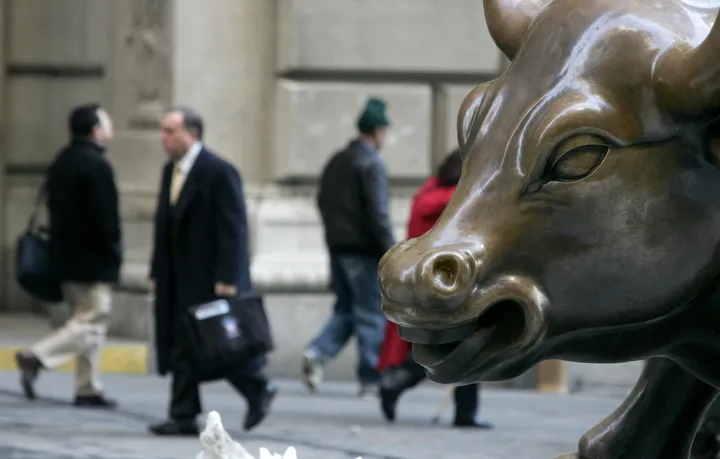
Bull

Public pension funds could be in a much bigger hole than they're admitting. And facing up to more realistic numbers won't be easy.

Across the country, pension funds have set unrealistically high expectations for future income, experts say, projections that could strain already tight city and state budgets. The typical public pension fund projects an 8 percent annual return, a figure that's held steady even after the financial crisis decimated funds' value nationwide.

Over the past 10 years, any investment with consistent 8 percent returns, compounded annually, should have seen an increase of about 116 percent. By comparison, the S&P 500 during that period dropped about 13.5 percent. Despite the weakened economy, funds have retained a pre-crisis optimism.

But lowering expectations by even a small amount could inflate funds' liabilities by billions of dollars, each. When pension funds calculate the size of their liability -- the amount of money they must set aside in order to pay what they've promised to pensioners -- they subtract the returns that they expect to earn on their assets, called the discount rate. Setting this expectation too low represents the liability as unrealistically large, putting an extra burden on taxpayers. But setting the rate of return too high creates the opposite problem, as it makes the liability appear unrealistically small. In such a case, a government would owe more to its pension funds than it thinks.

New York City, whose largest fund has the most members of any municipal fund in the nation, faces an emblematic problem. As the city comptroller John Liu said last week at The Economist's Buttonwood Gathering in Manhattan, lowering the expected 8 percent rate of return by even half a percentage point "would be a tremendous hit to our annual budget." It would, according to a pension expert's calculation, increase the pension liability by about $9 billion.

Some city leaders are worried. "It's overstating it a little bit to say the only one who's done that well is Bernie Madoff," mayor Michael Bloomberg said last month, according to Bloomberg news. "But 8 percent for a long period of time is not something that very many pension funds have ever achieved."

The median expected annual returns at 77 large municipal funds examined in a recent study is 8 percent, a figure that has remained consistent for the past decade. According to the National Association of State Retirement Administrators, this 8 percent median rate is the same as it was in 2001 -- years before the financial crisis wiped out 29 percent of funds' value.

Pension experts say expecting 8 percent annual returns on public pensions is unrealistic. From the end of 2007 through the beginning of 2009, the Dow dropped about 46 percent, and the S&P 500 dropped about 48 percent.

"It's just borrowing in disguise," Northwestern University finance professor Joshua Rauh told HuffPost. "Basically all that you're doing is you're saying, O.K., we're going to make these promises and we're not going to fund them...and we're going to ask future taxpayers to make up the difference -- basically to write insurance on our investment policies."

If Rauh is right, then the problem is widespread.

"There's a trend, and a lot of pressure, for plans to reduce that [8 percent rate] to seven and three quarters or seven and a half," said Steve Kreisberg, director of collective bargaining for the American Federation of State, County and Municipal Employees. "The trend has certainly been to reduce it, not increase it."

But how feasible would a rate reduction be? For New York City, according to University of Rochester professor Robert Novy-Marx, who did the calculation for HuffPost, reducing the rate even half a percentage point would swell the liability by about $9 billion.

Novy-Marx, who co-authored with Rauh an October study on pension fund liabilities, used the latest comprehensive annual financial reports (CAFR) for each of the city's five pension funds (available online) to determine that, with the 8 percent expected rate of return, the city's total stated pension liability is $155.85 billion. If the city were to use a rate of 7.5 percent, the liability would jump almost $9 billion, to $164.78 billion. The city's budget deficit, by comparison, according to the latest statement, is about $96.7 billion.

To pay down that increased pension liability over a period of 30 years, Novy-Marx said, the city government would have to increase its annual contribution by about $300 million, starting in the first year. Considering that would almost certainly require an increase in taxes, it is, at this point, likely a political impossibility.

Liu, the New York City comptroller, who oversees the funds, acknowledged this issue during a question-and-answer session earlier this month at The Economist's Buttonwood Gathering in Manhattan. In response to a question about whether he would reduce the rate, Liu said, "That's quite a question," adding, "You asked a hot question." He said, "there's a movement to reduce this long-term rate of return," but did not say whether he would support such a step.

"The challenge for us as a municipality is that it would be a tremendous hit to our annual budget," he said. "Just lowering it half a percentage point...would introduce a strain of several hundred million dollars a year into our service budget."

Novy-Marx thinks even 7.5 percent is too high. "I think they should be using something quite a bit lower than that," he said. New York state, for its part, announced in September that it would reduce its expected rate of return from 8 to 7.5 percent. "In today's investment environment, the actuary thought it was best to lower the assumption rate by half a percent," Dennis Tompkins, a spokesperson for state comptroller Thomas DiNapoli told HuffPost. "In light of changing markets and volatility, it was a good time to lower it down."

When Sharon Lee, spokesperson for New York City comptroller Liu, was informed that the liability would increase by about $9 billion if the rate were reduced half a percentage point, she expressed surprise. But after repeated requests from HuffPost, the city comptroller's office would not produce a calculation to challenge Novy-Marx's figure and directed requests to Robert North, the city's chief actuary.

North said he will make a complete review of all the pension assumptions and methods in the next year.

If pension funds' assets do in fact yield 8 percent, then this potentially increased liability won't be an issue. And as Liu noted last week, the funds' investments are long-term, so a couple bad years shouldn't matter. The 8 percent figure is not supposed to represent a single year's returns but rather a smoothed-out picture of annual returns over the course of decades.

During the past 20 years, the Dow has climbed about 359 percent. During the past 10 years, though, it's increased only about 5 percent. The S&P 500, during that time, dropped about 13 percent.

"We don't react to one year," Tompkins, the DiNapoli spokesperson, said. "We look at long-term prospects and we try to measure that way."

"Public pension plans are long-term investments," Kreisberg, of AFSCME, said. "And that's the beauty of them."

Liu summarized the debate concisely: "Lots of people say, if you look at the last eight years, the last 10 years, how can you possibly expect an 8 percent annual rate of return on assets?" he said last week. "Others would say that, well, the duration of these pension liabilities are very long. They last for decades. And so if you look at the last 30 or 40 years, is 8 percent that far off from the annual average?"

FOLLOW HUFFPOST BUSINESS
Subscribe to the HuffPost Money newsletter!
Public pension funds could be in a much bigger hole than they're admitting. And facing up to more realistic numbers won't be easy. Across the country, pension funds have set unrealistically high ex...
 
 
  • Comments
  • 190
  • Pending Comments
  • 0
  • View FAQ
Comments are closed for this entry
View All
Favorites
Recency  | 
Popularity
Page: 1 2 3 4 5  Next ›  Last »  (6 total)
photo
HUFFPOST SUPER USER
Christopher Hull
Democratic Socialist
12:22 PM on 11/08/2010
We have created a system where it is impossible to save. And if you do save either inflation makes your money worthless if you leave it in a bank or stocks pay such a low dividend that unless you have millions of dollars you have to sell your stock to live.
It's time for some sort of societal reset. If it means everyone pays a 90 percent tax rate, we have no military and a two hundred percent tarrif on imported goods so be it.
I don't think we need to get that radical but we really need to put every option on the table. And I for one would love to see us cut our military in half and leave the rest of the world alone.
photo
HUFFPOST SUPER USER
joeneri
10:31 PM on 11/05/2010
Tax the Millionaires and above. That's where the money is.
11:12 AM on 11/05/2010
If under-funded pensions were the only problems states and their municipalities face, maybe this would not be a catastrophe. But they face at east 10 problems that have accrued to crisis levels in recent years. According to the Government Accountability Office study, GAO-10-899, even based on official delusional assumptions and old data, states and municipalities must immediately begin cutting expenses 12.3 percent a year and "each and every year for the next 50 years" to keep from going broke. The new governors and legislators have no idea what they've gotten themselves into.
http://www.franklincenterhq.org/1964/hey-new-governors-legislators-no-matter-how-bad-you-think-it-is-it%e2%80%99s-worse/
photo
HUFFPOST SUPER USER
mountainweb
Conservative Commonsense
10:58 AM on 11/05/2010
Anyone who expects an 8 percent rate is delusional. And yes, lowering the expectation"would be a tremendous hit to our annual budget", but maybe thats an indication that your budget is INFLATED and needs lowered to reflect reality....
10:51 AM on 11/05/2010
we have to tax people more so we can bailout these pensions. there are people depending on this money....especially me.
photo
HUFFPOST SUPER USER
MeinNH
Ooooo Silly Me
03:25 PM on 11/07/2010
In 2000 I had to go on Social Security Disability and was told that my pension from AT&T would be $649.00 per month as of that date. When I inquired about that with AT&T they told me that they had raised the age that one could be eligible for the pension and would send the information to me. Last year when I contacted them again, I was told that I now had to wait 2 more years as the age had increased (again), I asked for a statement of what my pension would be when I reached the appropriate age....I was told that it would be $144.00 per month. When I asked about he discrepancy, they told me that AT&T had no obligation to pay me a pension and that was the amount that I would receive. At this rate I will probably end up with $1.39 per month...that is no typo...one dollar and thirty nine cents and with the attitude that I was given I should say a big thank you for that.

When I think of all of the people who are getting shafted like this, and how our 401K sank and our savings are decimated by unemployment, illness and huge cost of living increases (that are only in our imaginations according to the powers that be) well no wonder we only have Social Security left.
10:42 PM on 11/08/2010
Get a lawyer and watch that pension multiply.
09:55 AM on 11/05/2010
The contracts worked out for what the pension funds would be able to get percentage wise were too optimistic. I blame the public service unions and the government officials responsible for setting the fund's rates. The contracts should allow for the natural ups and downs of the market. I wish I could get a guaranteed 8 % no matter what happens.
Unfortunately, the tax payers will have to foot the difference because of lack of negotiation skills in setting public service pension contracts.
photo
HUFFPOST SUPER USER
ambrecel
07:40 AM on 11/05/2010
Welcome to America, where greed rules and nothing else matters. Soup lines in the future for the oldest of us, and that shouldn't happen.
HUFFPOST SUPER USER
malander
04:30 AM on 11/05/2010
How much more mismanagement and fraud are we going to find in our financial system?
This user has chosen to opt out of the Badges program
photo
02:23 AM on 11/05/2010
You would think that David X. Li worked on the projections for these funds. Try using low-ball figures instead of the delusional wildly-inflated numbers that you have. When in doubt; try reality.
photo
HUFFPOST SUPER USER
joeneri
10:33 PM on 11/05/2010
Oh, you ain't seen nuthin' yet.
02:07 AM on 11/05/2010
I see a lot of partisan bickering going on here, as usual... But you should know that 8% is an absolutely insane rate of return for any investment over any period of time. Pension fund managers and the actuaries who sold them on these investment rates should be fired around the country. The reality is that our pension funds are woefully underfunded, and when push comes to shove, the voters are not going to increase taxes so that someone else can retire when their roads are crumbling, and schools are clamoring for more of the shrinking state budgets...

If I were a retiree on a public pension plan (or getting ready to retire), I would start saving every dime that I could. It is very likely that benefits are going to be severely cut, if not completely denied in some instances. And while it won't be legal to do so, you can't squeeze blood from a turnip.

The real shame here is that the union leaders, the city managers, the pension fund managers, and the actuaries have all been complicit in this scam and the person who worked faithfully for 20-30 years gets left holding the bag. Good job guys. I guess this is what it means to be an American these days.
HUFFPOST SUPER USER
garder54
10:36 AM on 11/05/2010
Municipalities, states, etc. are contractually obligated to pay those in the system their pension. Maybe they can stop from giving pensions to new employees. But those who are fully vested must receive their pension, or the employer faces a huge uphill legal battle.
12:50 AM on 11/07/2010
It will be interesting to see what happens, because taxing more to get the money will become an impossibility as folks with money will leave the state involved.
10:45 PM on 11/07/2010
Or, like the city of Vallejo, they can declare bankruptcy and then have a judge decide what the pension payments should be.
01:44 AM on 11/05/2010
Delusional, more like it.
This user has chosen to opt out of the Badges program
photo
JasonJM
Life isnt fair, get used to it.
01:17 AM on 11/05/2010
Unions are great for America!
01:50 AM on 11/05/2010
No less than neocons,
12:09 AM on 11/05/2010
Worthless IOUs for the lemmings
11:34 PM on 11/04/2010
I heard on the radio this afternoon that by 2015 , 98% of Orange county's revenues(tax dollars) will have to go to pay union pensions. It was going to be much higher in San Diego and LA. California is really a sinking ship.
01:49 AM on 11/05/2010
Yeah, like this is "fact" for the next twenty years? Money takes advantage when money can, be it Wall Street or Main Street, Personally, I think Wall's way ahead,

I'd take my payout early, if I were a CA public servant.
photo
HUFFPOST COMMUNITY MODERATOR
Jason Abdon
03:16 AM on 11/05/2010
voting for more republicans will fix the problem. Maher is right. But I've known this for 46 years.
Eat the rich.
yappnmutt
humping legs for liberty
11:24 PM on 11/04/2010
in twenty years gen x,y and z will be working their tails off to support social security and .gov pension endowed baby boomers ordering hookers, food and drinks from them while they live and wiping their behinds when they are dying.