
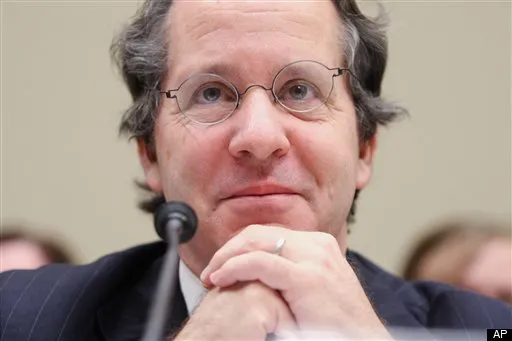
Gene Sperling, the Treasury official widely expected to take over as President Obama's chief economic adviser, is the sort of figure who has been around Washington for so long that he can easily be slotted in to whatever narrative is in fashion about the times.
Following several months of sniping from corporate America that President Obama is supposedly anti-business, Sperling's anticipated selection has raised hopes in such quarters that he signals a fresh new effort from the administration to woo business and patch up rifts.
Not lost on Wall Street is the fact that Sperling has worked there: He served as a consultant to Goldman Sachs, and in 2008 harvested sums reaching seven-figures for his work there and in delivering speeches to the highest ranks of the financial services realm.
Not lost on the rest of the business world is the role Sperling played in helping balance budgets as a White House economic adviser during the Clinton administration, or the bill he helped craft in the Obama administration delivering $30 billion in direct government investments to banks in the hopes they would lend to small businesses.
But among critics who portray the Obama administration as a captive of Wall Street--eagerly bailing out the banks that wrecked the economy while doing little for working people--Sperling's selection has been construed as a sign of more of the same ahead.
Among those inclined, such as the economist Dean Baker and the liberal pundit Robert Kuttner, a key item on Sperling's resume is the nearly $900,000 he earned as a consultant for Goldman Sachs, at the very time the bank was playing a leading role in the worst financial crisis since the Depression.
But a careful examination of Sperling's quarter-century-long career--years he has spent mostly in public service--lends itself toward a more complicated and internally contradictory view. His record fleshes out a portrait of a figure who is neither the Wall Street agent he is sometimes made out to be, nor the champion of the working poor he and his allies advance.
Usually, Sperling winds up somewhere in the middle, operating as a pragmatist and deal-maker who starts from the assumption that, in Washington, policy-making is all about the possible.
Famously inclined toward compromise, Sperling earned Obama's enduring gratitude late last year when he played an instrumental role in delivering the deal to extend the tax cuts handed out by President George W. Bush to the wealthiest Americans in exchange for continuing emergency unemployment benefits.
Faced last year with controversial demands from liberal Democrats that a small business relief effort must deliver taxpayer funds directly to small businesses, Sperling won over centrist Democrats, Republicans and the financial services lobby with a carefully calibrated deal that filters the money through regional and community banks.
In short, Sperling appears to be a species of Washington creature that sometimes seems endangered in this era of extreme partisan polarization in which every issue is a venue for capturing sound bite-billing on cable television: He is, say those who have worked with him, a classic Washington centrist, a power-broker cut in the mold of fellow Clinton-era officials, who pursue policies that can be easily sold to Democrats and Republicans alike, and prove neither controversial nor radical.
At a time when the soul of the Obama administration seems up for grabs, and with Republicans taking over control of the House and gaining seats in a still-Democratic controlled Senate, that may turn out to be a useful credential, say his allies.
"He's an ideal choice," said Damon Munchus, managing director of The Cypress Group, a financial services lobbying and advisory firm, and a former deputy assistant secretary for banking and finance in the Obama Treasury. "I just always remembered Gene being a forceful advocate for working families in almost every single policy debate we had. His beliefs are genuine and real. But I respect the fact that he also wants to get things done."
The "get things done" label may provide little comfort to those who came to see Obama's outgoing economic policy chief, Larry Summers, as too enabling of Wall Street, and now wish to see the balance tip toward job creation to attack near-double digit unemployment. Yet the myriad accounts of Sperling's pragmatist credo complicates the popular notion that he will simply do the bidding of the financial services giants who have recently employed him, irrespective of competing interests, as he returns to a post he inhabited once before.
During his last stint in the White House under Clinton from 1993 to 2001, Sperling also served as a deputy economic aide to Robert Rubin, who had previously led Goldman Sachs. That tenure has dogged Sperling's prospects to assume his new role: Wall Street critics have noted what took place during the Clinton reign--the deregulation of vast swaths of the financial world, including the exotic investments known as derivatives, whose toxic meltdown played a central role in the financial crisis of 2008.
Yet it was during those same years that Sperling championed several initiatives that have become much celebrated by liberal economists, not least the expansion of the earned income tax credit, which significantly increased earnings for the working poor and lifted millions out of poverty.
He played a key role in increasing federal aid to college students and in creating a taxpayer-backed fund that provides money to small lenders focused on under-served communities.
Sperling also helped deliver a program that provides health insurance to children of working-class families, an initiative loathed by many Republicans as a supposed expansion of big government but beloved by Democrats.
"I have high regard for Gene Sperling," said Rev. Jesse Jackson, a long-time leader of the liberal wing of the Democratic party, during an interview in New York on Thursday. "Gene has a real sense of the struggle for urban America, and for rural America. I hope he'll be able to bring that to the job."
But other aspects of Sperling's lengthy resume have tripped alarms among those hoping for a changed focus in the Obama administration, one that emphasizes aid for strapped communities and expanded initiatiaves to generate jobs.
Sperling was a principal negotiator with then-Treasury Secretary Summers in lifting the Depression-era law that had long separated Wall Street deal-making and trading from plain vanilla banking. Though none of his former colleagues contacted for this article were willing to speak publicly, behind the scenes, in off-the-record conversations with reporters, many have been laboring in recent days to separate Sperling and those now-controversial events.
Sperling also played a leading role in finalizing the deal that brought China into the World Trade Organization, handing the nation expanded access to a multitude of markets for its goods.
Trade unions and pro-labor Democrats have come to blame China's inclusion in the global trading system as a milestone that has expedited the loss of American manufacturing jobs, while American multinational companies have reaped increasingly large benefits.
As word spread that Obama was preparing to name Sperling to the new post at a Maryland factory on Friday, most reactions--positive or negative--centered on his proven record as a pragmatist, with critics suggesting that it makes Obama overly prone to bend, and proponents hailing a refreshing inclination toward compromise.
Following the Democrats loss of control of the House in November's midterm elections, some saw in Sperling's expected appointment evidence of the administration's intentions to bend toward prominent business interests.
"Obama is showing he's learned the lesson of the midterms," said Andrew Busch, global currency and public policy strategist at BMO Capital Markets in Chicago.
Yet it is difficult to flesh out a picture of Sperling as a supposed resolute friend of Wall Street with some of the lesser-explored aspects of his most recent government stint, as a counselor to Treasury Secretary Timothy Geithner
The administration took flak for administering the second half of the federal bailout for banks without conditioning the money on new rules for the financial system, yet Sperling fought to levy a fee on the nation's biggest lenders to recoup the costs of the taxpayer rescue.
The levy, dubbed the Financial Crisis Responsibility Fee, was supposed to temporarily tax banks based on the risk they posed to the financial system. Popular among finance experts and economists eager to reform the system, it was touted as a way to help end the notion that some banks are too big to fail by enticing lenders to shrink in order to avoid the levy.
It died after it came under harsh criticism by Republicans in Congress, where it was viewed as an impediment to jump-start lending. But the idea itself is now cited as Exhibit A among those who portray Sperling as committed to forcing Wall Street to repay taxpayers for their largess.
Sperling also played a key role in creating the program that is to pump up to $30 billion in taxpayer funds into small- and medium-sized banks so they can lend it to small businesses.
"He always had an intuitive feel for the underdog," said Munchus.
But despite White House promises that the new program for small business lending will boost hiring, doubts persist that it will even achieve its goals for additional lending, let alone spur significant improvements in the broader economy. Some banking experts have criticized the program as a backdoor means of bailing out undeserving lenders.
As Sperling steps into the job of charting policy in the midst of continued economic anxietiy in millions of homes, he finds himself in a familiar place: smack in the center.
That may prove a valuable asset, enabling deal-making with a Congress in which Republican power has been expanded, or it may prove a diluting influence, a continued mixed message from an administration that has yet to prove to many ordinary Americans that it is genuinely laboring to improve their lot.
*************************
Shahien Nasiripour is a business reporter for The Huffington Post. You can send him an e-mail; bookmark his page; subscribe to his RSS feed; follow him on Twitter; friend him on Facebook; become a fan; and/or get e-mail alerts when he reports the latest news. He can be reached at 646-274-2455.