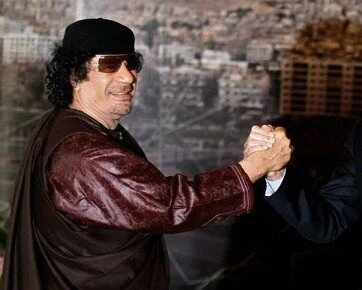
NEW YORK -- A broad coalition of interests from oil companies, defense manufacturers and well-connected lobbying firms to neoconservative scholars and Harvard Business School professors has worked in recent years to advance a rapprochement with Libyan leader Muammar Gaddafi and take advantage of business opportunities in the country, even in the face of the longtime international pariah's brutal repression of his people and his legendary belligerence.
Yet Libya's opposition leaders say that such efforts have harmed the interests of the North African country by helping enrich Gaddafi's family and close allies at the expense of the majority of Libyans, serving only to prolong Gaddafi's brutal reign. They also blame U.S. policy for prioritizing national security interests over issues of reform and human rights, the lack of which helped fuel the country's ongoing violent upheaval.
Soon after U.S. President George W. Bush dropped sanctions against Libya in 2004, when Gaddafi announced that he intended to give up weapons of mass destruction and expressed his eagerness to join the war on terror, U.S. and British oil producers and business interests jumped at the chance to expand into the country, which has been ruled with an iron fist by the unstable leader for some 40 years.
Some of the biggest oil producers and servicers, including BP, ExxonMobil, Halliburton, Chevron, Conoco and Marathon Oil joined with defense giants like Raytheon and Northrop Grumman, multinationals like Dow Chemical and Fluor and the high-powered law firm White & Case to form the US-Libya Business Association in 2005. The members of its executive advisory council each pay $20,000 in annual dues to the group, which is managed by the National Foreign Trade Council, a coalition that seeks to facilitate international opportunities for U.S. companies. Most of the group's members have lobbied the U.S. government since 2004 to protect their investments in Libya or to iron out business problems with the regime. Bilateral trade with Libya totaled $2.7 billion in 2010, compared to practically nothing in 2003 when sanctions were still in force.
The role of the USLBA, which calls itself the only U.S. trade association focusing solely on the United States and Libya, combines lobbying for the former outlaw state with advancing the commercial aims of the association's member groups. The nonprofit has sponsored policy conferences, briefing sessions and events featuring senior U.S. and Libyan officials -- two months ago, the group's honorary chairman David Mack, a former U.S. ambassador, and executive director Charles Dittrich traveled to Libya for meetings with Libyan government officials, private business leaders and representatives of American companies working in the country.
On its now-offline website, the group said it seeks to promote Libya by educating the White House and Congress about the country's "growing importance in maintaining stability in North Africa as well as Libya's potential as an expanding commercial market for American business." The website also touts the USLBA's proximity to Gaddafi, stating that "we were the only U.S. business group to meet privately" with the leader during Gaddafi's "historic first visit" to the United Nations in 2009.
As one measure of the group's influence, founding chairman David Goldwyn was appointed the State Department's coordinator for international energy affairs by Secretary of State Hillary Clinton. On a visit to Libya in December 2008, Goldwyn waxed rhapsodic about the "fantastically warm reception" he and eight U.S. executives received from senior Libyan officials.
In light of the turmoil in Libya, the group says that it took down its website over the weekend. "If we have no business in the country, there won't be much point in us continuing as an organization," honorary chairman Mack told The Huffington Post. "Our whole point is to help U.S. businesses overcome impediments in that country, from the U.S. side and more recently from the Libyan side, either in terms of administrative red tape or discrimination against U.S. companies."
Libyan Opposition: Business Lobby Helped Prolong Gaddafi's Reign
Ibrahim Sahad, the secretary general of the National Conference of the Libyan Opposition, the largest coalition of Libyan opposition groups, blames the USLBA and U.S. firms that have lobbied and consulted on behalf of the Libyan government for helping keep Gaddafi in power.
"We found ourselves at odds with the pressure groups of these American companies, and previous officials in other administrations that took part in these groups," said Sahad, who was forced into exile in 1986 and occupies a prominent place on Gaddafi's enemies list. "They think about oil, they take their own interests into account -- they don't care about human rights. Without the support of Bush, there would be no oil concessions with Libya."
Sahad is also critical of the role of the Monitor Group, a consulting firm with ties to Harvard Business School that was hired by the Libyan government to burnish its reputation. The group twice sent Richard Perle, the prominent neoconservative and former Pentagon policy adviser, to Libya, as well as academic all-star Francis Fukuyama -- current Obama White House official Cass Sunstein was also considered -- to interview Gaddafi for a planned book about him.
The group also brought Gaddafi's son and likely successor, Saif al-Islam, to Harvard to discuss potential reforms and the idea of forming a National Security Council in Libya, shortly after he completed his Ph.D. thesis on "soft power" and democracy at the London School of Economics. Saif, whose charity, the Gadhafi International Charity and Development Foundation, hired lobbying groups in Washington to advance its cause, was considered by many Libyans to be the country's best hope for reform. But Saif was sidelined in 2009 by the regime's hardliners.
According to a diplomatic cable from U.S. embassy officials in Tripoli, which was released by WikiLeaks:
In addition, senior officials brought in by Saif al-Islam to help implement reform measures have encountered serious opposition from regime figures skeptical about the strategic decision to re-engage with the West (and particularly the U.S.) and concerned that their livelihoods, which depend on the old, kleptocratic way of doing business, will be directly threatened by reform. Dr. Mahmud Jibril, Chairman of the National Planning Council and head of the affiliated Economic Development Board, was personally wooed back to LIBYA by Saif al-Islam to help implement reforms recommended in a MONITOR GROUP report developed under the direction of Harvard University's Dr. Michael Porter. (Note: Jibril holds a PhD from the University of Pittsburgh and owns a successful business consultancy firm with offices in Cairo and London. End note.) xxxxxxxxxxxx(strictly protect), a U.S.-based, businessman with dual U.S.-LIBYAn nationality, told P/E Chief in early February that Jibril was "profoundly disappointed" by his limited ability to effect change and had submitted letters of resignation three times in the second half of 2007, but had been dissuaded from leaving.
"The Monitor Group did consulting to help Gaddafi stay in power," Sahad claimed. In a statement, the group declined to discuss specific projects it engaged in on behalf of the African nation. Saying that "we are deeply distressed and saddened to witness the current tragic events in Libya," the statement concludes:
"It is of public record that we worked on projects for the Libyan government, beginning in 2006. Our work was focused on helping the Libyan people work towards an improved economy and more open governmental institutions. This is within a context of a period that was widely perceived as holding meaningful potential for reform within, and new opportunity for, Libya. We sought, consistently, to enable such progressive developments."
Several miles from the Monitor Group's brick headquarters in a Cambridge, Mass., office park lives Mohamed Eljahmi, a soft-spoken software engineer whose brother Fathi died in custody in 2009 after being jailed for seven years by Gaddafi. His crime: as a provincial governor and former head of Libya's National Planning Council, Fathi Eljahmi called for free elections and the release of political prisoners. When Gaddafi offered him a position to lead an engineering company that would be used to buy influence with other African leaders, Fathi Eljahmi turned him down, saying, "I cannot accept this in this current political climate, where only prostitutes and pimps benefit," according to his brother.
Mohamed Eljahmi said he is outraged by Monitor's work on behalf of the Libyan government, as well as the USLBA's activities, saying that the engagement primarily benefits Gaddafi and his cronies due to corruption within the Libyan economy. "Gaddafi and his sons get a percentage of all these deals. So these deals don't benefit the average Libyan," Mohamed Eljahmi said. "There were no reforms, that was just an attempt to prolong the life of the regime. It was Gaddafi's attempt to fool the international community."
The software engineer was also critical of U.S. diplomatic efforts, citing the case of David Welch, the former State Department official who signed a settlement agreement with Libya over outstanding legal claims from terror victims, clearing the way for full normalization of relations. Welch left his post in 2009 to take a job with Bechtel, the construction giant which later opened its first office in Libya since the 1960s and helped build a massive power plant east of Tripoli, Libya's capital city. Welch, who is the president of Bechtel's Europe, Africa, East and Southwest Asia region, did not return a request for comment.
Mixing Diplomacy And Dealmaking
Whether or not Gaddafi gets a cut, USLBA's mix of diplomacy and dealmaking has led to employment for thousands of Libyans. It has benefited the association's member groups on a much greater scale, however: BP and ExxonMobil have oil production deals worth billions of dollars; Dow Chemical was the first worldwide chemical company to participate in Libya through a joint venture with the state-owned oil company to expand its petrochemical facility; Halliburton, which had operated in Libya through subsidiaries long before sanctions were lifted, was well-placed to profit through multiple contracts to service oil productions platforms throughout the country.
To strike the lucrative deals, some of the world's top oil executives have personally endured challenges from Gaddafi. The strongman was outraged by the Lautenberg Amendment, a congressional effort to allow the victims of Libyan terrorism to be compensated through the seizure of the nation's assets, and he was obsessed with a feeling that he was not being sufficiently compensated for his decision to give up WMDs and renounce terrorism. Thus, when ConocoPhillips CEO Jim Mulva met with Gaddafi in 2008, he was subjected to a 30-minute harangue, according to a diplomatic cable from the embassy in Tripoli:
ConocoPhillips CEO Jim Mulva was summoned to Sirte for a half-hour "browbeating" by Leader Muammar al-Qadhafi during his visit to Libya on/about February 24. Country manager Page Maxson told P/E Chief that the entire conversation focused on al-Qadhafi's "personal ire" about the so-called "Lautenberg Amendment" (section 1083 of the National Defense Authorization Act of 2008) and the USD 6 billion award against Libya in the UTA bombing case, and al-Qadhafi's view that Libya had not been sufficiently compensated for its decision to give up WMD and renounce terrorism. Al-Qadhafi passed a copy of his recent letter to the President on the subject (ref B) to Mulva. Telling Mulva that he and his fellow U.S. oil company CEOs needed to engage members of the U.S. Congress and the Administration on the matter, al-Qadhafi threatened to dramatically reduce Libya's oil production and/or expel out U.S. oil and gas companies. Al-Qadhafi claimed Libya would rather "keep its oil in the ground" and wait for a more favorable overseas investment climate than continue high levels of production in an environment in which sizeable portions of its oil-related assets could be seized.
Mack, the honorary chairman and former ambassador, defended the USLBA, arguing that engagement is more effective at reforming the country than sanctions. He praised the Obama administration for taking a restrained approach during the current upheaval in Libya. "They know very well that unilateral efforts on our part at affecting behavior in Libya do not do well," he said. "And when we did that in the '80s, it bombed. It caused more terrorism."
Mack declined to comment on Gaddafi's belligerence, saying that "psychological assessments" of the leader are not helpful in the current crisis. Though the USLBA has been in limbo since the unrest in Libya turned violent, Mack says he talked to Libyan ambassador Ali Aujali shortly before the other man's comments on Monday criticizing Gaddafi's crackdown on protesters.
A former lobbyist for Libya, Randa Fahmy Hudome, whose firm was paid a $300,000 quarterly retainer to help the country get off the State Department's list of countries that sponsor terrorism, also insisted that engagement is more effective than isolation. Hudome, who currently consults for companies interested in working in the region and served as associate deputy secretary of energy in the Bush administration, denied that pressure from oil companies or business interests prompted the rapprochement with Gaddafi, though she conceded, "It's in our national security interest to ensure a stable supply of oil."
But the deal was primarily motivated by national security concerns, Hudome said. "Unlike Saddam Hussein, Gaddafi really had WMDs, including chemical weapons," she said. "We rid a rogue nation of WMDs and made the world a safer place." Added Hudome: "What if he had those weapons today? We'd be in deep shit -- he'd probably use chemical weapons on his own people. Instead, he only has his army planes to murder people with."
Despite the Bush administration's public claims that Gaddafi was scared into making a deal by the invasion of Iraq, Hudome said negotiations had been going on in secret for years. "The final straw was the U.S. going into Iraq, but the Libyans insisted that there be no regime change," she said. "We made a deal, a calculated move to remove those weapons but to keep Gaddafi in power."
It was a difficult call, Hudome said, and hotly debated within the Bush administration, as President Bush and then-National Security Advisor Condoleezza Rice were initially skeptical about negotiating with Gaddafi.
Hudome said she doesn't recall that the deal involved any discussion of political reforms or any promises by Gaddafi to improve his human rights record. "We made the world a safer place, but we traded that the dictator gets to stay in power and we look the other way when he oppresses his people," she said.
The USLBA heavily lobbied the Bush administration and members of Congress over the Lautenberg Amendment, which threatened to scuttle billion-dollar production deals given Gaddafi's outrage. The USLBA joined other trade groups, such as the National Association of Manufacturers and the U.S. Chamber of Commerce, in pressuring Congress and the White House to drop the amendment.
In addition, USLBA member BP played an instrumental role in fulfilling one of Gaddafi's most-cherished goals -- freeing the accused Lockerbie bomber from a Scottish jail cell. The oil giant, which was in the middle of negotiating a lucrative deal to start drilling off the coast of Libya, pressured the British government to release Abdelbaset Ali al-Megrahi on compassionate grounds in 2009, despite opposition from the United States and the families of the victims of the 1988 bombing of Pan Am Flight 103 over Lockerbie, Scotland, according to Congressional and British investigations. On Tuesday, the Libyan justice minister who resigned in protest over the use of force against unarmed civilians amid the current unrest made headlines by claiming to have proof that Gadaffi himself ordered the bombing.
Even before the formation of the group and George W. Bush's election as president, former Vice President Dick Cheney was already lobbying the Clinton administration to ease sanctions on Libya and Iran while he headed Halliburton. Not that it was necessary for the oil servicing giant -- in 1995, Cheney's first year as CEO, Halliburton pleaded guilty to criminal charges of violating a U.S. ban on exports to Libya by selling Gaddafi six pulse neutron generators, which can be used to detonate nuclear weapons. "The good Lord didn't see fit to put oil and gas only where there are democratic regimes friendly to the United States," Cheney quipped.
Libya's Lobbying And PR Push
Libya also employed several well-connected lobbying firms in Washington to help normalize relations with the U.S., hiring The Livingston Group, White & Case and Blank Rome for more than $2 million in 2008 and 2009. Former Rep. Bob Livingston (R-La.) said he helped smooth the way for the rapprochement between the two countries but insists that he "fired" Gaddafi after the leader gave a hero's welcome to the freed Lockerbie bomber.
"That was just a bridge too far," Livingston told New Orleans's Fox-8 News earlier this week. "We had to fire the client."
Former Libyan officials insisted that the breakup was the other way around, saying that the country didn't need the expensive lobbyists anymore since the country had already achieved its aims -- normalizing relations and freeing al-Megrahi. Livingston did not return requests for comment.
A spokesman for White & Case, which advised on the first-ever international project finance deal in Libya, declined to describe the firm's work for the country beyond the information contained in government filings to register as a foreign agent. Christopher Curran, the head of the firm's D.C.-based litigation practice, represented Libya during arduous negotiations to settle 20 lawsuits brought by relatives of terror victims. Those cases were settled in a 2008 bilateral agreement that granted the Libyan government immunity from future terror-related lawsuits and involved Libya paying $1.5 billion into a settlement fund.
Curran, who did not return calls for comment, told American Lawyer in 2009 that the firm did not play any role in the release of al-Megrahi.
To help polish its image, Libya also hired New York public relations firm Brown Lloyd James, which helped Gaddafi place op-ed articles in the Boston Globe and the Washington Times. The firm, which opened an office in Tripoli, was founded by Peter Brown, a friend of Peter Mandelson, a close aide to former British prime minister Tony Blair, whose government's negotiations with Libya paved the way for America's rapprochement with Gaddafi. The firm used to tout its work for the country on the "Public Diplomacy" section of its website, but those references have since been removed.
Other Americans working in Libya did not share USLBA's optimism that the relaxing of sanctions and increased engagement would lead Qadaffi to carry out crucial reforms.
Reema Ali, a lawyer with D.C.-based Legwell, Ali and Partners, which has an office in Tripoli to help U.S. companies negotiate the torturous contracting process in Libya, said that she knew Qadaffi had no intention of delivering on his promises to Western leaders. "We knew that this was going to happen," she said, referring to the current unrest. "During the 30 years of sanctions, the people were told by their leaders that they have to sacrifice. Then things opened up and people waited in vain for a better life and better services, a breath of fresh air in terms of rights and liberties. Nothing was delivered. Instead, the corruption got worse and Gaddafi and his family got richer. The real story is that these are people who treat the country as if it's their own company." Ali said that corruption is endemic in the country and operates in a way similar to Egypt -- except that instead of Mubarak's sons demanding a partnership in the operations of multinationals, Libya thrives on good old-fashioned bribery. She claims that Gaddafi's sons, who control a wide range of government agencies and private companies, and the family's friends can interfere with the bidding process so that "you could be awarded the contract but it's not signed and then you find out that someone else got the deal." In one analysis done by the University of Washington's Ali Tarhuni in 1994, comparing Libyan government revenues to public sector spending and investment, he estimated that $46.5 billion has gone "missing" since Gaddafi seized power in 1969.
USLBA officials declined to discuss how alleged corruption and bribery impacted the activities of the group's members in Libya.
Arms Deals And The Obama Administration's Military Aid
Defense manufacturers from around the world have also made a major push to sell weapons to the country. "After Libya's diplomatic isolation ended, everybody wanted a chance to have at the market because everyone wanted its resources," said Lauren Gelfand, the Middle East and Africa editor for Jane's International Defense Review, noting that Libya's defense budget is projected to increase by 91 percent from 2011 to 2012. Though U.S. oil companies and construction firms like Fluor have thrived in Libya, U.S. defense manufacturers have not fared as well. They are currently restricted by the U.S. government's continuing ban on military sales to the country, which receives most of its armaments through longstanding arrangements with Russian and French companies.
But U.S. firms are well-positioned to do well if arms sales are allowed. USLBA member Northrop Grumman and several smaller firms have exhibited their wares at LibDex, Libya's biennial defense, security and safety show at Tripoli's Mitiga Airport.
The British affiliate of U.S. defense giant General Dynamics signed a $165 million deal in early 2008 with Libya to equip the country's mechanized Elite Brigade with a tactical communications and data system, in addition to technical and training support. Britain sold Libya more than $6 million in ammunition, including riot-control ammo, in the third quarter of 2010.
Out of gratitude for the British government's assistance in clinching the deal, General Dynamics UK sent letters to the British ambassador to Libya, Sir Vincent Fean. In one letter, the company representative wrote: "Thanks for not giving up when all looked lost on several occasions! Persistence was all!"
The Obama administration has provided aid to the Libyan military, though in amounts that pale next to that provided to Egypt and Israel and other Mideast allies, increasing its request in the 2012 budget for military financing from $150,000 in fiscal year 2011 to $250,000. In 2010, the State Department requested $350,000 in International Military Education and Training funding for Libya to "support education and training of Libyan security forces, creating vital linkages with Libyan officers after a 35-year break in contact," according to a Congressional Research Service report.
That same year, the administration also requested Foreign Military Financing assistance for Libya for the first time, with the goal of providing assistance to the Libyan Air Force in developing its air transport capabilities and to the Libyan Coast Guard in improving its coastal patrol and search and rescue operations. In 2009, the State Department gave Libya $500,000 for higher education, $300,000 for human rights, $500,000 for good governance and $200,000 for civil society programs.
Hudome, the former lobbyist for Libya, argued that greater U.S. engagement might have helped tamp down the current wave of anti-Gaddafi unrest. "There is some argument that he was tamed by engaging with us," she said. "And we mishandled our relationship -- this was no marriage -- if we had engaged more and not kept Libya like the secret girlfriend hiding in the closet, we would have been in a better position."