

WASHINGTON -- In early 2010, Goldman Sachs announced two blockbuster numbers: profits of $13.4 billion for the prior year and compensation of $16.2 billion -- the equivalent of about $500,000 for each employee at the Wall Street titan.
All of this lucre, of course, came courtesy of a massive federal bailout of Wall Street that helped keep Goldman and the nation's other commercial and investment banks afloat in 2008 and 2009, when the worst financial cataclysm since the Great Depression began to ravage the economy. Taxpayers were footing the bonus bill.
When news of Goldmanesque bonuses first sparked public outrage, both Wall Street and the White House combated the criticism with a persistent argument: Yes, it might be deeply frustrating to see taxpayer dollars used to further enrich already wealthy bankers, but these bonus deals were were contractual obligations and America is a nation of laws. You just can't tear up contracts, the argument went. So, with few exceptions, the bonuses stayed.
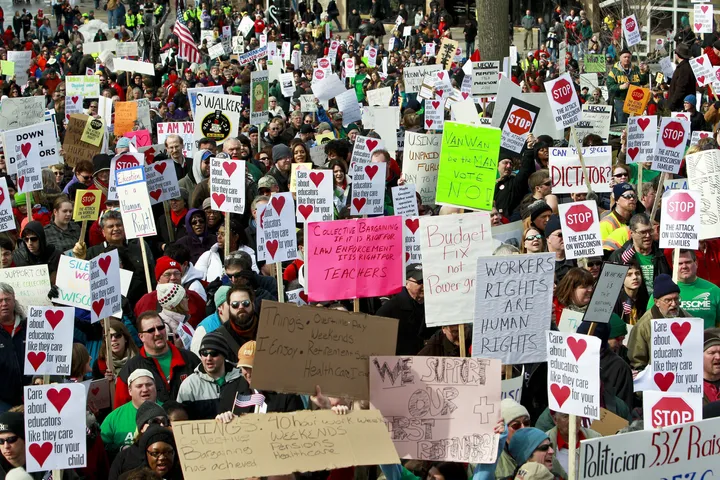
Yet now, with state leaders planning pay cuts for teachers, firefighters and other public workers, contracts aren't described as so sacrosanct anymore.
In Wisconsin, Indiana, Ohio, Florida and New Jersey, Republicans swept into power last year by voters outraged about ongoing economic distress are now targeting benefits for pensioners, hiking taxes for employees who will one day receive a pension and, in Wisconsin, even trying to eliminate the right for public employees to collectively bargain for a pension.
Pensions, needless to say, are, like some bonuses, contractual obligations. They're deferred compensation that formed the basis for years or, in some cases, decades of work already performed. Any state government that fails to pay those pensions in full are in default on the contracts. Pensions for workers who have already retired are protected by dozens of state constitutions.
The average annual pension for government workers is roughly $19,500 a year, according to the American Federation of State, County and Municipal Employees, one of the nation's largest labor unions. That would mean $500,000 could provide about 25 years worth of payouts to a retired public servant. The $9 million bonus Goldman Sachs chief executive Lloyd Blankfein received for 2009 could have provided two decades of pension pay for 23 such public workers.
The push to rewrite pension agreements is predicated on the much-discussed fiscal challenges facing states. But while states do face gaps in their general budgets -- and, at the local level, municipal budget crises are forcing many cities to make tough choices -- most states' pension funds are doing just fine, including those of some states currently engaged in high-profile political budget standoffs.
Wisconsin's plan, in fact, is one of the healthiest in the nation. While many states will need to bolster their pension programs over the coming years, none face an immediate crisis. Even the most cash-strapped state plans in the nation are simply not in any danger of near-term financial distress.
"It would require a calamity of unbelievable proportion to have a cash-flow shortage with pension funds," said Monique Morrissey, an economist at the Economic Policy Institute, which is partly supported by labor unions. "They're advance-funded, so in any given year, pension fund benefit payouts are a very small fraction of what's actually in a pension fund account."
State pensions have garnered headlines for a variety of troubles during the recession -- some have been underfunded in recent years, several took heavy losses on subprime mortgage bonds and nearly all took a beating during the 2008 and '09 stock market slides. As layoffs and foreclosures have depleted tax revenues for state governments, elected officials have targeted large public programs like pension funds in an effort to ease budget deficit concerns.
But while the recession has taken a major toll on state tax revenues, economists say it has not had a drastic impact on pension funds -- the stock losses were followed by a major market rebound, recovering losses. States pay out billions of dollars a year to pensioners, but every single state plan is also sitting on several billion more in revenue-generating assets. Many pension funds face no problems at all. Those that do must deal with a long-term revenue shortfall, still several years away, which can be prevented with modest reforms in the present.
"In some cases you're looking at 10 to 15 years, in some cases you're looking at 30 to 40 years where you're going to be running out of money," said economist Christian Weller, a professor at the University of Massachusetts at Boston and an analyst for the Obama administration-allied Center for American Progress. "The fixes in most cases are very manageable. Many states had already started to address this years ago."
Pension obligations can seem disproportionately large compared to the scope of annual state budgets, Weller and others say, because pension funds calculate their total liabilities over the entire estimated lifetime of every pensioner and current public employee budgets. And it's easy to make those sums look even bigger by assuming that pension fund investments will only earn low rates of return, like those on Treasury bonds (which are currently producing record-low yields).
That operating assumption was used in a December study from the Mercatus Center, a think tank founded and funded by billionaires Charles and David Koch, oil barons who have supported Tea Party groups and invest heavily in conservative causes. Using that methodology, the report projected a $3 trillion shortfall for state pension funds and another $574 billion shortage for local government programs. Mercatus also prefers to project pension fund asset earnings at the 15-year Treasury bond interest rate, which is much lower than the 30-year interest rate, even though pension fund liabilities are calculated over a window that frequently eclipses 30 years.
The numbers in the Mercatus paper were taken from a study by Northwestern University economist Joshua Rauh and University of Rochester economist Robert Novy-Marx, who used the same assumptions. Eileen Norcross, the Mercatus author, insisted that the Treasury bond standard is not just an effort to game the numbers.
"You can't pay out something that's 100 percent certain with uncertain investments," she said. "If they get those returns, that's great. But there are also downturns, and you have to hedge against that. And what's the hedge right now? It's, 'Oops, we have to raise taxes.'"
Others say such conservative projections are just hocus-pocus. Most pension funds have recovered from the losses taken in the 2008 stock market slide.
"These people would never invest all of their own money in Treasury bonds alone, yet they expect pensions to plan as if they did," says EPI's Morrissey. "They're resorting to accounting gimmicks to make the hole look a lot bigger than it really is. The reality is that contributions can be adjusted very gradually because there isn't any immediate cash-flow problem."
A $3 trillion shortage would be a tremendous problem if governments had to cope with it in a single year. But it's actually a shortfall accumulated over about 30 years, or about $100 billion per year. In the context of a national economy generating $14.7 trillion a year, even amid the worst economic downturn in generations, that number is significant, but much less frightening.
And by assuming traditional rates of return for pension funds, the number gets far smaller. A recent paper by economist Dean Baker, co-director of the progressive think tank Center for Economic Policy and Research, does exactly that, pegging the 30-year shortfall at $647 billion, or $21.6 billion per year, even if recent stock market gains for pension funds are not factored in.
The major immediate threats to state budgets are the same problems facing citizens: foreclosures -- an estimated $19,000 or so a pop to local governments, and currently running at a rate of 1 million a year -- along with plunging home values and layoffs. But generous upper-end tax cuts aren't helping, either. When Wisconsin Gov. Scott Walker took office, for instance, he immediately implemented two tax cuts for the wealthy and large corporations that put the state's budget under pressure.
"Look at Walker, he manufactured his deficit with tax cuts for the rich," said Ron Blackwell, chief economist for the AFL-CIO, the largest federation of U.S. labor unions. "For pensions, the problem in general is not an especially bad one. And to the extent there are problems, they're caused by the stock market declines. They have nothing to do with how public sector unions negotiate these so-called 'generous' benefits."
Of course, some public employees really are enjoying extravagant retirements on the public dime. Unions representing California prison guards and other police forces have bargained for extremely generous payouts, while a handful of states have indeed mismanaged their pension plans. "For Illinois and New Jersey, 'raided' is probably a better word," Morrissey, the EPI economist, says.
But while the excesses of a few are being used to justify drastic action against public workers everywhere, even some of the worst-off state systems, like New Jersey and California, do not face an immediate crisis.
New Jersey has one of the most underfunded public pension plans in the country. During the 1990s, under Gov. Christine Todd Whitman (R), the state slashed its annual pension contributions in order to finance a slate of tax cuts, and didn't begin seriously boosting those contributions until 2007. By June 30, 2009, the fund was sitting on $86.5 billion in assets, but the projected long-term pension costs were expected to run about $130.2 billion. Over the course of 30 years or so, the state would come up about $43.7 billion short of meeting its pension obligations, which total about $8 billion in payouts each year. The fund currently has $71.6 billion in its coffers.
Last year, Gov. Chris Christie (R) took a page from Whitman's playbook, forgoing the $3 billion annual state contribution to the pension plan while pushing $1 billion in tax cuts for the state's wealthiest citizens. This year, under a new pension plan reform law, Christie is required to make a $500 million contribution to the fund -- just 1.7 percent of his proposed $29.4 billion budget -- but the governor is refusing to make this legally mandated payment unless public workers accept reductions in pension benefits and a tax increase to support the fund.
Meanwhile, Christie's budget for fiscal 2012 includes $200 million in corporate tax cuts, with plans to increase those cuts to $690 million a year by 2016, along with $180 million in 2012 tax cuts for homeowners. It's a fairly straightforward proposition: Christie is taking money from public workers and giving much of it to corporations, cloaking the transfer of wealth in the language of fiscal responsibility.
New Jersey will clearly have to ramp up contributions to its pension fund to sustain it through the coming years. But doing so doesn't require any particularly tough choices -- it just means raising taxes on those who can afford it instead of continuing to cut them.
And it doesn't even require much of a tax hike, according to a recent study by CEPR's Baker. If state economies grow at the nation's overall rate, only modest tax increases will be required even without further spending cuts, Baker concludes. For all of the major state pension programs in New Jersey, the study calculates either no need for any boost, or an increase of no more than 0.13 percent of 30-year tax income.
Baker calculates similarly low increases for other states. Even Illinois, the most underfunded pension plan in the country, would only have to boost tax revenue by less than 0.2 percent over the next 30 years to meet its projected shortfalls.
The math on New Jersey gets far more dire if you assume the funds' investments will perform terribly. Norcross generates a $173.9 billion shortfall by assuming the funds will only reap 3.5 percent return -- the 15-year Treasury rate -- over several decades. The median return for state pension funds over the past 20 years, however, has been about 8 percent, the amount generally projected by state plans (New Jersey assumes and 8.25 percent return). Based on actual historical returns and economic projections from the Congressional Budget Office, Baker calculates that pension funds should be able to secure returns between 7.3 percent and 8 percent, depending on inflation assumptions.
.
In California, the state's three major public pension programs are a magnet for criticism as a result of the lavish benefits paid out to relatively few retirees. According to data compiled by the California Foundation for Fiscal Responsibility, a right-leaning group that focuses primarily on state pension and retiree health care obligations, a total of 16,062 former California public servants receive a pension in excess of $100,000 per year.
Some of these payouts are the result of some very unseemly elements in California politics. The prison guards' union, for example, is extremely active in state elections and has managed to secure particularly large compensation packages from Democratic and Republican governors alike. Yet according to CFFR data, former prison guards account for only about 300 of California's six-figures club, roughly even with the number of former state highway patrolmen, another politically active public union. When combined with other local police, cops make up a large portion of the state's high-rolling pensioners. Another 5,309 big-ticket pensions are paid out by the pension plan for teachers, CalSTRS, and 1,642 previously worked for the state's university system.
Jon Hamm, chief executive of the California Association of Highway Patrolmen, argued that good retirement pay is critical to attracting strong applicants, given the stresses and dangers of police work. Hamm said the Highway Patrol currently employs about 12,800 people, and that all of the six-figure-pension patrolmen were former managers. He also emphasized that the group agreed to pension reforms with then-Gov. Arnold Schwarzenegger last summer that cut benefits for future pensioners and raised taxes on current employees.
While these big-ticket pensions reek of pay-for-play politics, they have a relatively minor impact on the state funds' operations. California's entire $100,000-plus club amounts to less than 1 percent of the state's pensioners. The largest of California's pension plans, CalPERS, which includes retired prison guards and highway patrolmen, pays benefits to over 1.6 million pensioners. CalSTRS, the teacher pension plan, has about 224,000 members. The average yearly pension for CalPERS, according to the plan's data, was about $25,000 for a pensioner who spent more than 20 years working for the state. And those pensions are particularly important for retirees in California, one of several states in which public employees are not eligible for Social Security.
Studies like Baker's suggest that states can manage their long-term pension costs without slashing benefits or dramatically raising taxes on state employees. In addition to sitting on big piles of assets, states typically make their own annual contributions to pension funds and require some kind of contribution from employees in order to grow that asset base -- all of which is stipulated in the employees' contracts.
Yet some governors now seek to dismantle the public guaranteed-pension system in favor of riskier 401k plans, a practice long advocated by conservative antitax activists. As far back as 1999, the Grover Norquist-led group Americans for Tax Reform was promoting so-called "pension liberation," a phrase that has since been adopted by the Koch-funded group Americans for Prosperity.
As it stands, pension contributions appear to have a relatively small impact on state budgets. According to an October study by the centrist Boston College Center for Retirement Research, those state pension expenditures accounted for just 3.8 percent of state government budgets in 2008. In order to meet long-term obligations under standard investment return expectations, the report claims that states should bolster that figure to 5.0 percent -- assuming no increased burden on employees and no cuts to benefits. Assuming the Treasury bond-only investment strategy, however, states would have to ramp this up to around 9 percent.
Many of the states currently subject to the most intense political uproar over pensions have some of the strongest programs in the country. Despite major standoffs between conservative governments and labor unions in Wisconsin, Indiana, Ohio and Florida, these states' pension plans are all on strong footing, even given disastrous economic conditions. Wisconsin and Ohio were each cited in a 2010 study by the Pew Center for the States as "a national leader in managing ... long-term liabilities for both pensions and retiree health care." Florida was cited by the same report as a "top performer" for its pension fund.
Economists analyze several statistics to determine pension fund stability, but the most closely watched is a metric known as the "funding ratio," which compares the assets currently owned by pension funds to the total lifetime payments required by every pensioner and every current worker who will eventually be eligible for a pension. The Pew study, for instance, demands an 80 percent funding ratio for fiscal rectitude. To meet that mark, a pension fund must be able to cover at least 80 percent of its long-term costs if its investments were to be sold off now. At the time of the Pew study, Florida's ratio was 101.39 percent, Wisconsin's ratio was 99.67 percent, Ohio's was at 86.83 percent, while Indiana was at 69.67 percent.
That last ratio was enough to justify "serious concerns" at Pew about the Indiana fund's long-term viability. The Pew study found that 19 states fell below its favored 80-percent threshold, but other studies use lower benchmarks to measure stability. New methodology from Fitch Ratings requires a 70 percent funding ratio for pension fund stability, and doesn't claim that any plan is "weak" unless its funding ratio drops below 60 percent. Fitch, in fact, dismissed concerns about Indiana's relatively low funding ratio in a February report, arguing that other revenue factors made it of little concern.
And the Fitch report repeatedly emphasized that the vast majority of pension funds are not in crisis. "Fitch believes that the vast majority of governments will withstand the substantial pressures they face from their pension obligations," the firm said.
That seems to be the story for state pension funds: Many will need to make adjustments, but none are insurmountable. And to the extent that any face problems, they are long-term issues. Hence: No immediate crisis in state pensions.
"They have time to make adjustments," said Keith Brainard, research director for the National Association of State Retirement Administrators. "The idea of imminent insolvency is a gross distortion."